
This index separates primary orders and correspondence, party submissions and the participant’s account awaiting the hearing transcript. No private banking originals or unredacted correspondence are published here.
The January exchange / Complete letters
The demand. The refusal. The challenge.
Read the complete letters in sequence. Mr J’s allegations and legal arguments are his own; the investigation explains the distinction between payment and recoverable liability, and the firm’s reply is reproduced between his two letters.
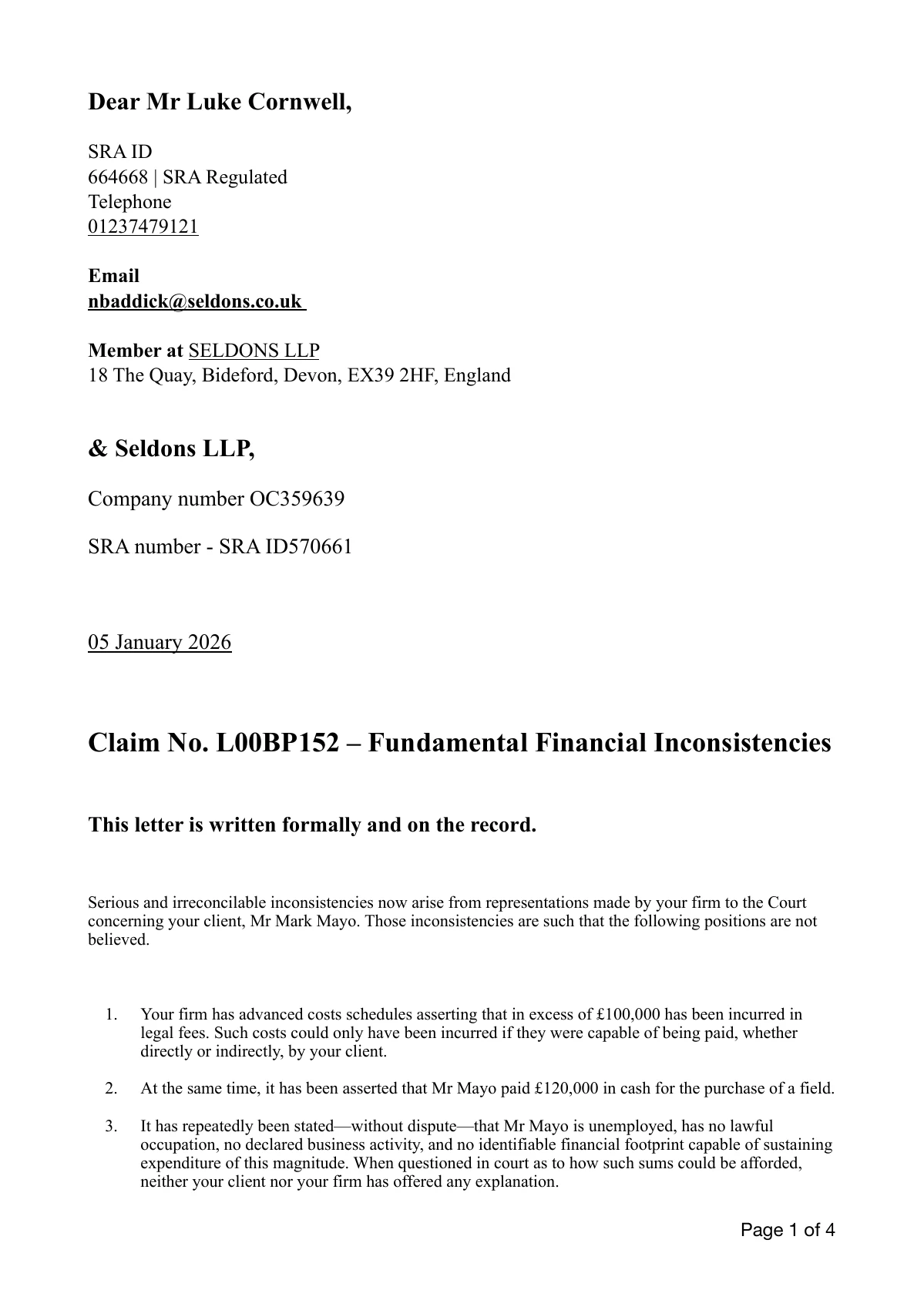
Mr J · 5 January 2026 / 4 pages
The demand: substantiate the financial representations.
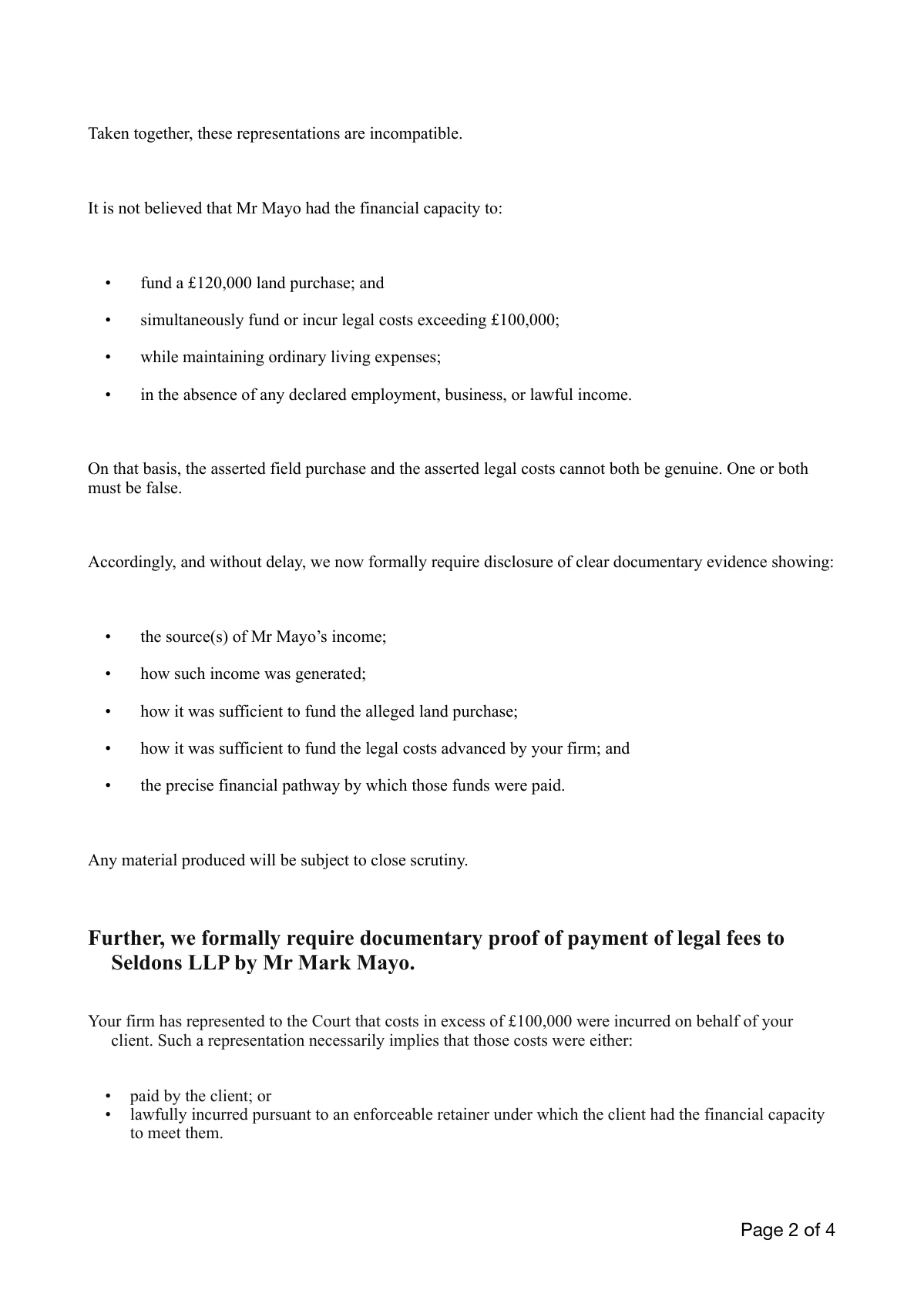
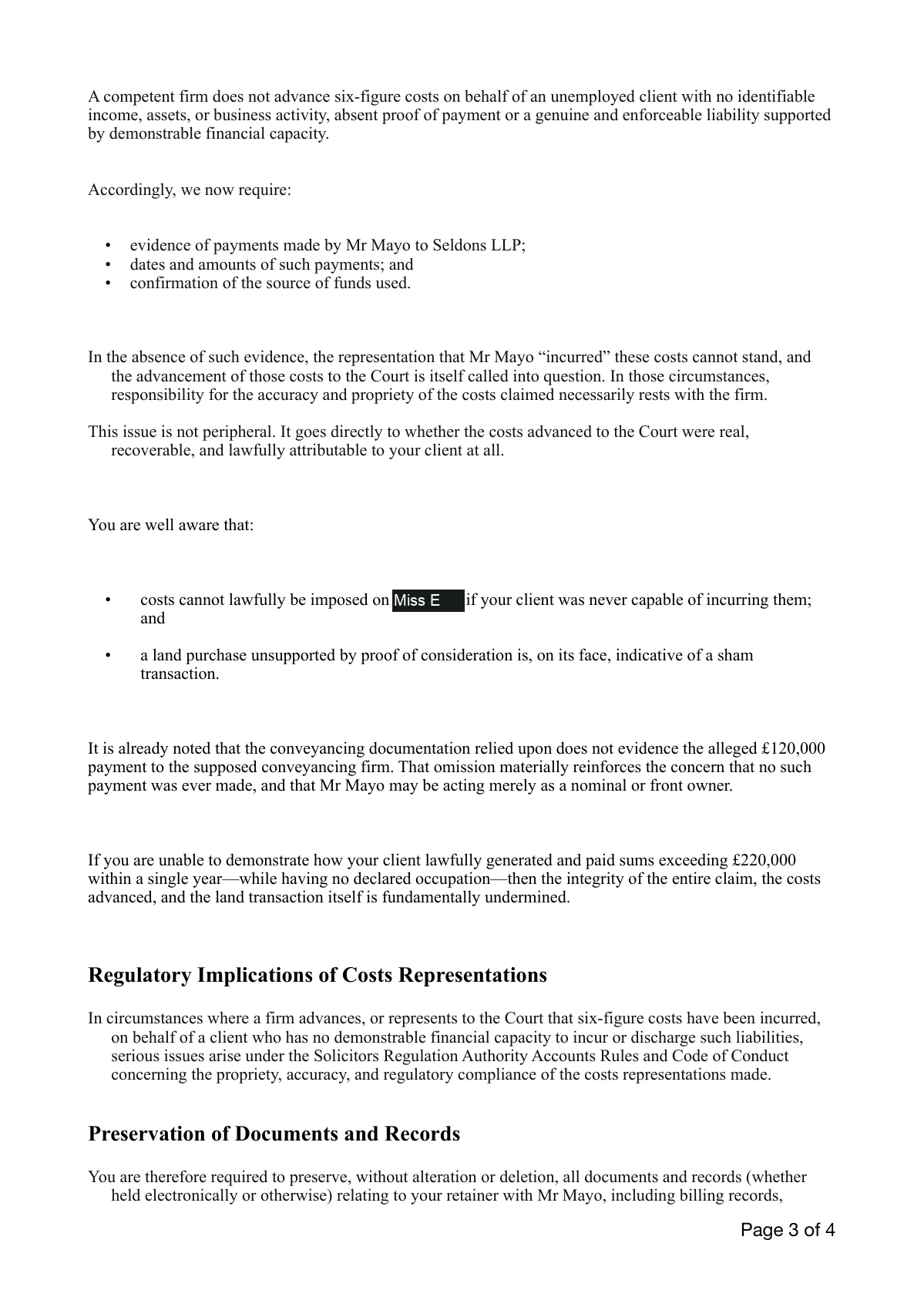
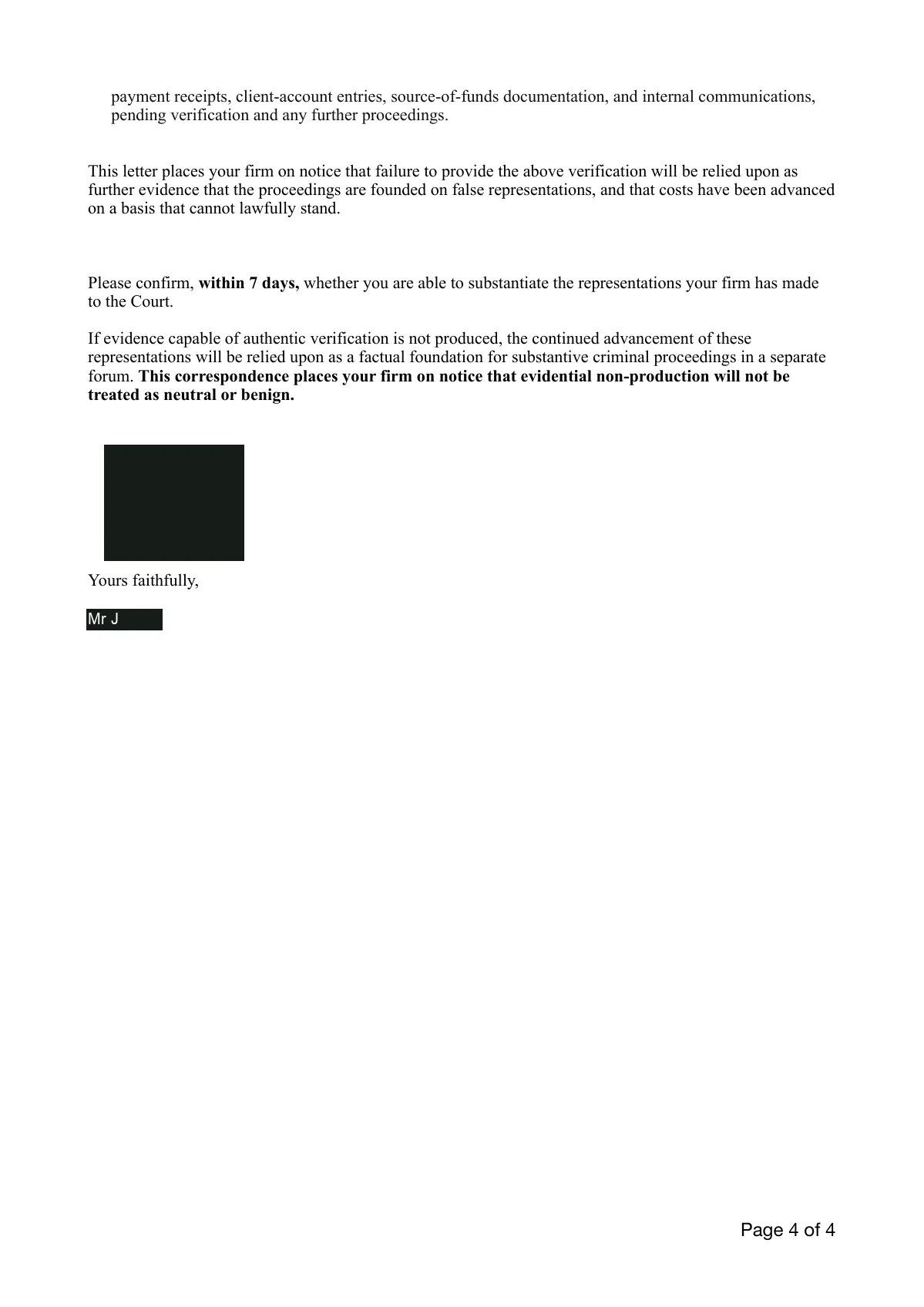
The originating letter demands documentary verification of the costs and field-purchase representations, asks for the payment pathway and requires preservation of billing, client-account and source records.
Download letter · 4 pages Open PDF
Read pages 2–4
Seldons LLP · 9 January 2026 / 2 pages
The response: disclosure refused.
The firm rejects the documents as irrelevant, warns that it will oppose a disclosure application and seek indemnity costs, cites costs-certification authority and distinguishes incurred from estimated costs.
Download letter · 2 pages Open PDF
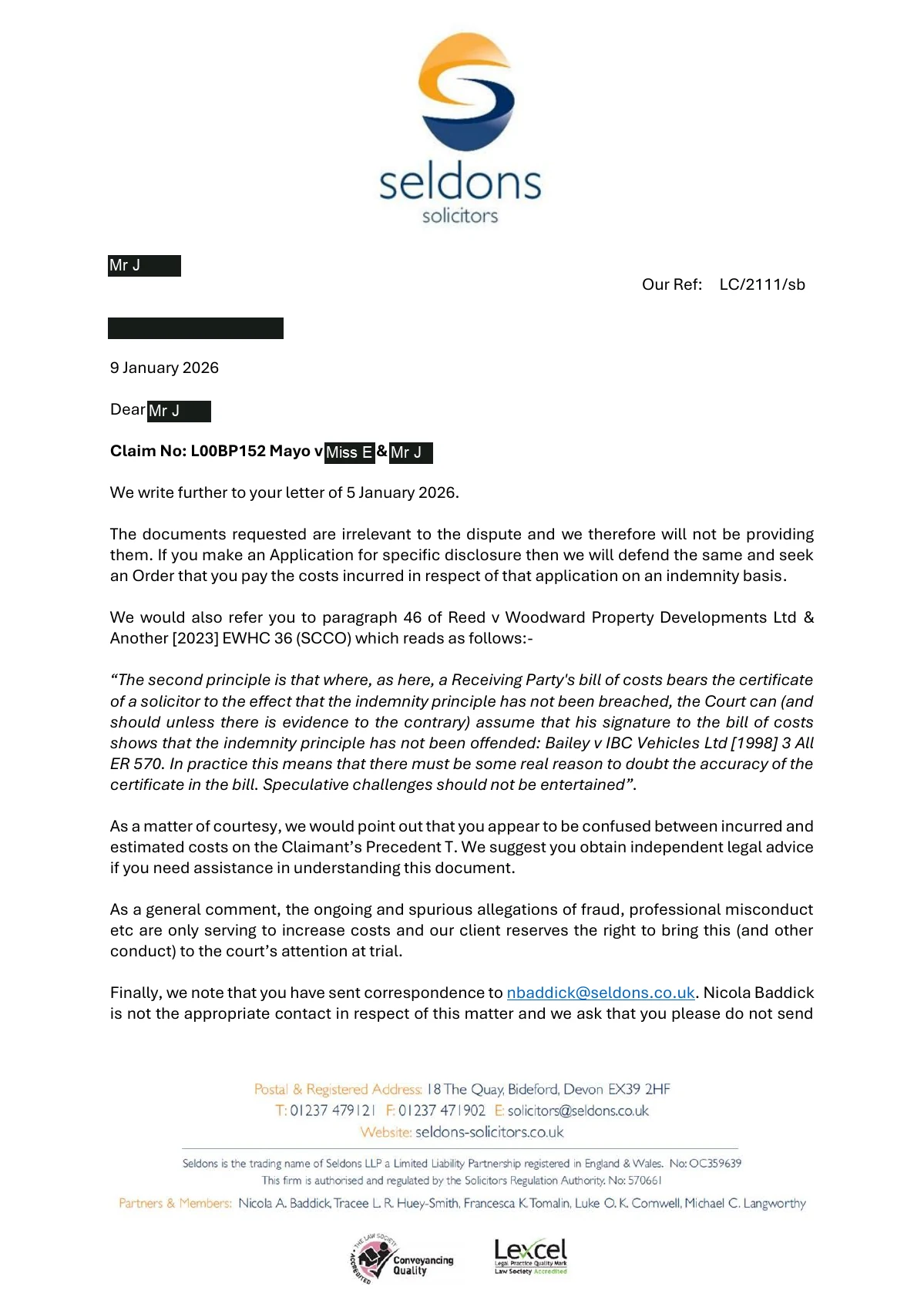
Read pages 2–2

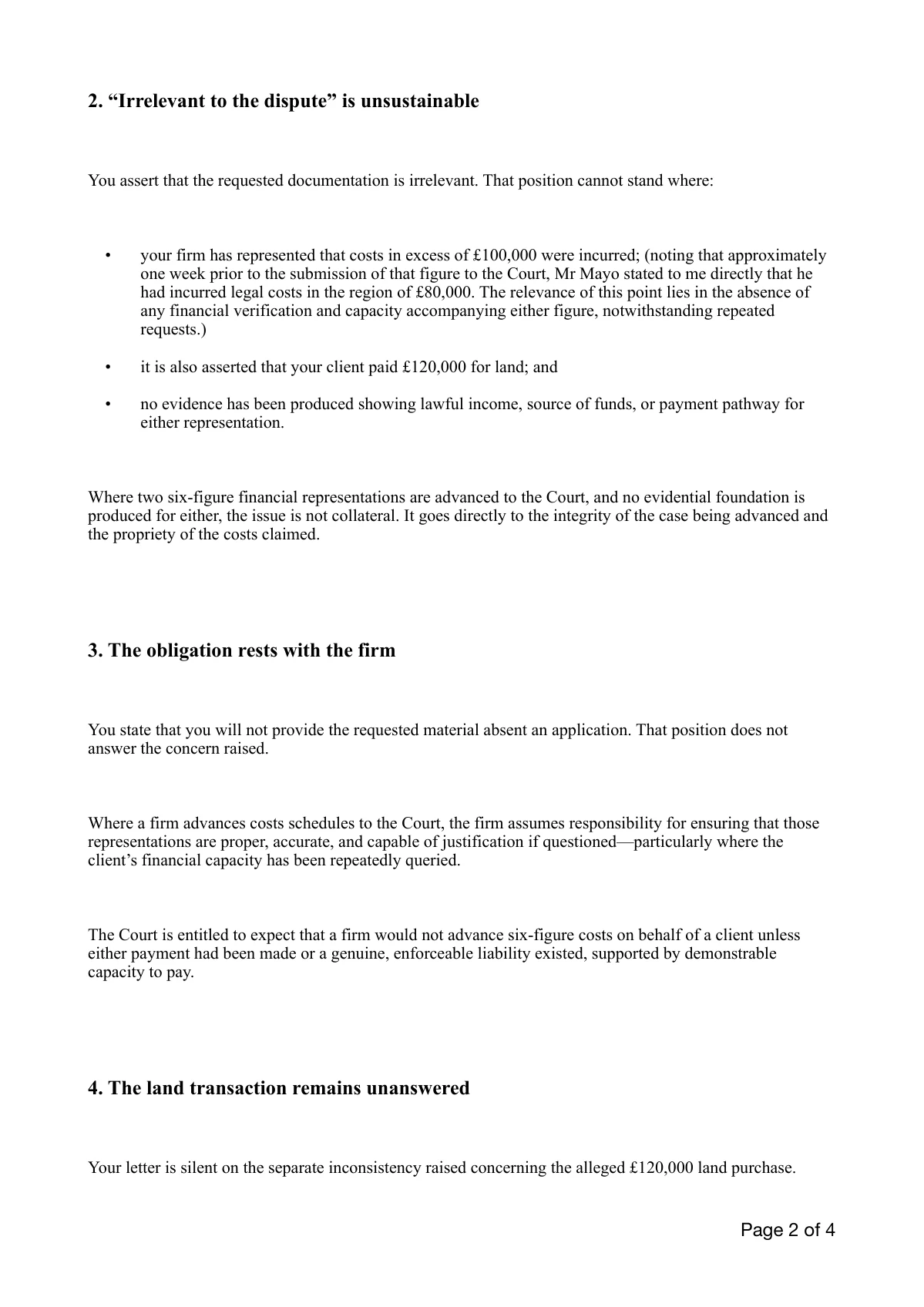
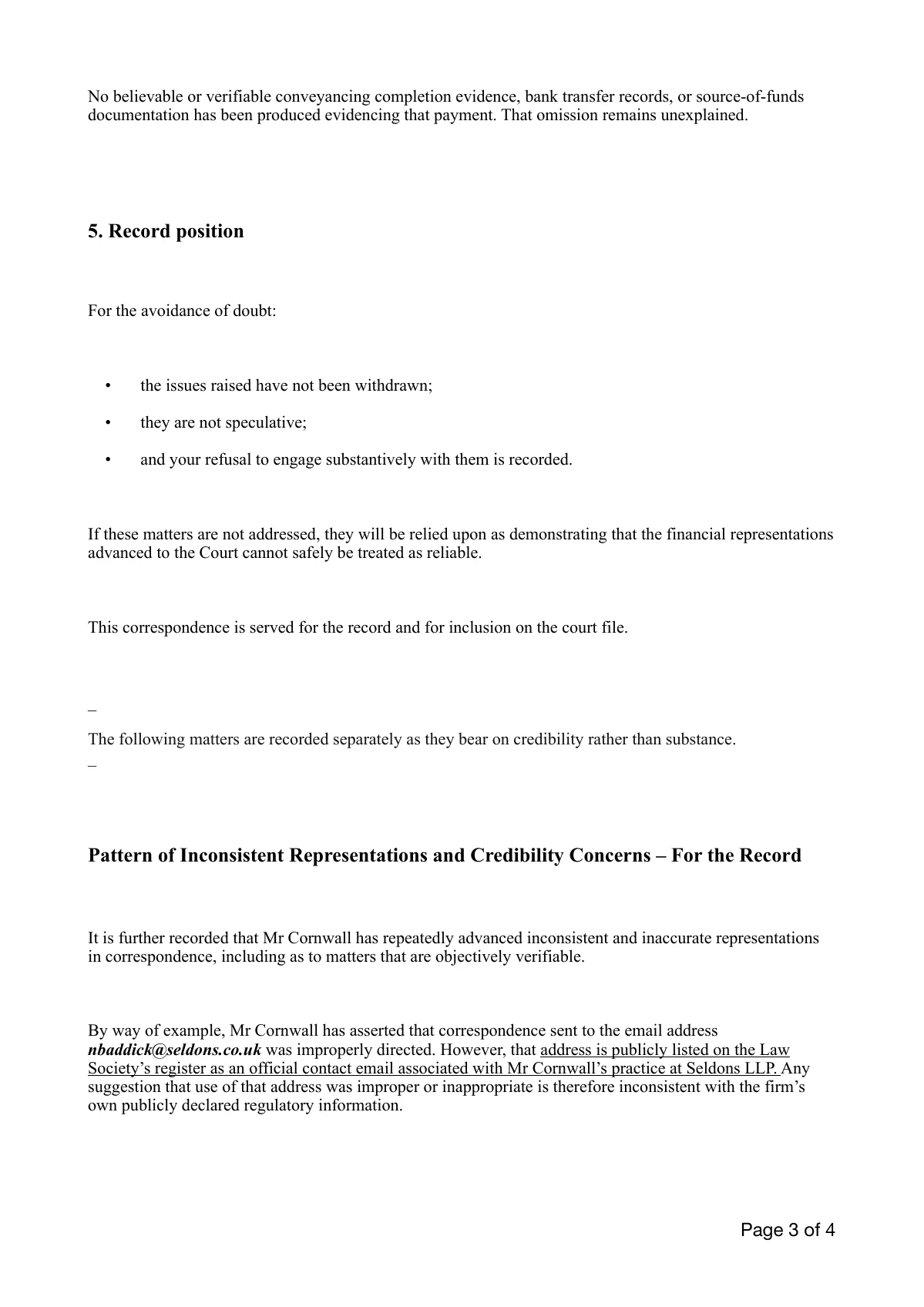
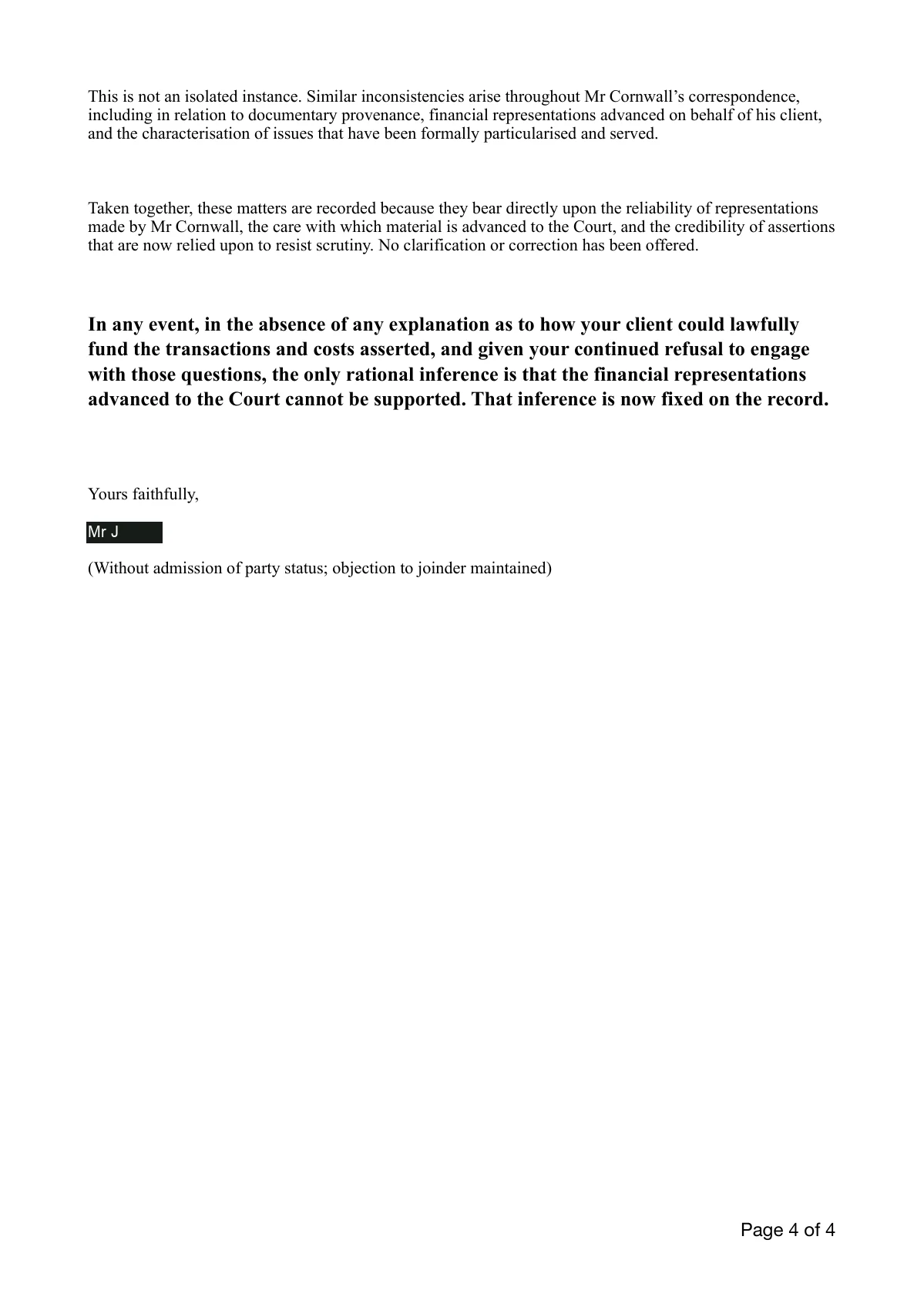
Mr J · January 2026 reply / 4 pages
The challenge: the refusal does not answer the substance.
Mr J challenges the refusal, records the unanswered verification demands and asks how the costs can be attributed to the client. The reply also disputes the characterisation of his correspondence.
The source prints “9 January 2025” but expressly answers the firm’s 9 January 2026 letter. The apparent year error is retained in the document.
Download letter · 4 pages Open PDF
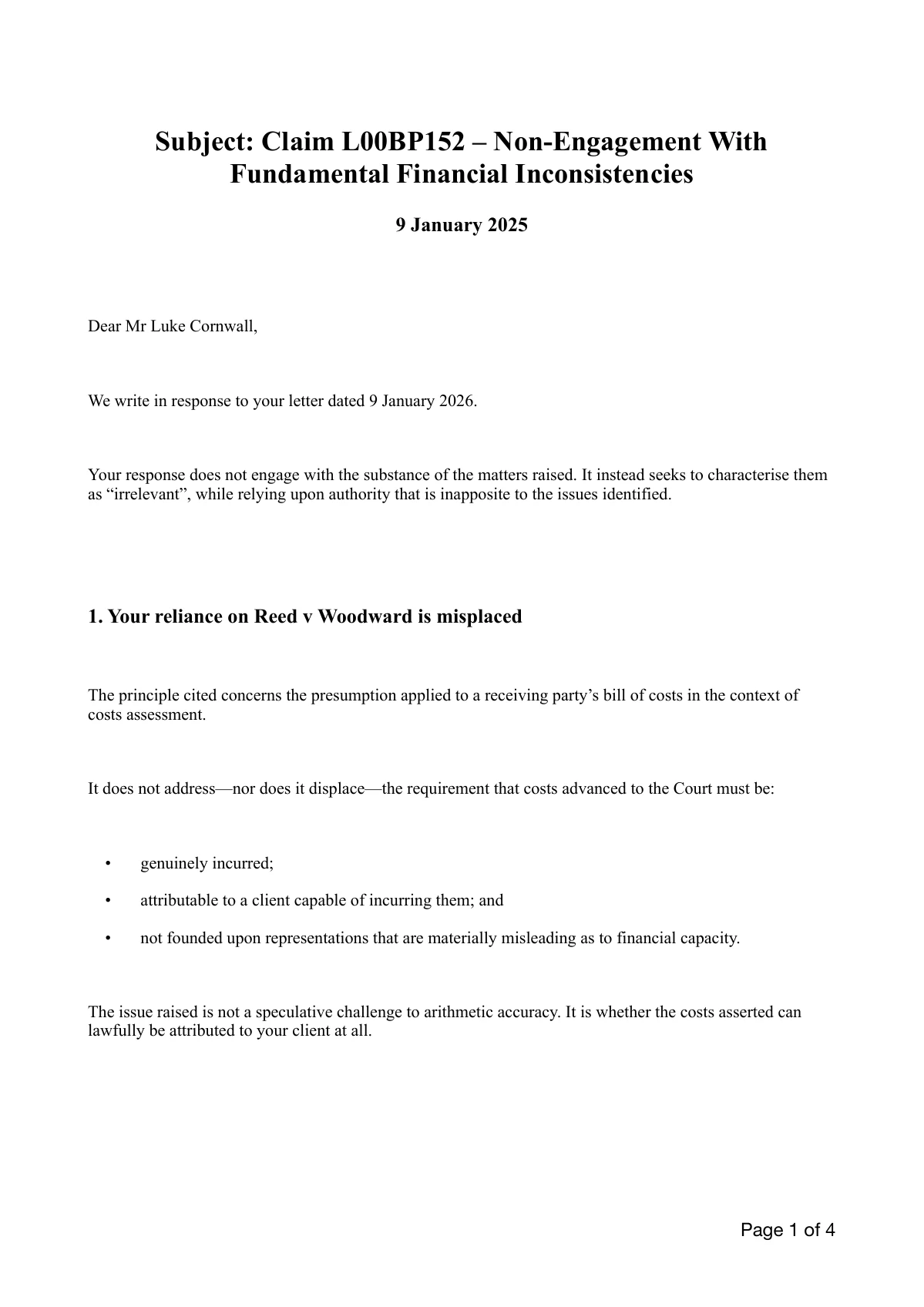
Read pages 2–4
Status of Miss E’s intended claim
On 2 October 2026, the family confirmed to this publication that Miss E plans a claim against Mark John Mayo (claimant in L00BP152; Higher Barley Hayes, Torrington area, Devon) concerning what it describes as extortion and wrongful accusations. This is a statement of intention, not a filed pleading, a new court case number or a determination of liability.
The four-step evidence route organises existing records for that proposed action. The appropriate civil legal basis, any separate criminal or regulatory referral, the particulars and the remedies require their own assessment. Existing appeals retain their separate identities and status.
The home, enforcement and joinder: 7 June 2024–23 September 2025
Seldons, 7 June 2024: the letter treats Mr J as a non-party and declines to liaise unless he is a legal representative. Seldons, 23 June 2025: the June trial bundle, pages 653–657, records ownership correspondence of 16, 17 and 20 June, a 2 May Land Registry application, the firm’s suspicion of a transfer to avoid enforcement, and its stated intention to pursue an award against the house. Pages 655–656 connect registration by Mr J to an application to add or substitute him and possible enforcement against him.
15 July order: bundle pages 202–203, paragraph 5 lists a September hearing to consider substitution or addition. 2 September order: pages 204–205, paragraphs 1–2 join Mr J and require the claimant’s amended case against him by 23 September. The written order does not expressly confine joinder to a boundary declaration.
Second amended particulars, filed 23 September: page 2 pleads alternative beneficial-ownership grounds and intended legal transfer. Pages 5–6, paragraphs 16–18, and page 13, paragraph 45, add allegations concerning June, July and November 2024 as acts by Mr J as agent or independently. Page 14 seeks damages and costs against the defendants. The verification date on page 15 visibly corrects February to September; it is not treated here as an uncorrected February signature.
The family disputes the scope permitted at the hearing. Its compiled judicial extracts contain editorial material and are not the complete approved transcript. The amended pleading concerns earlier events; that is distinct from backdating the date on which Mr J became a party.
Ownership and the December challenge
Mr J’s 30 August 2025 supplementary note already asserts beneficial ownership. His 3 December formal objection states that legal-title registration completed on 14 October 2025. This is his documentary account, not a fresh Land Registry verification. Ownership information was therefore being discussed before October.
The claimant’s trial chronology, page 13, describes the 1 December hearing as refusing oral reconsideration of the September order. Mr J’s subsequent statement disputes the handling and reasons. These are opposing accounts; the complete December order and transcript are needed to resolve the scope dispute.
January 2026 demands and the firm’s response
The Costs Liability Funding Exhibit Bundle records Mr J’s 5 January demand at C3, pages 21–24; Seldons’ 9 January response at C4, pages 26–27; and his reply at C5, pages 29–32. The reply’s printed year conflicts with the surrounding January 2026 exchange and is not used to create a separate 2025 event.
Seldons declined the requested documents as irrelevant, opposed specific disclosure, relied on costs-certification authorities and said the challenge confused incurred and estimated costs in Precedent T. Mr J’s 14 January email disputes the costs representations; the chain also disputes which budget was operative. His 23 January post-hearing record and demand, concerning the 19 January hearing before Richard Lloyd Griffiths (District Judge, South West; appointed 30 January 2017), requests proof of payment or enforceable liability.
The family’s six-figure totals are disputed representations in that correspondence, not verified payments or a consolidated costs award. No total is presented as established expenditure here.
1 April 2026: incurred liability and funding privacy
Exhibit C6, pages 34–36, records Seldons’ answer that work need not already have been invoiced or paid if the client is liable for it. The firm refers to funding options as private and declines to comment further. It also disputes the alleged arithmetic mistake, distinguishing document work from attendances.
The family suspects a conditional-fee arrangement. This response does not admit one. Neither the reviewed retainer evidence nor this correspondence establishes that Mayo paid nothing. The issue for assessment is the liability actually incurred, its recoverability and accuracy—not a presumption that every unpaid bill is invented.
April–May 2026: Blohm, the grading correction and VAT
23 April order, KA-2025-BRS-000045: varies the earlier direction to £600 plus VAT. It records consideration of the bill and evidence and regards detailed assessment as disproportionate. Its heading and internal recital contain different April dates; this page identifies it by the dated order rather than silently reconciling them.
18 May email from Cornwell to the court: says Mayo will attend alone; acknowledges that Grade A was entered on the N260 in error, asserts Grade B at £247 plus VAT and offers a reduction of £7.20 plus VAT; asks about the court fee. The local correspondence chain is titled Re: Re: Hearing on 22 May – Attempt to avoid it not accepted, pages 11–12. Its quoted reference to a Friday in March conflicts with the surrounding May exchange.
10 May hearing notice, forwarded in Miss E’s 20 May correction request: lists Mr J alongside Mayo in the caption. Miss E challenges his inclusion in this separate application and other notice errors. This is a hearing notice, not an order proving a costs liability against him.
22 May hearing; emails of 23, 24 and 26 May: Miss E seeks the sealed order, transcript, e-filing material and a breakdown, including the £313 fee, VAT, grading correction and treatment of the earlier award. Her 26 May statement reports a substituted £1,000 inclusive figure. The final sealed May order and transcript have not been verified for this report; that amount is attributed to her contemporaneous correspondence.
Mr J’s account: Mayo said he paid the company and it paid his legal expenses; Blohm then allowed 20% VAT without supporting evidence being shown. This is an attributed participant account, not a checked verbatim transcript. The transcript is needed to establish the precise words, context, VAT evidence and calculation.
Company identity and the separate March N260
Companies House identifies Mayo Media 2015 Ltd, company 09412563, and Mark John Mayo as a director. The register establishes a company role, not personal disposable wealth, a litigation budget or tax treatment. Company record · Officer record
British Dealer News and the publisher name: BDN’s 21 July 2022 announcement identifies Mayo Media as its publisher. Its website terms name Mayo Media Ltd at the same Daddon Court business address as the registered company. Those pages do not give company number 09412563. The publisher name and the registered directorship are therefore recorded separately, not treated as proof of the precise entity that paid any legal bill. Mark John Mayo’s Companies House appointments record his appointment to Mayo Media 2015 Ltd on 29 January 2015. Read the linked business background.
The request for the original March 2025 N260 and its filing/service evidence is a separate, specifically identified demand. The later schedules discussed in 2026 do not substitute for it. Read the underlying costs and enforcement record · Read the later disclosure-refusal challenge
The July 2025 order records production of field-transfer documents. The family disputes their authenticity in its separate article. This report does not collapse disputed documents into a claim that no financial documents of any kind were ever supplied. Invoice, completion statements and bank-record comparison
Insurance notification: the request, the reply and the claim letters
- 8 January 2026, 21:49 UK: Mr J’s email, Claim L00BP152 – Record Preservation & Escalation Notice (Attached), to the courts and copied to Seldons and other parties. The attached 12-page notice is named Preservation & Escalation Notice – 06 January 2026; its first page prints 5 January. Section 5.3, page 7, requests insurer identity and policy number for notification of potential claims. The email’s sending date, the filename date and printed document date are kept separate.
- 9 January: Cornwell’s reply for Seldons, under the same subject, names HDI Global and Browne Jacobson LLP and gives Gary Oldroyd’s professional email. No policy number or claim reference appears in that reply. This is a separate email from Seldons’ same-day financial-disclosure refusal displayed elsewhere in this article. The insurer email was also forwarded to Miss E on 16 February.
- 24 March: Cornwell’s email, quoted in the later Claim No: L00BP152 – Solicitor Conduct chain, states: “Please kindly forward a letter before claim which we may provide to our insurers.”
- 27 March: Miss E’s reply, Formal Letters Before Claim – Financial Misrepresentation, copied to Mr J, attaches LBC1 – Costs Schedules – Seldons LLP & Cornwell and LBC2 – Enforcement (No N260) – Seldons LLP & Cornwell.
- 1 April: Seldons’ three-page letter, Your Purported Letters Before Claim, reference LC/NB/1782. Page 1 asserts notification of insurer solicitors and their agreement that the claims are clearly vexatious. It reserves the firm’s position and disputes the claims and particularisation. Pages 2–3 address costs liability, funding privacy and the N260 requests; these are distinct from the requested insurance particulars. The financial-liability response in context.
The record above is based on the reviewed email chain and letter. It establishes what Seldons said; the insurer’s receipt, full attachment inventory, actual policy and the authorisation for the April position are the records requested. The January naming of Browne Jacobson does not identify the unnamed insurer solicitors in April without confirmation.
The disclosure and notification standards
Rule 9.2 applies where a claim concerns a matter within minimum-terms cover and requires the relevant insurer name, policy number and claims contact details on request. MTC clauses 1.1 and 7.1 distinguish the coverage trigger from agreed policy conditions. Obtain the notification clause and dates before determining compliance. SRA Indemnity Insurance Rules and MTC
For claims within its scope, the Professional Negligence Pre-Action Protocol contemplates requests for immediate insurer notification and forwarding of the letter of claim (§§5.3 and 6.2(h)). Its applicability to these particular claims needs assessment. Official protocol
Professional identities—not guessed policy details
“HDI Global” is the name supplied in January. The SRA participating-insurer list names HDI Global Specialty SE, but that list does not identify Seldons’ particular underwriting entity. The policy must do so. Browne Jacobson’s official profile confirms Gary Oldroyd’s Exeter partnership and financial/professional risk role, not the terms of his mandate here.
Insurer-notification investigation and full context · Five direct notification questions
Tax treatment, VAT recoverability and HMRC’s remit
Official guidance checked on 2 October 2026. HMRC EM8505 distinguishes lawful remuneration and director-loan treatment of personal expenses. HMRC BIM47107 explains the company deduction for taxable remuneration costs. Neither establishes the treatment used in this case.
PD44 paragraphs 2.3–2.5 address the costs receiving party’s entitlement to recover VAT, partial recovery and evidence where entitlement is disputed. Company payment and a Corporation Tax deduction do not determine that entitlement.
HMRC’s reporting guidance provides the official route for suspected tax fraud and instructs reporters to describe available documents rather than send them initially. HMRC’s confidentiality framework explains why taxpayer records and investigation details are protected. No HMRC referral or investigation is reported here.
Read the tax-treatment challenge · MEDIA-05: request the records
Rules checked for this inquiry
CPR 44.1: conditional liability · PD44: VAT and summary assessment · CPS: blackmail · SRA: individual conduct · SRA: firm responsibilities