
Named in this strand



The house beside the route
The reported collision: five metres from the house.
Mr J describes a right of way crossing Lower Barley Hayes and passing within approximately two feet of the vulnerable Grade II-listed historic home. He says its first floor relies on a roughly 300-year-old timber beam, there is a single exit, and he understands the concrete has no steel reinforcement. His concern is the consequence of a heavy vehicle striking the house or obstructing that exit.
One exit. A risk to escape as well as impact.
Mr J says the house has only one exit. His concern is that a heavy vehicle losing control on the steep approach could strike the vulnerable Grade II-listed historic home, cause serious injury, and damage or obstruct that exit. Falling material or a blocked doorway could trap Miss E, other occupants or pets inside. The concern is therefore about people’s ability to escape, not simply the cost of repairing the house.
The family’s position is that protection should address the danger before another collision—not wait for the house to be struck. They rely on the reported tractor incident and the driver’s reported loss of control as the reason the risk required attention.
Where did the judgment address the risk to occupants and their only exit? →
Who lives with the consequences?
Mr J says Miss E spends much of her time in the home with her pets. For him, the concern is both personal and financial: his mother’s life and well-being, and his investment in the vulnerable Grade II-listed historic property. They would bear the immediate consequences of a serious impact. The judge deciding the access dispute does not live with that physical exposure; Mr Mayo’s interest in using the route is not the same as living inside the home beside it.
The family says it would be irresponsible to leave these risks unanswered until someone is injured or killed. They fear that damage could trap occupants, destroy irreplaceable historic fabric and leave specialist reconstruction costs exceeding the property’s value. Their demand is for protection before harm—not compensation after an avoidable tragedy.
The question for Timothy Edmund Walsh: where do the reasons assess the likelihood and possible severity of harm to Miss E, other occupants and the historic home, alongside the reported loss of control and the conveyance’s care obligations? What preventive safeguards were considered, and why was the final access outcome considered appropriate?
Protection need not wait for completed damage.
English law recognises preventive, or quia timet, injunctions against threatened infringements of legal rights. In Vastint Leeds BV v Persons Unknown [2018] EWHC 2456 (Ch), paragraph 31, the court explains that relief can precede completed damage and, when considering a final preventive injunction, examines the likelihood of the threatened infringement and whether the resulting harm would be so grave and irreparable that damages would be inadequate. The principle supports asking for evidenced risks to be addressed before harm occurs; its application depends on the rights, evidence and relief before the court.
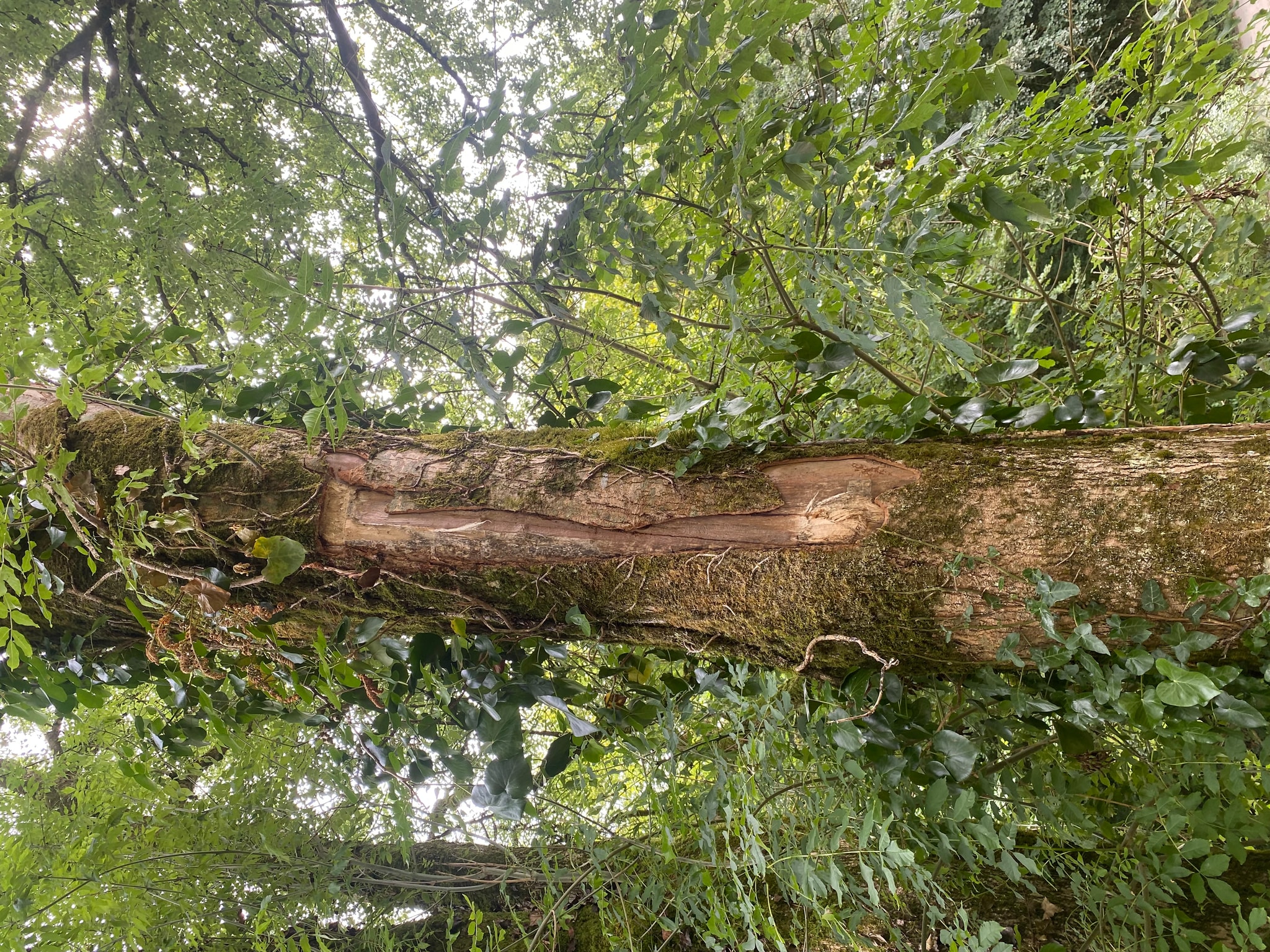
The earlier defence already records a reported collision. PD1, page 34, alleges that a tractor conducting business with Mr Mayo struck the tree beside the house and that the tree prevented a collision with the building. Mr J now identifies the driver as neighbouring farmer Mr Folland (neighbouring farmer identified in Miss E and Mr J’s account of the tractor collision), whom he associates with Tarka Springs, and says the visit concerned collecting a basket for carrying forestry logs from Mr Mayo. Those identification and equipment details are his account. Photo, earlier allegation and current account →
Mr J places this tree approximately five metres from the house. In Miss E’s trial account, relayed to Mr J, Mr Folland said he lost control of his tractor and had to swerve into the tree to avoid hitting the house. The five-metre distance concerns the tree; the approximate two-foot clearance above concerns the route beside the historic home.
The family’s point is concrete: in their account, control had already been lost beside an occupied home. They say their complaint sought protection for Miss E, her pets and the building against a recurrence—not the suppression of ordinary access.
Open full image ↗
The family’s later working rebuttal records a dispute over the extent of the photographed damage; Miss E denies altering or enlarging it. The contemporary photographs, incident account and hearing evidence are therefore central to checking what happened.
What was the tractor carrying or collecting, for whose work, and what was done to protect the house after the reported strike? The photographed machinery and timber, together with Mr J’s account of the log-carrying equipment, raise a specific question about the journey’s purpose. The answer belongs in the access record. Questions to Mr Folland and Mr Mayo →
The duty in the conveyance—and the earlier undertaking.
Clause 2(ii) of the 1987 conveyance, referred to by the family as clause 2.2, requires the purchasers and their successors:
“to exercise with due care and skill the rights and liberties hereby granted and avoid as far as possible causing any damage injury nuisance or disturbance whatsoever in the exercise of such rights and liberties.”
This is the wording the family relies upon when asking how the route could be used without exposing the neighbouring home to harm. Read the deed reference →
Mr J also recalls Offen recognising a problem with the way the route was being used at the earlier hearing. The written interim order records Mr Mayo’s undertaking to use the driveway for residential purposes, excluding agricultural vehicles while allowing commercial vehicles for domestic purposes, such as oil deliveries. It also preserves a hooked-chain arrangement. Read the interim order reference →
What explains the move from that interim restriction to the later general vehicular right, and where were the collision evidence and clause 2(ii) addressed? The family asks for the reasoning connecting the evidence, the deed and the outcome. Why this matters to the judgment challenge →
What work was taking place?
Miss E and Mr J say this was more than occasional domestic tree maintenance. They allege substantial felling, timber movement and heavy-vehicle use, with noise, damage and safety consequences for their home. Mr J says the concrete surfacing was laid to facilitate those operations and that the previous owners did not consent. The work records, dates, routes and consent are among the specific matters the questions below ask Mr Mayo to identify.
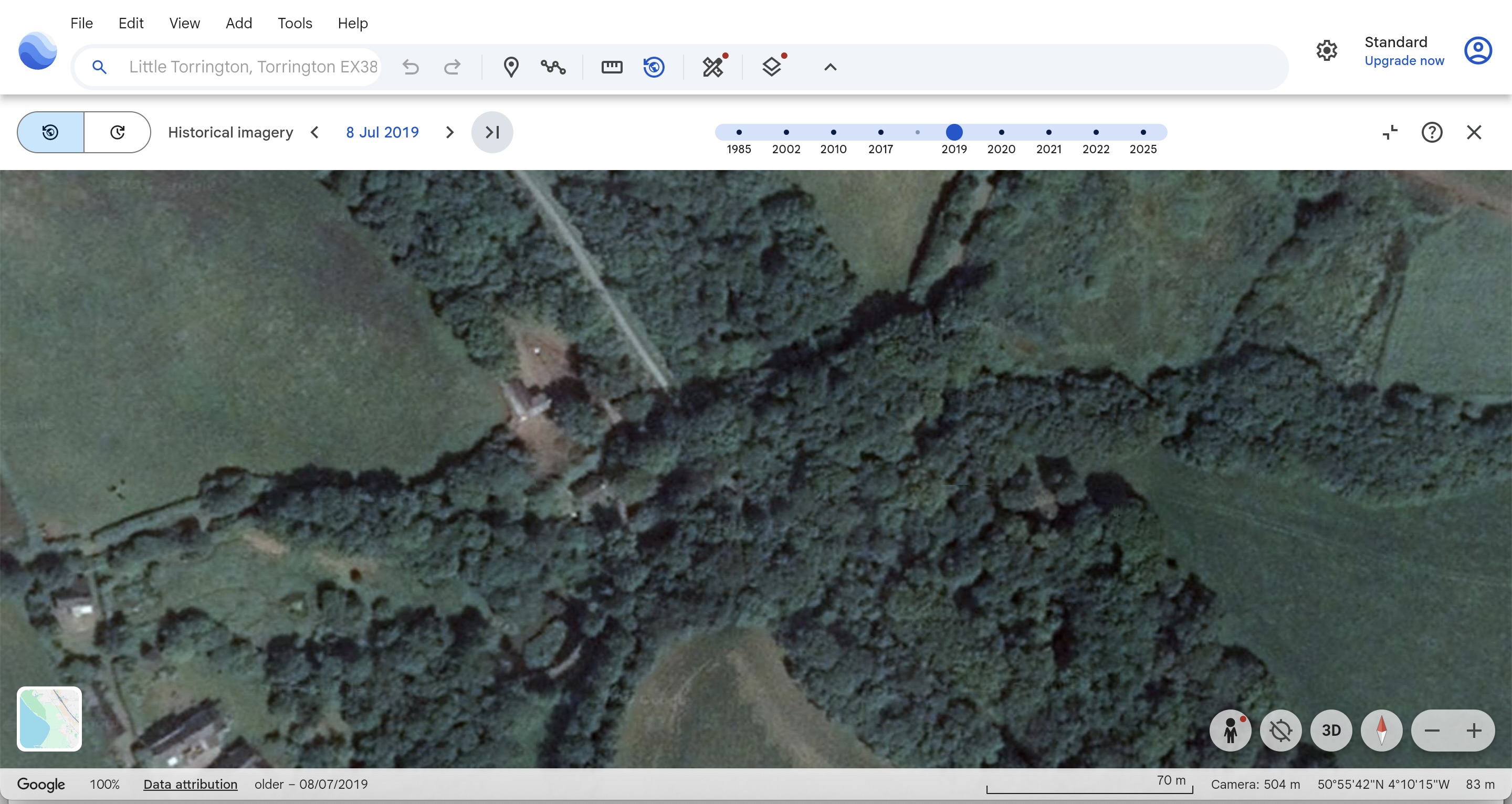
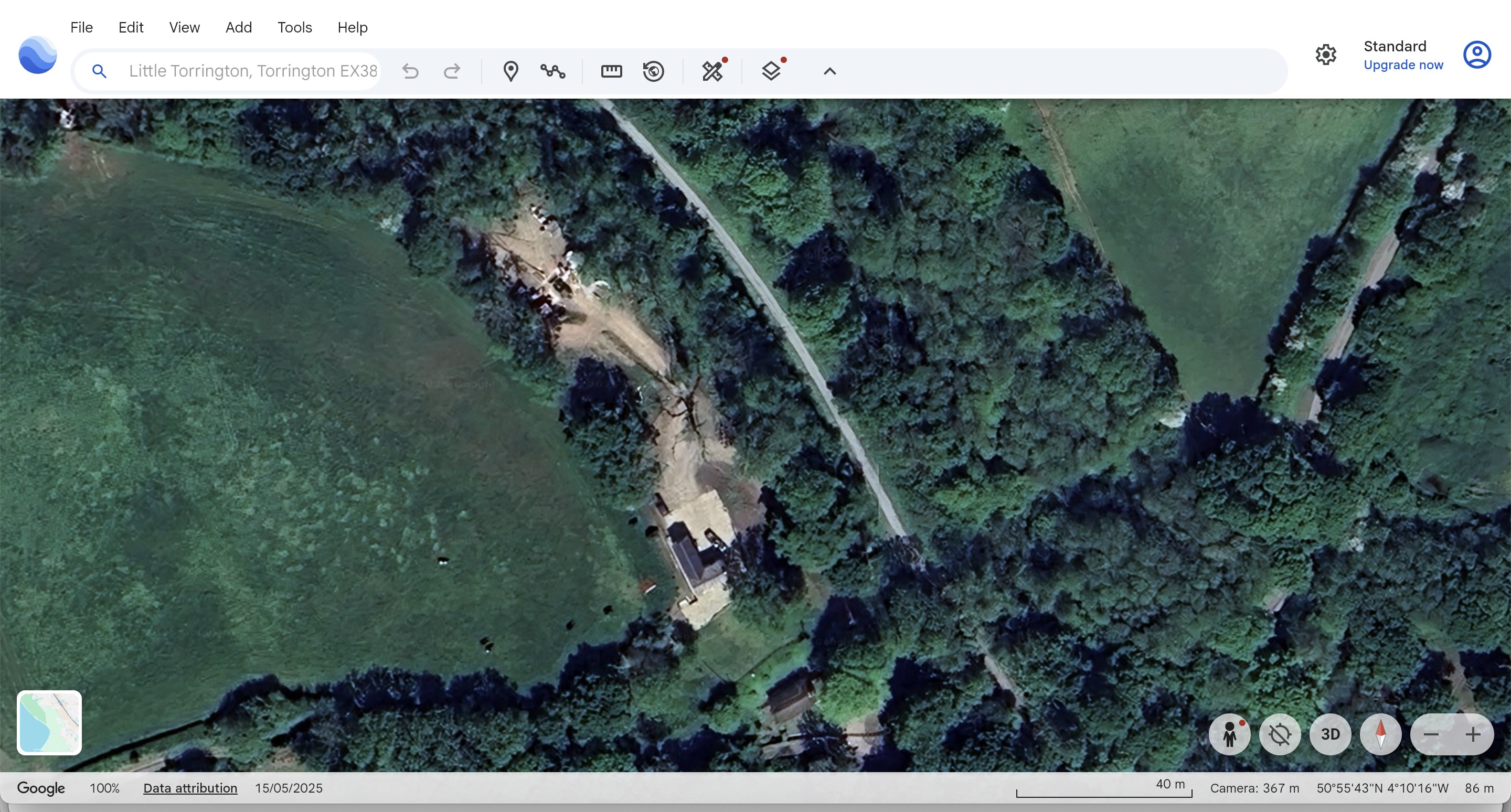
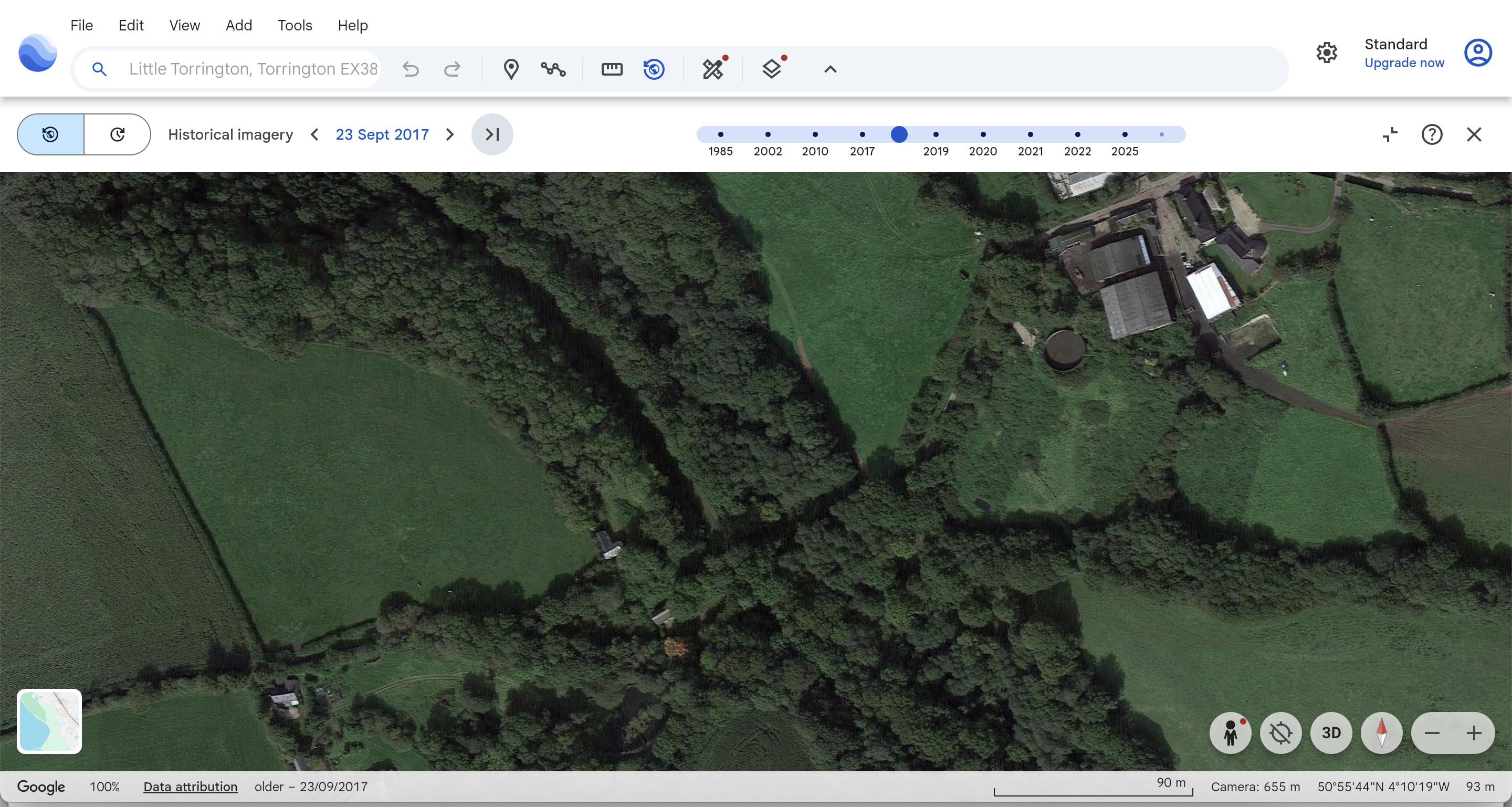
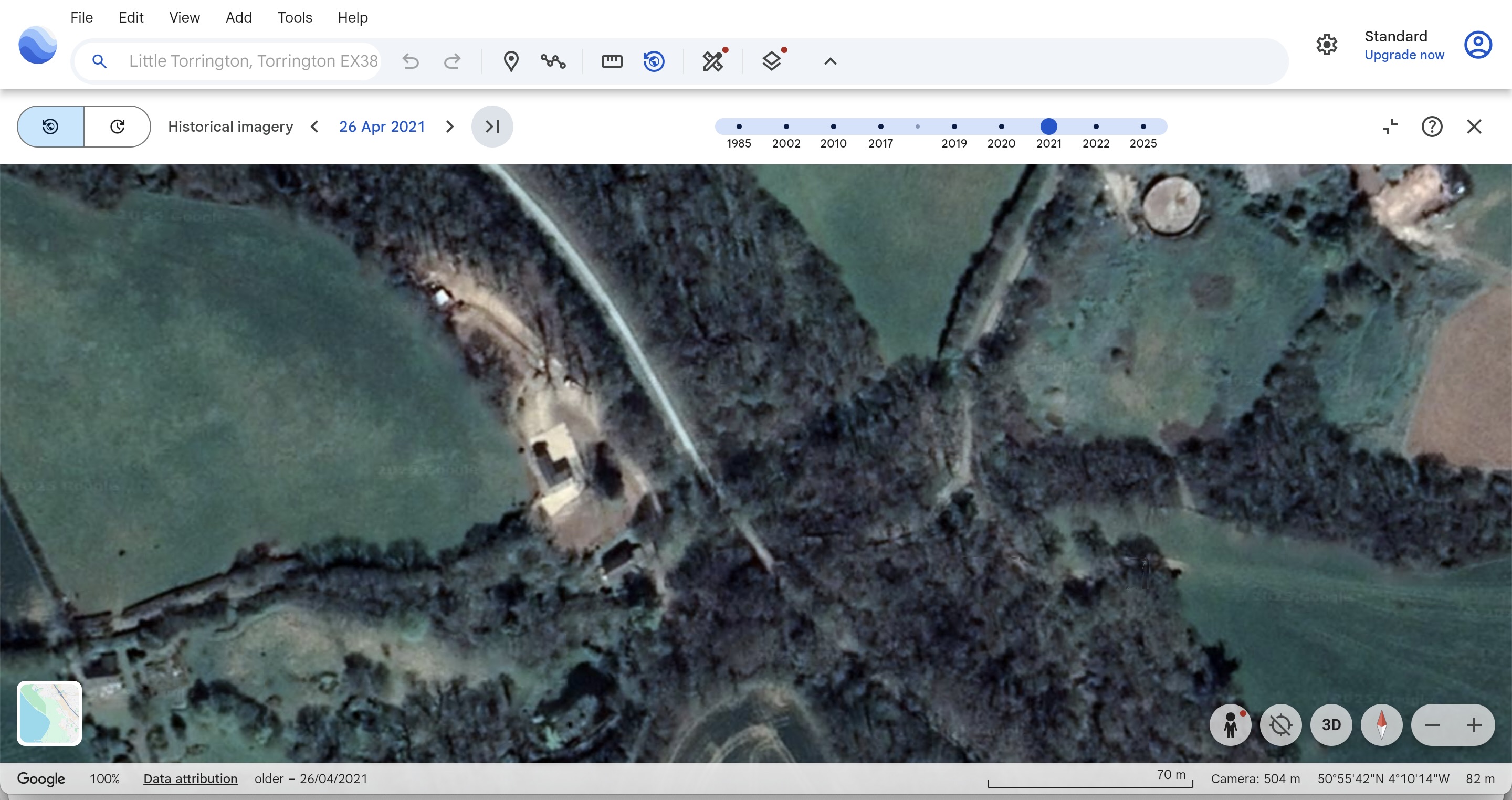
The supplied aerial sequence begins in 2017, continues through 2019 and 2021, and ends in May 2025. It shows the changing appearance of the land; the licence history and dated operations record are needed to establish which cutting was authorised or exempt. The licence question →
02 / On the ground
A denial of commercial felling.
The machinery and timber photographed.
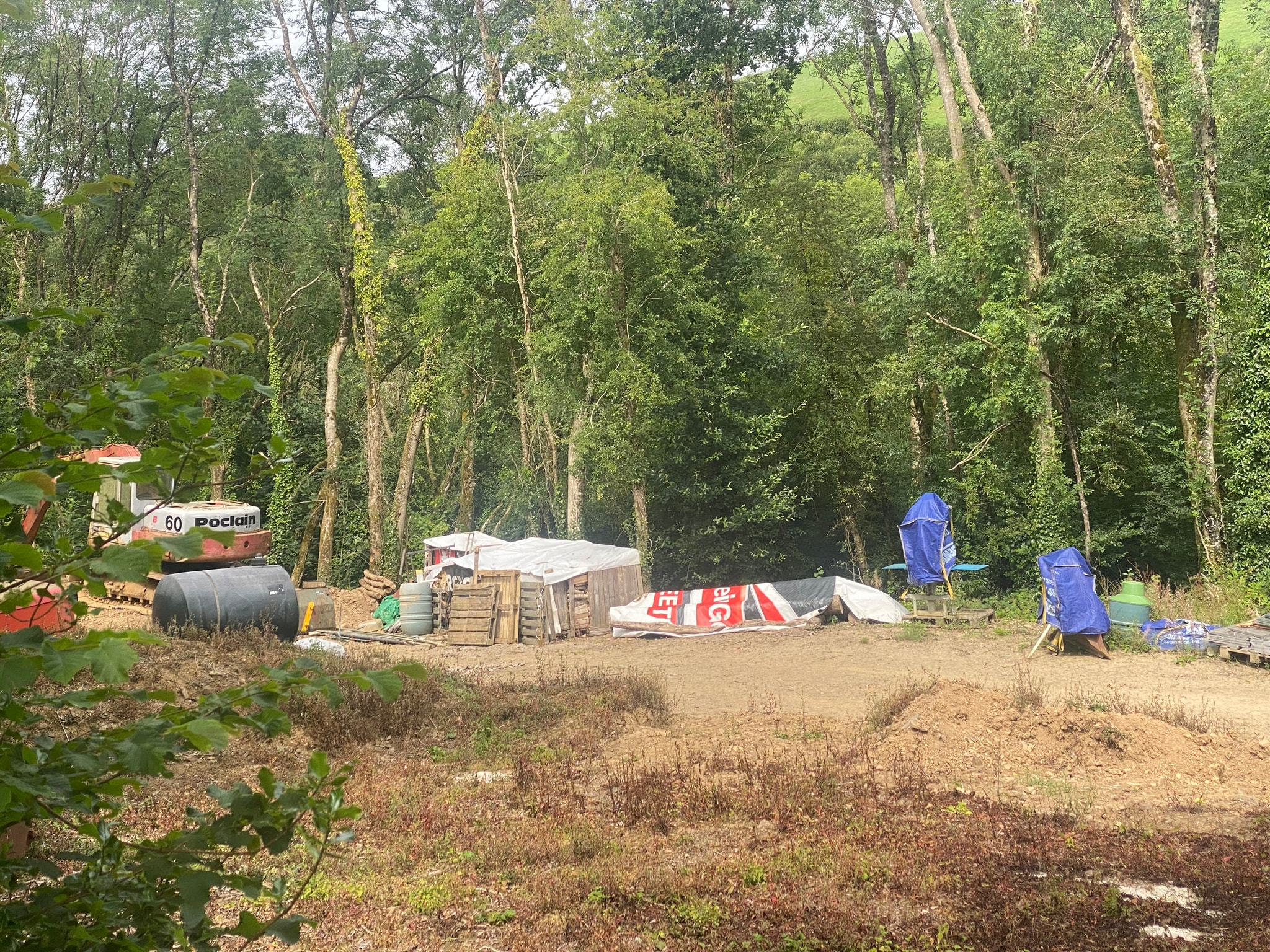
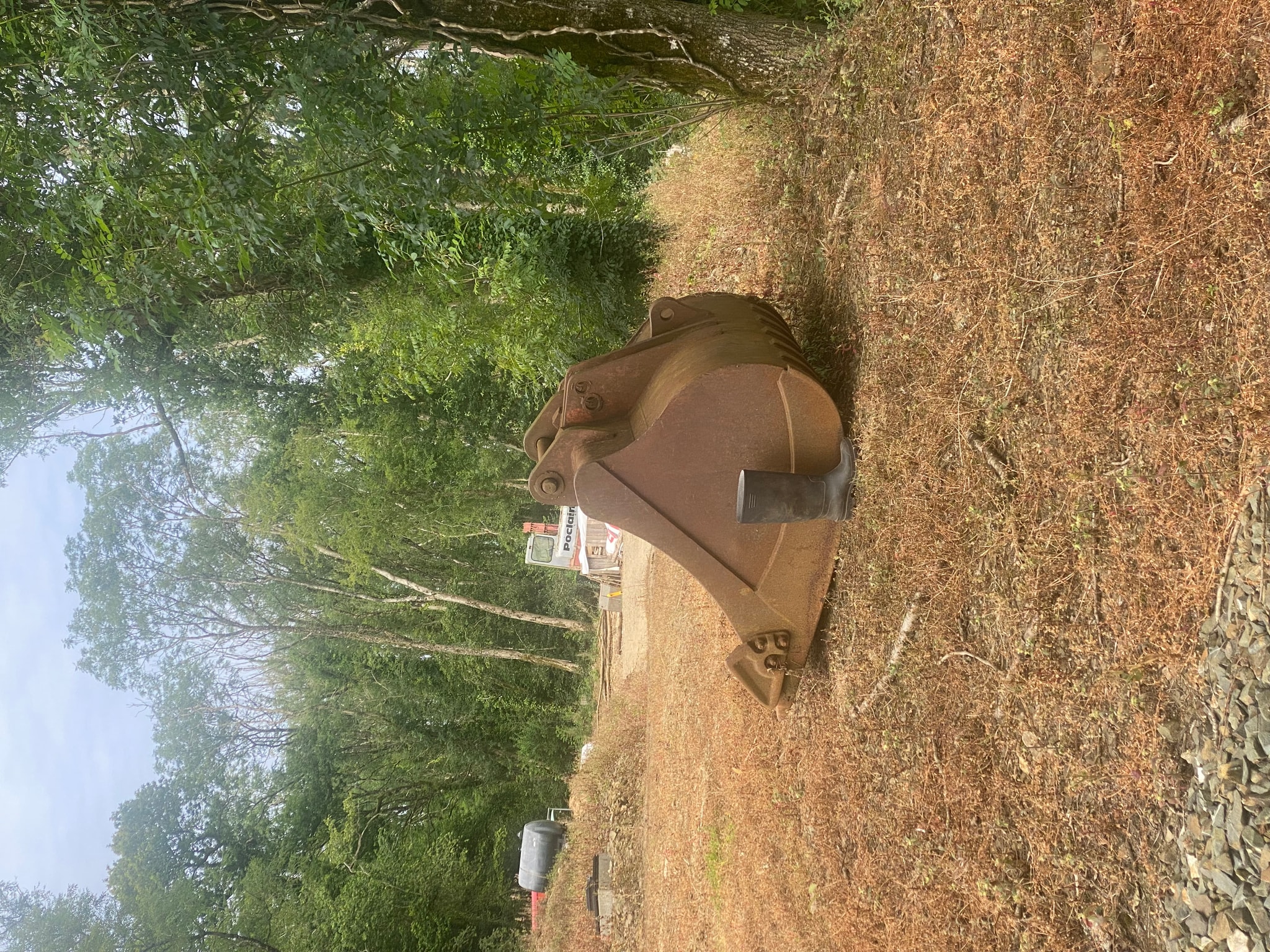
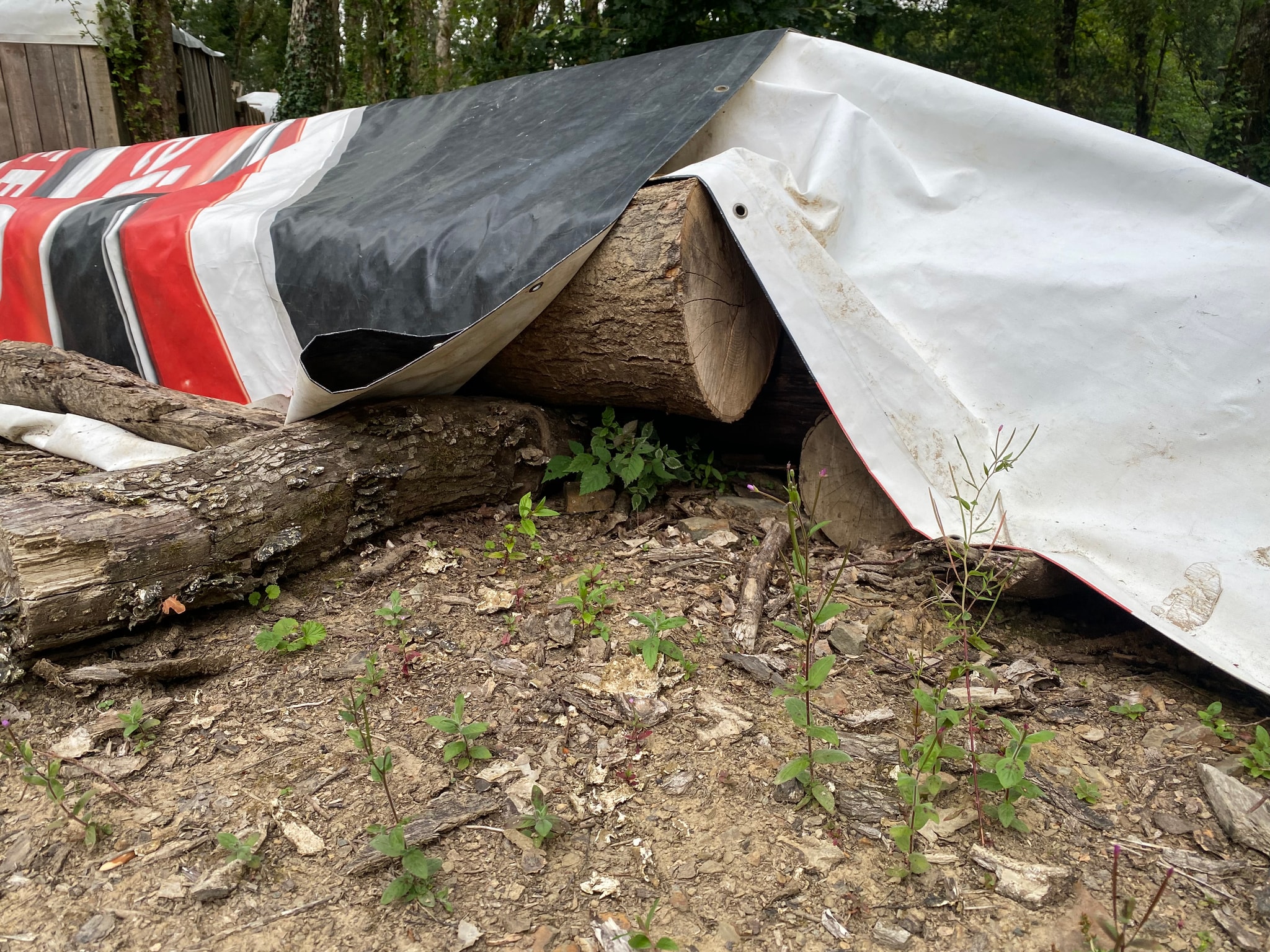
Miss E recalls Mr Mayo denying commercial felling under oath, as she reported to Mr J. Miss E and Mr J challenge that denial by pointing to the excavator, cut timber, equipment and alleged movements over the driveway. What work was this machinery doing, where did the timber go, and how were those questions resolved by Walsh? Compare the reported account with the aerial images →
The earlier Primary Defence document includes machinery and driveway photographs. The August 2026 court email again attached photographs of an excavator, its bucket and the working area. These images sit alongside the family’s allegation about the nature and scale of the activity. The earlier defence photographs →
Open full image ↗
Open full image ↗
Open full image ↗
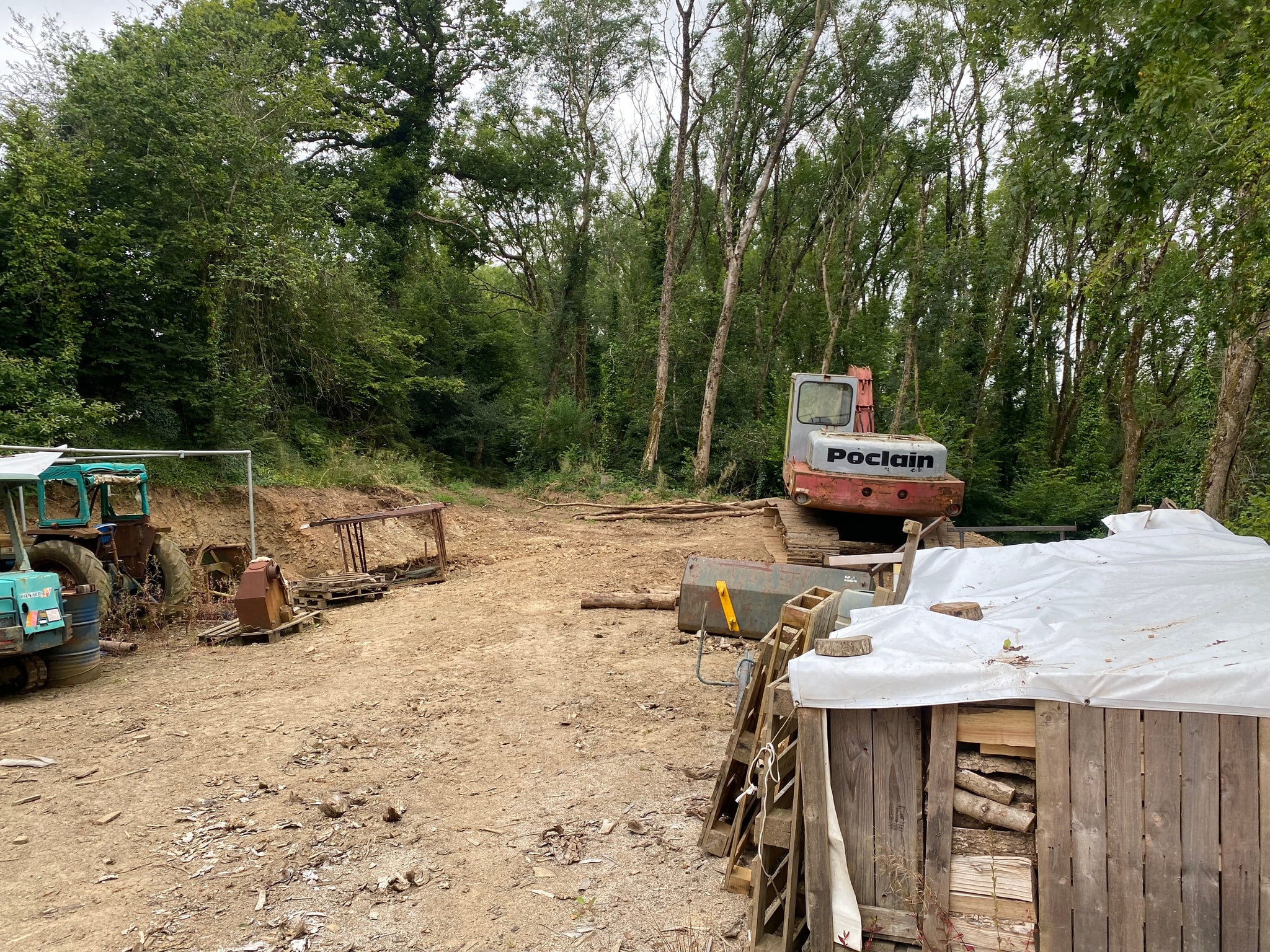
Open full image ↗
The family asks why this material was not reconciled with the description of the operations given to the court. Which machines were used, for which work, and over which access route?
03 / From complaint to proposed court evidence
Follow the emails.
“I cannot see any current felling licence”.
David Dyball’s reply is dated 6 August 2024 at 16:06. He reports the concern to the local Woodland Officer “to look into what is happening and take any action required”. Read his reply below.
David Dyball — Operations Admin Officer, Forestry Commission England, Operational Delivery Team, Kennford, Exeter, in his August 2024 reply · Dated Forestry Commission reply
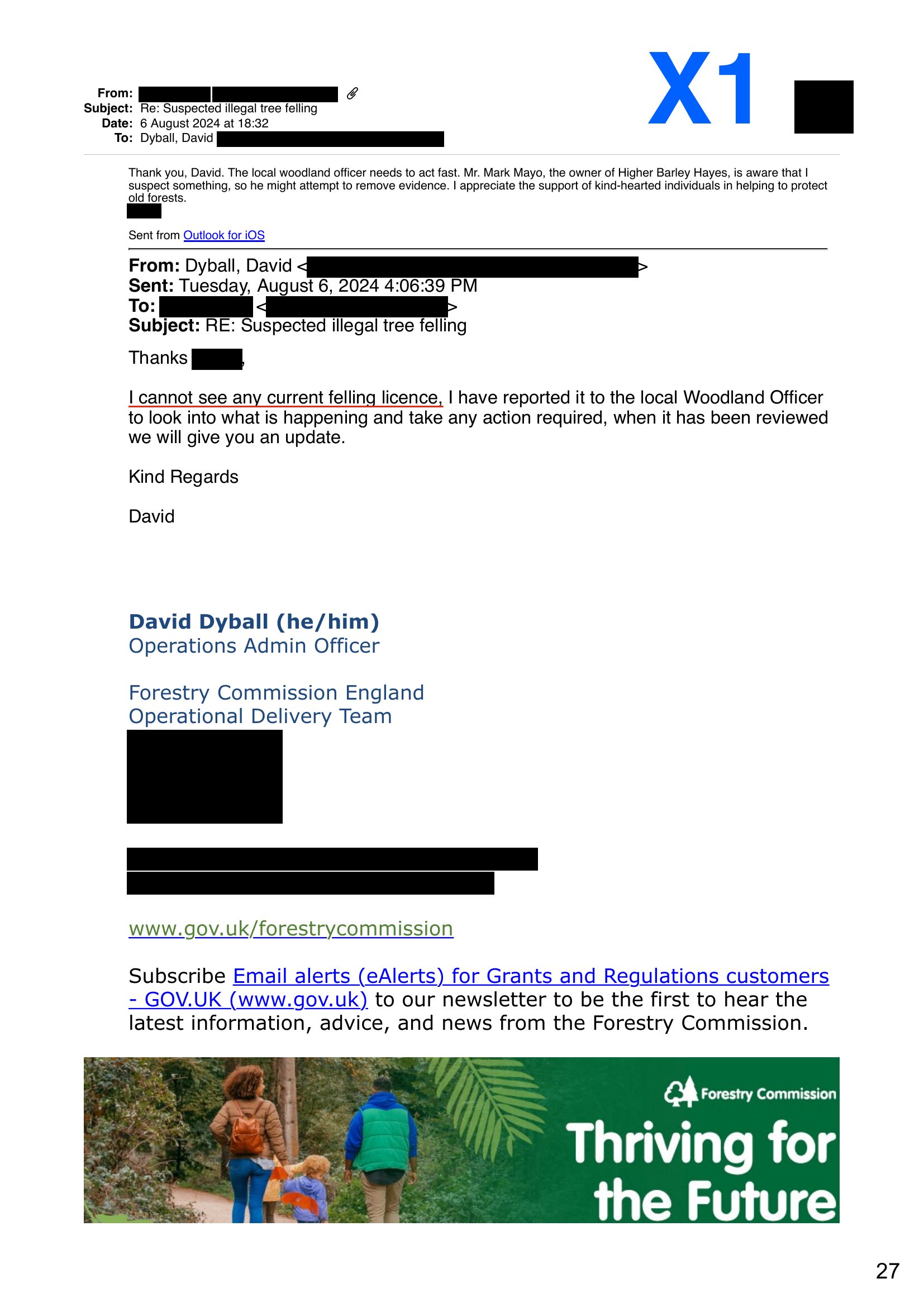
Read the reply at full size ↗
Mr J reports suspected unlawful felling and supplies location material and aerial images. David Dyball of the Forestry Commission replies: “I cannot see any current felling licence”. He refers the concern to the local Woodland Officer. Source: the Dyball exchange
After the visit, Mr Mayo asks Henry Bexley for an email confirming no illegal or commercial timber activity. He specifically asks that it say the chain “appeared locked at first glance”.
Mr Bexley sends typed visit notes for Mr Mayo to confirm. He expressly allows the notes to be shown “in evidence for any reason”. Repeating the account that access had been blocked, he writes: “This appeared to be the case on arrival with a padlocked chain across his driveway.”
Mr Mayo says he will discuss the email with his solicitor: “We may decide to forward to the judge”. He also asks to share it with Torridge District Council regarding an equipment shed and a new entrance across the field.
After the message proposing court and planning use, Mr Bexley replies: “Hello Mark, that’s fine, these are my site visit report notes”. He says they also assist the licence application and advises no further felling until the licence is received. Mr Mayo agrees not to fell on 10 August. Source: the four-page correspondence
Read their correspondence.
This page displays Mr Mayo’s later reply above Mr Bexley’s earlier notes. Read the timestamps: the notes were sent at 17:54; the explicit proposal to discuss court use with the solicitor followed at 19:29. The complete four-page chain is linked below.
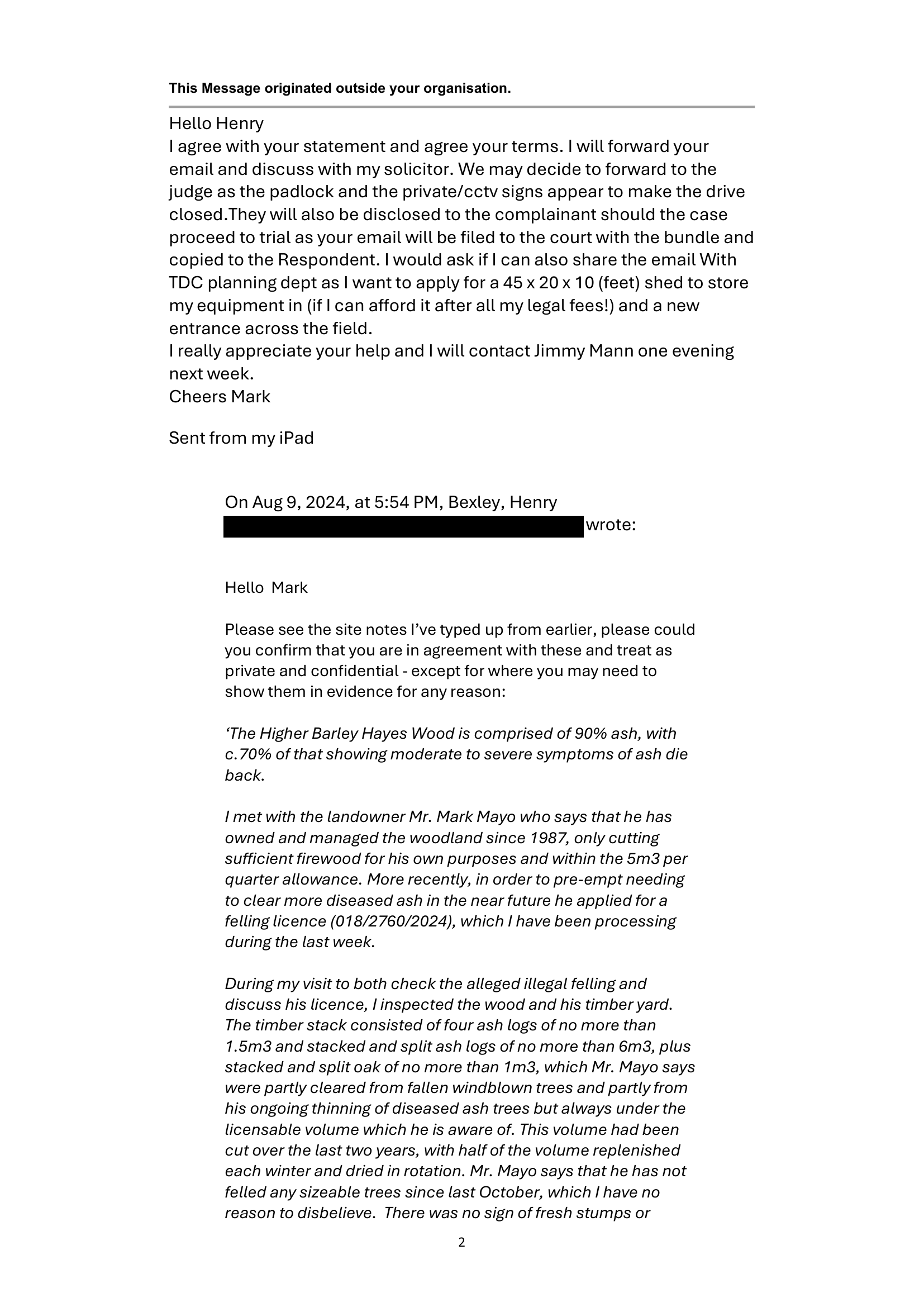
Open page 2 at full size ↗
Page image from the supplied “Felling Licence” correspondence. Contact email, telephone and office-address details are covered in these publication copies; names, dates and email wording are retained.
A forestry inspection. A proposed court exhibit.
Miss E and Mr J allege that the forestry visit was used to build a misleading obstruction case against them. Mr Bexley describes his visit as checking alleged illegal felling and discussing the licence. Yet the resulting notes also address Mr Mayo’s private access dispute, including an apparent blocked driveway. The family says the chain could be lifted from its hook.
The documentary sequence is specific: Mr Mayo requests the locked-chain wording at 11:10; Mr Bexley sends notes for his agreement at 17:54, allowing evidential use; Mr Mayo identifies possible use before the judge at 19:29; and Mr Bexley replies “that’s fine” at 19:38. That last reply follows a message about both court use and planning sharing. Check all four pages →
What independently established that access was blocked? The notes describe an appearance but record no attempt to lift or open the chain. Why include that account without recording such a check, and what was done to distinguish Mr Mayo’s requested wording and account from the officer’s own findings?
The family alleges manipulation and collusion on that basis. The records needed to test it are the original visit notes, any revisions, the complainant’s evidence considered, and the exact exhibit and submissions used in court. Questions to Henry Bexley and the Forestry Commission → · Questions to Luke Cornwell and Seldons →
Public inspection. Professional independence.
The Civil Service Code requires accurate records, evidence-based advice and fair treatment; it prohibits unjustified favouritism and misuse of official position to advance private interests. These are the standards against which the Forestry Commission is asked to explain the wording, checks and handling of the proposed court use.
For the solicitor, the SRA Code addresses misleading presentation, including omissions (1.4), evidence misuse (2.1), improper influence on its substance (2.2), and properly arguable assertions (2.4). Official material may be used in litigation; the issue is whether it was obtained and presented accurately, without turning an untested impression into proof of obstruction. Read the linked question for SRA assessment →
Mr Bexley’s notes say he found no fresh stumps or sawdust and did not suspect commercial firewood selling, based on the quantities and woodland size. They record old timber, recent disturbance by a minidigger and an approximately 1.2-metre path. He describes the woodland as about 90% ash, with approximately 70% of that ash showing moderate-to-severe dieback, and the pending application as regeneration felling. Several historical statements are expressly attributed to Mr Mayo. The family challenges that assessment against the imagery, machinery and use of the route. Read the scope of the recorded assessment →
04 / The access allegation
A padlock on a chain — or a locked barrier?
Miss E and Mr J say the chain was resting on an open hook and could be lifted off. They say that was the arrangement during Mr Bexley’s visit. The photograph below shows the configuration they rely on.
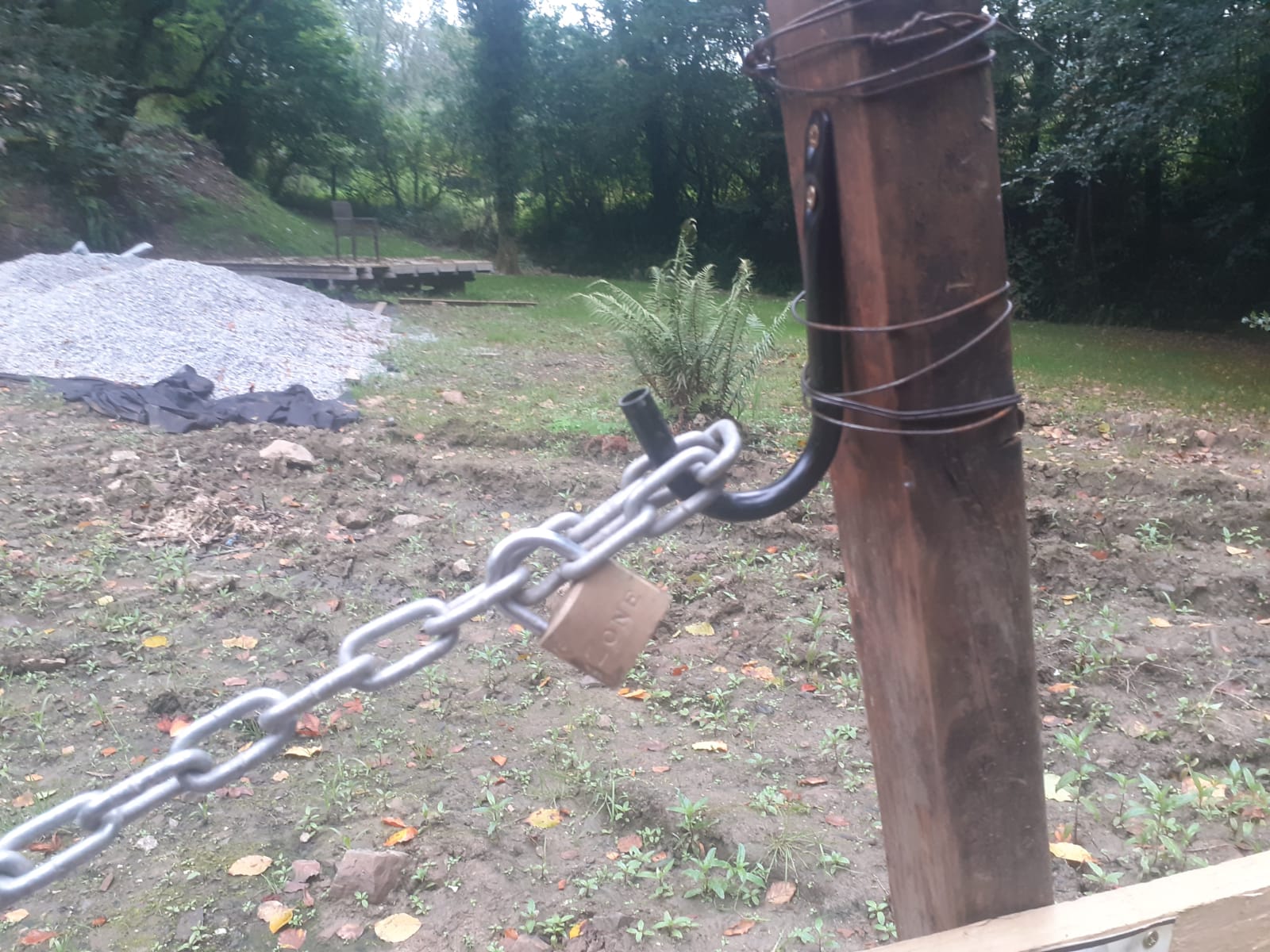
Open full image ↗
The exhibited interim order in related claim L00BP144 records undertakings concerning gates and an unlocked, hooked chain. Its heading is dated 13 August 2024 and its body specifies performance by 20:00 on 7 August. That chronology and the record of the 9 August visit are material. Source: the interim order and photograph
Did anyone test whether the chain prevented access, or was its appearance allowed to stand for that conclusion?
05 / Why this belongs in the right-of-way case
The trees and the track are connected.
The family’s case is that timber and machinery travelled over the right of way beside their home before the later switch to field access. Mr J links that change to the family’s objections to heavy vehicles and the earlier residential-use undertaking. He points to the 2025 field tracks as part of that chronology. The burden of the earlier movements must be considered alongside the 1987 conveyance’s provisions about care, damage, maintenance and fencing. Compare the images and the reported route change →
The March 2025 amended defence quotes planning application 1/0638/2024/AGR as describing the existing access as “not suitable for heavy / long loads as narrow, very steep & winding”. Mr J asks how that description can be reconciled with the actual use of the route and the position advanced in court. Source: the quotation in the amended defence, paragraph 59
Mr J also links the concrete surfacing to the alleged expansion of forestry activity. When was it laid, for what loads, with whose consent, and what evidence explains the relationship between the work and the movement of timber?
Named responsibility · public offices
Who will answer for the official record?
The family alleges that an official visit was turned into misleading litigation evidence. The Forestry Commission is asked to examine the original messages, the checks made and the account that reached the court.
- Richard Stanford CB, MBE (Chief Executive, Forestry Commission; Bristol correspondence office) — Chief Executive Officer, Forestry Commission · executive oversight · Bristol. Standards, supervision and independent review.
- Anna Brown (Director, Forest Services, Forestry Commission; corporate correspondence office in Bristol) — Director, Forest Services · Forestry Commission · service-level oversight. Standards, supervision and independent review.
- David Dyball — Operations Admin Officer, Forestry Commission England Operational Delivery Team · role recorded in August 2024. Referral and follow-up records.
- Henry Bexley — Woodland Officer, Forestry Commission England, identified in the August 2024 correspondence. Questions on the inspection and chain.
Official locations: the South West area office is at Bullers Hill, Kennford, Exeter EX6 7XR; the Chief Executive’s correspondence office is at 620 Bristol Business Park, Coldharbour Lane, Bristol BS16 1EJ. Official office directory · Chief Executive and complaint route.
Leadership details checked 19 September 2026. The executive questions seek present oversight of the 2024 events. Which rules applied? · Who will conduct the review?
The alleged practical consequence
A disputed account. An injunction against Miss E.
The defendant’s October 2025 rebuttal identifies a further injunction before Gibbs and costs exceeding £3,000 (page 6, section 5). The strike-out script requests review of the injunction, disclosure of the Bexley communications and written reasons if those requests were refused (pages 15–16). Read the submission references →
Mr J says these matters were raised before Paul Mitchell (Designated Civil Judge for Cornwall, Devon and Dorset; Exeter Combined Court Centre) at the strike-out stage without Mr Mayo being required to answer the specific alleged manipulation. Miss E’s account of the trial before Timothy Edmund Walsh, relayed to Mr J, is that the allegation was again raised without such questioning. What happened to the request to test the report, obtain the communications and review the order? The question seeks the hearing passage, application, ruling and reasons—not a general assurance that the case was heard.
The order chronology matters: the 9–10 August correspondence came after the earlier 7 August arrangement before Offen. The rebuttal identifies a later injunction; the exact order and evidential basis are requested below. Questions to Luke Cornwell and Seldons · Questions concerning Mitchell and Walsh
The challenge was particularised.
The corrected October 2025 strike-out submissions allege that the forestry correspondence was used to create a false obstruction narrative, seek an injunction and obtain costs. Annex E, updated 6 February 2026, repeats the allegation of deliberate coordination involving Mr Mayo, Mr Cornwell and Mr Bexley. Source passages and dates →
The supplied correspondence bears a header showing Luke Cornwell of Seldons forwarding the chain to himself on 8 November 2024. The questions are which version was filed, how it was presented and how the contrary chain and machinery evidence was addressed.
The challenge before the hearing
What reached the court—and what happened to it?
The inspected 13–14 October 2025 emails identify the strike-out submissions, the main bundle link, a separately sent photo-exhibit link and page-numbered replacements. Cornwell and Bubyer were copied. The court’s written confirmation records that the additional rebuttal was printed and placed on file.
The reviewed rebuttal challenges the Bexley account and the further injunction; the oral summary seeks disclosure and review. Which exhibit versions reached Mitchell, and where were those requests addressed? The same questions carry forward to the later trial record: what was tested, deferred or determined?
Read the dated filing sequence → · Which hearing papers reached the judge? · What happened to the report and injunction challenge?
Where was the photographic challenge answered?
Professional accountability · Luke Cornwell & Seldons LLP
Answer the risk—not just the person raising it.
Representing a client is not permission to take unfair advantage of a vulnerable opponent or mislead the court.
Miss E and Mr J allege that their safety concerns were met with attempts to discredit them rather than substantive answers. Mr J says the photographs were supplied to the claimant’s legal team long before trial and presented at the strike-out hearing. Their concern was concrete: heavy vehicles beside a vulnerable Grade II-listed historic home, a reported tractor collision nearby, an impact potentially blocking the only exit, and a conveyance requiring care and the avoidance, as far as possible, of damage, injury, nuisance or disturbance.
New: the CCTV complaints, Seldons’ 11 May reply and three regulatory-accountability questions →
The professional duties behind the questions
- No unfair advantage. Code 1.2 prohibits abuse of a solicitor’s position to take unfair advantage of clients or others.
- No misleading presentation. Code 1.4 covers misleading acts and omissions, including complicity in a client’s conduct.
- A properly arguable basis. Code 2.4 requires assertions and submissions to meet that standard. Read the SRA Code
- Particular care with vulnerable or unrepresented opponents. The SRA’s disputes guidance requires care against unfair exploitation and engagement with the evidential and legal merits. Read the disputes guidance
A client’s interests do not override the administration of justice. Where duties conflict, the SRA Principles give priority to those protecting the wider public interest, including justice and public confidence in the profession. Read the Principles
Cornwell and Seldons: identify the answer in the record
What evidence answered these safety concerns? Where were they addressed in your submissions? If Miss E’s concerns were characterised as exaggerated or obstructive, what evidence supported that characterisation?
Identify the passages, exhibits and dates—not simply the outcome you sought for your client. Explain the steps taken to avoid unfair advantage and to ensure the court received an accurate account. Read FOR-16: the specific accountability question →
A vulnerable person’s safety should not disappear behind an attack on their credibility. The issue is whether the evidence of risk was examined or displaced.
Luke Cornwell’s questions · Seldons LLP’s questions · The firm’s duties and proposed SRA assessment
The separate photographic-evidence questions ask Cornwell, Seldons and barrister Jack Christopher Kelsey Webb (professionally Jack Webb; barrister, 3PB, Bristol; called to the Bar in 2016) what each received, reviewed and advanced: read FOR-15.
The reported one-tree account, denial of commercial felling and Miss E’s contempt allegation are set beside the photographs above. In Miss E’s trial account, relayed to Mr J, Mr Mayo gave no substantive answer to her challenge and Timothy Edmund Walsh did not pursue it with further questions.
Mr J’s statement dated 18 August 2026, sent to the courts on 19 August, also challenges the one-tree account and the judgment’s treatment of the scale of felling. He says he personally attended delivery of the judgment and challenges the conclusion he heard that tree cutting had not occurred on the scale alleged. The question is precise: which tree and which period did the sworn account concern, and where did the court reconcile it with the photographic record? Statement and hearing-account source note →
Why the family alleges bias.
Timothy Edmund Walsh: the named questions, evidence and judicial identity →
Miss E and Mr J allege that Walsh was biased in the claimant’s favour and colluded with him. They connect that allegation to what they describe as the failure to reconcile the one-tree account with the photographic evidence, the reported loss of control beside the house, the protections they claim under clause 2(ii), and the earlier interim restriction on agricultural vehicles.
Their allegation is that minimising the operations also minimised the reason for the traffic and the danger they had complained of. Mr J says the final outcome left Miss E without effective protection against those risks. The challenge is therefore not simply how many trees were cut: it is whether an inadequate account of the activity displaced a material complaint about how the right of way was being used.
Where do the reasons address the driver’s reported admission, the risk to occupants if the only exit were blocked, and the precautions against a recurrence? How does the conveyance’s duty of care operate alongside the access declared? Read the court-record question →
Mr J says he personally presented these documents before Paul Mitchell. Miss E’s account of the later trial before Walsh is that the material was treated as though it did not exist. The family alleges that the evidence was not meaningfully examined—not that it had never been delivered.
The July 2026 order declares a general right of way serving Higher Barley Hayes, including vehicles reasonably accommodated by the roadway. It also records actionable nuisance concerning the locked/second gate and dismisses the counterclaim. Those later gate findings must be distinguished from the disputed condition of the hook-and-chain arrangement during the August 2024 visit. The family challenges the outcome and the treatment of the evidence leading to it. Their question is exact: where do the reasons reconcile the cutting account, the photographs and the use of the route?
Mr J confirms that every attachment reached the court: the family printed the full material and also sent it via WeTransfer. His challenge concerns how that evidence was addressed. Which images and exhibits were before the court at each hearing, when were they received, and where do the reasons explain their treatment? Statement, delivery clarification and later order
The questions by party
Identify the work.
Produce the record.
FOR-01 · Henry Bexley / Forestry Commission
Was the chain actually locked?
On 9 August 2024, did Henry Bexley try to lift or open the chain? Produce the contemporaneous notes and photographs showing whether it physically prevented access, and explain the difference between its appearance and any check actually performed.
Why it matters: An impression of obstruction can affect court proceedings. The physical check and its record are central to the family’s challenge.
FOR-02 · Henry Bexley / Forestry Commission
Why was the subject of the complaint asked to confirm the notes?
Why did notes from a visit to check alleged felling and discuss a licence include Mr Mayo’s private access dispute? What independently supported the blocked-access account and his requested chain wording? Identify the original notes, any revisions and checks against the complainant’s evidence. Why seek Mr Mayo’s agreement, permit evidential use at 17:54 and reply “that’s fine” at 19:38 after his court-and-planning proposal? Explain what that reply authorised, the limits on use and how accuracy, objectivity and impartiality were protected.
Why it matters: An official account must distinguish the officer’s observations from the investigated person’s account. Readers need to see who supplied, checked and changed each material statement.
FOR-03 · Henry Bexley / Forestry Commission
Which felling did the inspection assess?
Identify the land, cutting periods, timber volumes, machinery and historic imagery assessed. Supply the decision and plan for application 018/2760/2024, any exemption relied upon for earlier work, and the evidence addressing the family’s photographs and complaint.
Why it matters: The response must address the particular work reported, not leave uncertainty about which area and period were examined.
FOR-04 · Mark John Mayo
Why request the chain wording for possible court use?
Why did you ask a woodland officer checking alleged felling to include that the chain appeared locked at first glance? What evidence shows it was locked rather than resting on an open hook? At 19:29 you proposed discussing court use with your solicitor: what proposition did you intend the notes to prove, and how was the difference between appearance and verified obstruction explained?
Why it matters: The requested wording should be traceable to what happened at the visit.
FOR-05 · Mark John Mayo
One tree: which tree, which period—and what explains the images?
Miss E’s account is that, during her cross-examination of you, you stated under oath that you cut only one tree and denied commercial felling. Mr J says she recorded the answers in contemporaneous notes and subsequently challenged them in writing. Identify the exact statements, the tree, land and period they concerned. What operations and purpose were covered by the denial of commercial felling? How does that account fit the 2019–2025 imagery, the photographed cut timber and machinery, and the cutting described in the inspection notes? Give a dated schedule of the work, who carried it out, the quantities removed and the licence or exemption relied upon. Mr J says timber and machinery used the driveway before later field access: identify the dates, loads and vehicle records that confirm or dispute that sequence, including when the field routes came into use.
Why it matters: The family alleges that understating the operations discredited a genuine safety complaint. The scale, purpose, vehicle movements and route matter to the protection sought for Miss E and her vulnerable Grade II-listed historic home.
FOR-06 · Luke Cornwell / Seldons LLP
How was the officer’s impression presented to the court?
Identify the exact Bexley correspondence filed, its exhibit reference, hearing and the proposition it was used to prove. The defendant’s rebuttal alleges reliance before Gibbs to obtain a further injunction and costs exceeding £3,000: identify that application, dated order, costs decision and the submissions linking the notes to the relief sought. Did the court receive Mr Mayo’s wording request, the request for his agreement, the 19:29 court-use proposal and the 19:38 reply? Was an impression of a locked chain presented as verified obstruction or as a finding about lawful access? Identify the checks, qualifications and response to the hooked-chain evidence. Once the family alleged a contrived obstruction account, what did you investigate, correct or place before the court? Explain how the presentation complied with SRA Code 1.4 and 2.1–2.4.
Why it matters: The filed wording and the use made of it allow the alleged misrepresentation to be tested.
FOR-07 · Luke Cornwell / Seldons LLP
Where is the response to the chain and machinery challenge?
Identify the substantive response to the family’s photographs, the hooked-chain account and the forestry particulars in the strike-out submissions and Annex E. Preserve the original messages and identify any changes between the received chain, the 8 November 2024 self-forward and the filed exhibit.
Why it matters: The record must show how a specific evidential challenge was answered and which document version the court received.
Walsh’s identity, the family’s allegation and complete question pack →
FOR-08 · Paul Mitchell · court record / Timothy Edmund Walsh · court record
Where did the court reconcile the photographs, the collision and the access outcome?
Mr J says he presented the material before Paul Mitchell. Miss E’s account of the later trial before Timothy Edmund Walsh, relayed to Mr J, is that it was not meaningfully addressed. Where do the hearing record and reasons compare Mr Mayo’s reported one-tree account and denial of commercial felling with the dated images and machinery photographs? Mr J says he personally attended delivery of the judgment and heard Walsh conclude that felling had not occurred on the scale alleged: what evidence supported that conclusion, and how was the photographic contrast addressed? For the trial and final judgment, where is Mr Folland’s reported evidence of losing control and swerving into a tree about five metres from the house addressed? Explain the treatment of clause 2(ii) of the 1987 conveyance and the earlier interim undertaking excluding agricultural vehicles. What reasons explain the later access outcome and the response to the risk of a recurrence? Where were the likelihood and possible severity of harm assessed, including a vehicle strike or falling material blocking the home’s only exit? What preventive safeguards were considered, and why was the final access outcome considered appropriate?
Why it matters: The family says that minimising the operations displaced a material safety complaint. The evidence, the care obligations and the reasoning about vehicle use must be examined together.
FOR-09 · Mark John Mayo
When did field access replace the driveway—and what had already passed beside the home?
Mr J says timber and machinery used the right of way before the later change to field access, following the family’s objections to heavy vehicles. He points to field tracks in the May 2025 image and links the change to the residential-use undertaking recorded before Offen. Identify when that change occurred, which vehicles and loads used the driveway beforehand, and the dated records that confirm or dispute his account. How did those movements relate to the interim undertaking excluding agricultural vehicles while permitting commercial vehicles for domestic purposes? The family’s March 2025 defence quotes application 1/0638/2024/AGR as describing the existing access as unsuitable for heavy or long loads. Identify the original wording, the loads contemplated, and when and why concrete was laid. What precautions followed the reported tractor collision, and how do you say the use complied with the due-care and damage-avoidance wording in clause 2(ii) of the 1987 conveyance? Identify the landowner consent and maintenance arrangements relied upon.
Why it matters: The application, work records, collision evidence and conveyance should be addressed together when explaining the burden and safety of the traffic beside Miss E’s home.
FOR-10 · Mr Folland / Mark John Mayo
Did the tractor strike prevent a collision with the house?
Mr J identifies Mr Folland as the driver and places the tree approximately five metres from the house. Miss E’s account of the trial, relayed to Mr J, is that Mr Folland said he lost control and swerved into the tree to avoid the house. Is that an accurate account of the incident and testimony? Identify the hearing passage, date, vehicle, equipment, load and purpose of the journey. Mr J says the visit concerned a basket for forestry logs from Mr Mayo. What contemporary records explain the loss of control, damage and precautions taken afterwards?
Why it matters: The family says this was an actual loss-of-control event beside an occupied home. Its cause, the driver’s testimony and the response to the risk of repetition are material to how the route was being used.
FOR-11 · Richard Stanford CB, MBE / Anna Brown / Forestry Commission
Which rules governed the officer—and were they followed?
Richard Stanford and Anna Brown: identify the staff-conduct, case-record, inspection, evidence-sharing and supervision rules in force on 9–10 August 2024, with their effective dates and relevant provisions. Was this visit a complaint investigation, a licensing visit, or both? Did those rules permit the subject of the complaint to confirm the notes and obtain wording about a private access dispute for possible court use? Who supervised or authorised that handling? Explain, against the actual correspondence, whether Henry Bexley met the applicable requirements for accuracy, objectivity, impartiality and authorised use of official information.
Why it matters: Public authority lends weight to a document. The Commission should be able to identify the standard, the checks and the responsible decision-maker behind its own officer’s account.
FOR-12 · Richard Stanford CB, MBE / Anna Brown / Forestry Commission
Will you commission a review independent of the disputed handling?
Will you appoint a reviewer not involved in the visit or subsequent handling, preserve the original emails, headers, notes, photographs and revisions, and compare them with the court exhibit? Identify who will test the physical chain evidence, the requested wording, the court-use proposal and the response to the complainant’s photographs. Provide the reviewer’s remit, a case reference, the findings on each allegation and any correction or remedial action. If a review is declined, identify the decision-maker, reasons and applicable route for challenge.
Why it matters: The family alleges that the handling affected an injunction and costs against Miss E. A reasoned review must trace the official account through to its practical use, not simply repeat the disputed notes.
FOR-13 · Paul Mitchell · court record / Timothy Edmund Walsh · court record
What happened to the request to test the report and review the injunction?
For Paul Mitchell’s strike-out hearing: where were the Bexley allegation, hooked-chain evidence, request for the complete communications and request to review the injunction determined? Was Mr Mayo required to answer the particular allegation that an apparent-locking account was manufactured for court use? If the issue was deferred, identify the direction and how it was preserved for trial. For Timothy Edmund Walsh’s trial: where were those outstanding points tested and resolved, and what findings addressed their alleged effect on the injunction, costs and portrayal of Miss E? Mr J says Mitchell did not put the specific manipulation allegation to Mr Mayo at the earlier hearing; Miss E’s account of the trial, relayed to Mr J, is that Walsh did not do so either. Identify the hearing passages, evidence and reasons that address that account.
Why it matters: A challenge alleging that misleading official material produced a court order requires a traceable procedural outcome. The family asks what was decided, on what evidence, and why—not merely whether a hearing took place.
FOR-14 · David Dyball / Forestry Commission
What happened after the felling complaint was referred?
Your 6 August 2024 email says you could not see a current felling licence, had referred the matter to the local Woodland Officer and would provide an update after review. Identify the referral date, case reference, records and imagery passed on, who received them, and the inspection or review outcome. When and how was the promised update communicated? If the work was treated as licensed or exempt, provide the decision, relevant land and dates, and the records supporting it.
Why it matters: The original complaint and referral should lead to an identifiable review and answer. This question seeks the administrative trail connecting the family’s report to the officer’s visit.
FOR-15 · Luke Cornwell / Seldons LLP / Jack Webb
What did each representative know—and how was the photographic challenge answered?
Mr J says the photographs were supplied long before trial and presented at the strike-out hearing. Miss E’s trial account, relayed to him, is that the one-tree account and denial of commercial felling were advanced while her safety concerns were discredited. Mr J says the solicitors have not disputed that Mr Mayo made the statement. Do you dispute Miss E’s account of the words used during her cross-examination, which she says she recorded contemporaneously? Identify the hearing record supporting your position. For each representative, identify the hearings attended, the dated images and forestry allegations received, when they were received and which were reviewed. What account of the scale, purpose and traffic did you advance, and in which submissions or exhibits? What instructions and records supported that account? How did you address the apparent photographic contradiction, the reported tractor collision, the only-exit concern and the conveyance’s care obligations? If you became aware of a material inaccuracy, what correction or clarification did you place before the court, and when?
Why it matters: The family alleges that a false account displaced a genuine safety complaint. The answer must identify each representative’s knowledge and actions: what was known, what was said, and what the court was asked to do about the risk.
FOR-16 · Luke Cornwell / Seldons LLP
Answer the risk—not just the person raising it.
What evidence answered the family’s safety concerns about heavy vehicles beside Miss E’s vulnerable Grade II-listed historic home, the reported tractor collision, the only-exit risk and the conveyance’s care obligations? Identify the exhibits, dated submissions and passages where you addressed them. If her concerns were characterised as exaggerated or obstructive, identify the words used and their evidential and legal basis. What steps avoided unfair advantage of a vulnerable or unrepresented opponent and ensured an accurate account reached the court? Explain compliance with individual Code 1.2, 1.4 and 2.4 for Cornwell, and Firms Code 1.2, 1.4 and 7.1(a) for Seldons. How did you apply the disputes guidance and protect duties to the administration of justice where those duties conflicted with your client’s interests? Identify any correction made, and when.
Why it matters: The family alleges that attacks on credibility displaced examination of danger. The professional-accountability question is whether the safety evidence was fairly and accurately addressed, with a proper basis for the assertions advanced—not merely whether the client obtained the outcome sought.
The record behind this article
Photographs, correspondence, the early defence, the strike-out particulars, Annex E and the post-judgment statement are indexed together with page references.
Open the complete source index → · Back to the Annex E allegations →
Have a record that answers these questions?
Send the question number, your response and supporting documents to theunansweredrecord@gmail.com. Responses and further evidence will be examined and the reporting updated.
The reporting record
What changed in this article.
- Professional accountability
Answer the risk—not just the person raising it.
The forestry investigation now connects the family’s safety complaint to the SRA rules on unfair advantage, misleading presentation, properly arguable assertions and vulnerable opponents. FOR-16 asks Cornwell and Seldons for the evidence, submissions and steps addressing those duties, with a linked proposed regulatory assessment.
Read the accountability section - Route chronology clarified
The driveway first. The field tracks later.
Mr J’s account of the earlier driveway traffic is now placed beside the aerial sequence and linked to the family’s objections and the interim residential-use undertaking. The questions focus on when field access replaced those movements, the vehicles and loads involved, and the records addressing that chronology.
Read the route-change account - Attribution corrected
Who heard the testimony—and who heard the judgment
Miss E’s account concerns her cross-examination of Mr Mayo and the contemporaneous notes described by Mr J. Mr J personally heard delivery of the judgment. The article distinguishes those sources and records his account of the later written challenge and the solicitors’ reported lack of denial that the statement was made.
Read the corrected attribution - Materiality & representation
Why the alleged false account matters to Miss E’s safety
The photographic comparison now explains the family’s allegation that understating the operations discredited a genuine safety complaint. New linked questions ask Luke Cornwell, Seldons LLP and Jack Webb which images they received, what account they advanced and how they addressed the risks beside the historic home.
Read why the alleged contradiction matters - Evidence comparison
Only one tree? Explain the photographic record.
The reported sworn account and denial of commercial felling now sit beside the dated aerial images, with Miss E’s contempt allegation and direct questions about Walsh’s treatment of the photographic evidence. The machinery photographs carry the linked challenge about the work and timber movements.
Compare the account with the photographs - Named oversight and court-record questions
Who will answer for the official record?
Richard Stanford and Anna Brown are named for Forestry Commission oversight, with a referral question for David Dyball. Expanded questions to Seldons and the court record address the alleged later injunction, the requested disclosure and the handling by Mitchell and Walsh.
Read the named oversight questions - Correspondence and standards
A forestry inspection. A proposed court exhibit.
The email sequence now includes the officer’s express allowance for evidential use and his 19:38 reply after the court-use proposal. Questions about independent checks and accurate court presentation are linked to Civil Service and SRA standards.
Read the inspection-to-litigation sequence - Safety argument and legal context
Who lives with the consequences?
The family’s concern for Miss E’s life, her pets and the historic home is now set alongside the law on preventive injunctions. The court-record questions ask where the likelihood and severity of harm, and protective safeguards, were addressed.
Read the prevention argument - Safety concern clarified
Why the single exit matters
Mr J’s concern about occupants being trapped if a vehicle strike blocked the only exit is now explained alongside the reported tractor incident. The court-record question asks where that risk and preventive precautions were addressed.
Read the single-exit safety concern - Evidence and hearing account
The collision, the conveyance and the judgment challenge
Mr J’s account of the tree’s five-metre distance and Mr Folland’s reported loss-of-control testimony is now connected to the exact deed wording, the earlier interim undertaking and the family’s allegation of judicial bias. The linked questions ask how those matters were addressed in the access outcome.
Read the safety and judgment connection - Source image added
David Dyball’s licence reply—now visible
Read the dated Forestry Commission reply: “I cannot see any current felling licence”, followed by the referral to the local Woodland Officer. The email page is reproduced at full size with recipient names and contact details covered.
Read Dyball’s reply - Source images added
Read the Bexley–Mayo emails
The correspondence discussion now displays the page containing the request to confirm the visit notes and the proposed court use. All four supplied pages can be read in full in the linked source record, with contact details covered.
See the email pages - Expanded investigation
The house beside the route—and the one-tree account
The tree-strike photograph and earlier defence are now linked to Mr J’s safety concerns, his account of the court challenge and ten questions about the operations, inspection notes and evidence. Mr Folland is included in the question register.
Read the expanded investigation - Contributor clarification
Forestry attachments: delivery to the court clarified
Mr J confirms that every attachment reached the court, with the material printed and also sent via WeTransfer. The article and source note now record this clarification; the questions concern how the court addressed the evidence.
Read the clarification - Illustrated investigation
The trees, the track and the photographic record
Four dated aerial images and machinery, timber and chain photographs accompany the family’s forestry allegations, the Bexley correspondence and nine precise questions about the right-of-way proceedings.
Read the illustrated investigation
Substantive additions and corrections will be recorded here. The full case can be followed through Latest developments.
The record must account for the images.
Not leave them out of the story.
The next step is to follow the evidence into the hearing: the exact exhibit, the use made of it and the reasons given.
Stay with the story
Follow the investigation
as the record develops.
Follow what changes when another document, account or answer enters the record.
Follow Daux Scythe, our presenter, on LinkedIn for new reporting, evidence reviews and significant developments. The website remains the home of the articles, documents and response record.
This opens his profile; choose Follow on LinkedIn.