Miss E and Mr J challenge the judgment’s treatment of their evidence and its consequences for their home, property rights and costs. Miss E’s appeal, filed on 12 August 2026, records eight grounds. Her detailed rebuttal and Mr J’s statement develop the connected objections.
New to the case? · About three minutes
A home. A disputed record. A continuing demand for answers.
Miss E and Mr J say that genuine concerns about their home, safety and property rights were discredited instead of properly examined. This investigation follows the documents behind that challenge—and asks the people responsible to explain what they did with them.
What is at stake?
At the centre is a Grade II-listed historic home in the Torrington area of Devon and an access route running beside it. Miss E lives there. The family describes heavy machinery and timber movements, a tractor collision nearby and concern about the consequences of an impact on a home with one exit. Those concerns connect the forestry activity to the dispute over how the route could be used.
Why are the documents contested?
Electricity pole BH68 connects the documentary dispute to the field boundary. Miss E’s signed National Grid plan marks it beside the property edge; the family identifies its position as the stock fence at the top of the bank. They say that arrangement had gone undisputed for decades and allege that Mark John Mayo’s competing pole claim sought to undermine their boundary evidence. See the plan and why the fence line matters → Historic agreements and conveyancing material were later supplied; the question is how they connect to the particular land, poles and rights claimed.
The family set out allegations in court submissions, correspondence and a document called Annex E. The published record identifies filings, acknowledgements, replies and the SRA’s decision not to investigate the earlier report. Miss E and Mr J challenge both the adequacy of those responses and the court’s treatment of their evidence. Their costs questions ask what material and reasons supported the financial orders against them.
How does the wider story fit?
The forestry, BH68, costs and regulatory strands concern the same litigation and family. The police and Council chapter examines the warning, five-year notice and Miss E’s separate CPN appeal; independent scrutiny examines the Blohm order and protective appeal. The planning chapter examines neighbouring works, heritage objections and the reported effect of a sign on their attempted sale. Each chapter identifies the specific connection it examines, the documents behind it and the question it puts to a named person or organisation.
The Unanswered Record supports Miss E and Mr J in bringing those concerns into public view. The central demand is practical: identify the original records, explain the discrepancies and show where the material objections were answered.
A developing record. Further accounts, correspondence, documents and video material will be added as they are examined. New material will be placed in the event chronology and linked to its relevant chapter. Latest developments records what has changed in the publication.
Read in sequence—or choose a strand
12 routes through the record.
Begin with the home and access dispute, then follow the documentary and institutional questions. These are reading chapters; the event timeline below supplies the dates.
Begin with Paul Mitchell’s allocation, affordability warnings and the allegation of deliberate hardship. Continue to Miss E’s planned claim against Mark John Mayo, the enforcement-and-joinder letter, costs liability, VAT and enforcement. Each allegation links to its own source and response.
Paul Mitchell — Designated Civil Judge for Cornwall, Devon and Dorset; Exeter Combined Court Centre · Judiciary leadership directory ↗
The central question: Were management decisions, disputed accusations and financial demands used to place improper pressure on the family and their home?
Start with Miss E’s eight filed appeal grounds, then her developing rebuttal and Mr J’s ten-point statement. The three records connect the process, evidence, property findings and costs.
The central question: Where did the judgment resolve the material objections and contrary evidence?
Follow the account restriction, changing orders, the December hearing and participation challenge, then the writ, Shergroup’s changing accounts and continuing N260 requests.
The central question: If the costs schedule was sent, why has the original email and attachment not been supplied again?
Compare the pre-sale answers, the letter before action and the sellers’ reply with the prior-dispute recording, shooting history and conveyance obligations.
The central question: What did the sellers know before purchase—and what was the buyer told?
Event dates · Not publication order
The sequence examined so far.
These milestones place the reviewed material in time. Earlier history and further events will be added as the record expands.
Dated image
An earlier view of the land
The aerial record shows the landscape at this date. The forestry chapter compares it with the later images, including May 2025.
Pre-sale property questionnaire
“No” to excessive noise and boundary disputes; shared access disclosed
The previous-owners PIQ later supplied by Webbers records the answers at the centre of the sellers’ disclosure challenge.
Council complaint record
The shooting-noise complaint reaches the Council
The Council dates the first approach to 21 December; Miss E’s later email records a telephone conversation on 22 December. The shooting investigation traces the diary, monitoring and response.
Film, phone report and signed diary
Distress at home is recorded and brought to the Council’s attention
The diary records repeated shooting, ear pain and distress. The dated phone report and family-supplied film sit alongside the January correspondence arranging to show an officer the footage.
Monitoring summaries and video email
Different upper readings; an assessment and a further video link
The Council’s 7 March summary gives several readings of 80–90 dB; its 15 March assessment gives some gunshots up to 80 dB and concludes statutory nuisance was not established. The 29 March email sends a video link and records an earlier viewing.
Relocation correspondence
A relocation is reported; Miss E asks how it will protect her
McIver reports the organiser’s proposed relocation. Miss E asks whether the move will be far enough away and what happens if disturbance returns.
Agreement
Miss E’s BH68 agreement
The reviewed signed agreement and apparatus plan identify BH68. This is the document against which the family challenges the competing claim.
Police and Council correspondence
The ASB route and a police–Council meeting
The published emails discuss an anti-social behaviour route alongside the civil injunction. Mayo’s statement and exhibits are forwarded, and a police–Council meeting is reported.
Correspondence
The forestry complaint and inspection correspondence
Dyball’s reply, Bexley’s notes and Mayo’s requested wording form the sequence now examined for its connection to the access dispute.
Proposed allocation
The court proposes small claims
The N149A says L00BP152 appears suitable for small claims and invites directions questionnaires and objections. This is the documented initial proposal, not a final allocation.
Warning
A Community Protection Warning is served
The warning states a 24-month period and names Ian McIver and PS 18490 Donna Gutteridge. The CPN investigation follows the warning and the later notice.
Dated CCTV clips
The entrance checks and night-time security concern
Separate recordings show vehicle movements and Miss E checking the entrance with a torch. The family links these to the burden of securing the entrance; the clips retain their gaps and individual context.
Email to a former seller
Miss E says disclosure of the shooting would have stopped her purchase
Her email to Rosalind June Jenkins (Former seller of Lower Barley Hayes; witness statement signed 14 March 2025) also raises the conveyance obligations and the burden at home.
Boundary and witness correspondence
Miss E challenges the difference between the sale plans and proposed evidence
She asks why the alleged historic boundary position was not explained when she purchased.
Court-directed submission
Miss E objects to multi-track expense
Her pre-CCMC document records unaffordable representation and her financial position, and seeks a less burdensome resolution. Receipt and consideration are among the records requested.
Allocation and directions
Mitchell allocates multi-track
The order provides for a joint surveyor and ADR stay and approves the claimant’s estimated £35,750 budget. The challenge asks for the allocation reasons and proportionality assessment.
Renewed shooting complaint
Disturbance is reported again and fresh diary sheets requested
Gilbert’s reply refers to the previous investigation and requires diary sheets before allocation. The family asks how the earlier evidence and relocation assurance informed protection against recurrence.
Hearing and subsequent challenge
The costs hearing
The costs strand concerns this hearing and the subsequent order dated 21 March. The family asks for the assessment’s supporting material and reasons.
Signed witness statement
Rosalind June Jenkins gives her account of boundaries, access and observations
Her statement is compared with the disclosure record, the later driver conversation and the family’s challenge.
Reported incident, CCTV aftermath and correspondence
Miss E reports injury; the replies become part of the vulnerability challenge
The recordings show her return to the home, not the alleged assault itself. The article connects her account and request to the court with the solicitor’s letters and Mayo’s denial.
Warning and subsequent order
A financial-harm warning and a procedural response
Mr J sends his reallocation request to the courts. The next day’s order refers to a non-party submission and a proper application; its text does not substantively assess the affordability concern.
Expert order and instructions
Seldons acknowledges Miss E’s agreement in its instructions to Venn
The 23 May order permits claimant-only instruction. The 30 May letter expressly mentions Miss E’s one-pole wayleave; the investigation asks whether the executed agreement and signed plan were supplied.
Recorded conversation
A delivery driver recalls an earlier dispute
The continuous face-blurred excerpt records his recollection. Miss E and Mr J interpret it as placing problems before their purchase; readers can hear the conversation in context.
Expert report
Missing agreements, followed by a boundary inference
Venn records non-receipt of the requested utility agreements, yet relies on asserted wayleave benefits and rents in his boundary reasoning. The new strand examines that documentary foundation.
Letter before action and sending email
The sellers receive a formal misrepresentation demand
Mr J’s email attaches the three-page letter addressed to both sellers, asserting that disclosure would have prevented the purchase.
Substantive reply from the sellers
The Jenkins deny knowledge and prior disputes
Their reply refutes the allegations, points to access disclosure and says they were unaware of shooting so close as described.
TPDO and correction record
An account restriction, a challenge and changed order copies
HSBC confirms receipt of the original October order. The family’s 25–27 October challenges precede the changed judge name and date. The court attributes the decision to Griffiths and describes recording errors. HMCTS is asked for the original decision and authority for each amendment.
Filings, decisions and replies
Challenges reach the court, firm and regulator
The court confirms the rebuttal was placed on file. Cornwell replies and supplies records; the SRA closes its file on 30 October. Historic agreements arrive on 6 November and Mr J challenges them the next day.
Written request later published in her review
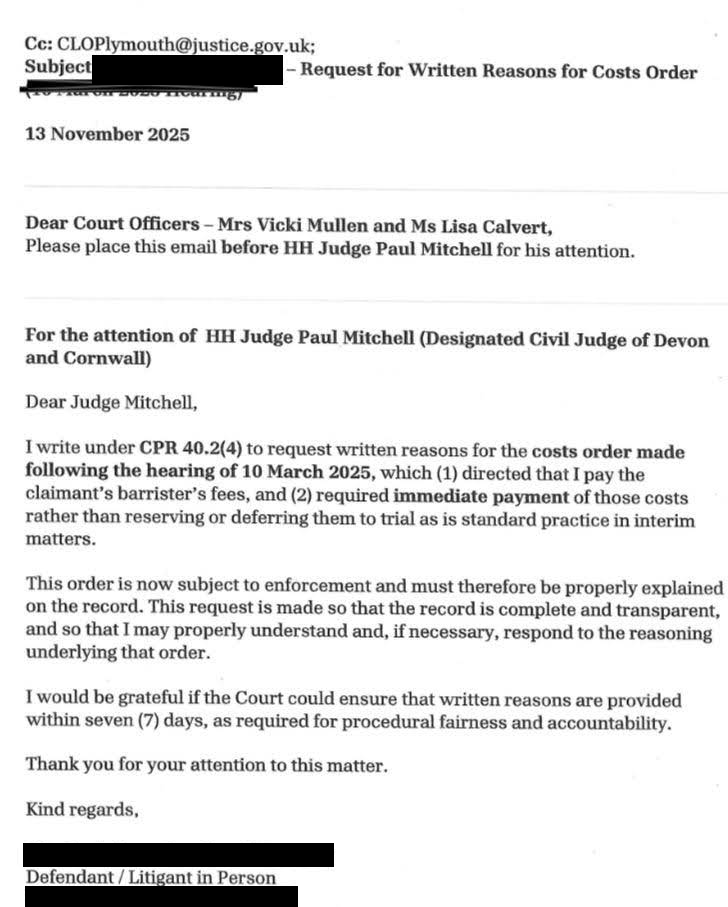
Miss E asks Paul Mitchell for written reasons
Her letter asks for reasons for the March hearing’s costs and immediate payment requirement. The original image is now available beside the later disclosure refusal.
Pre-hearing statement and sending record
Miss E seeks the original decision and full order history
Her six-page statement asks for the judicial decision, amendment and service records behind the conflicting third-party debt order copies. The December hearing follows those written objections.
Representation notice and TPDO hearing
Seldons ceases acting; Miss E challenges enforcement before Nicholas Johnson
The N434 notice records Mayo acting in person. The hearing transcript records muting, disagreement about appeal status, further costs references and bank information discussed after the final muting. The order directs payment of £115.98 and adds £135 issue costs.
Mr J’s letter to the courts
The family challenges the conduct of the hearing and absence of underlying reasons
Mr J’s eleven-page letter distinguishes a decision from the reasons supporting it and raises participation and conduct concerns. The new branch compares that complaint with the transcript and approved judgment.
Further written request
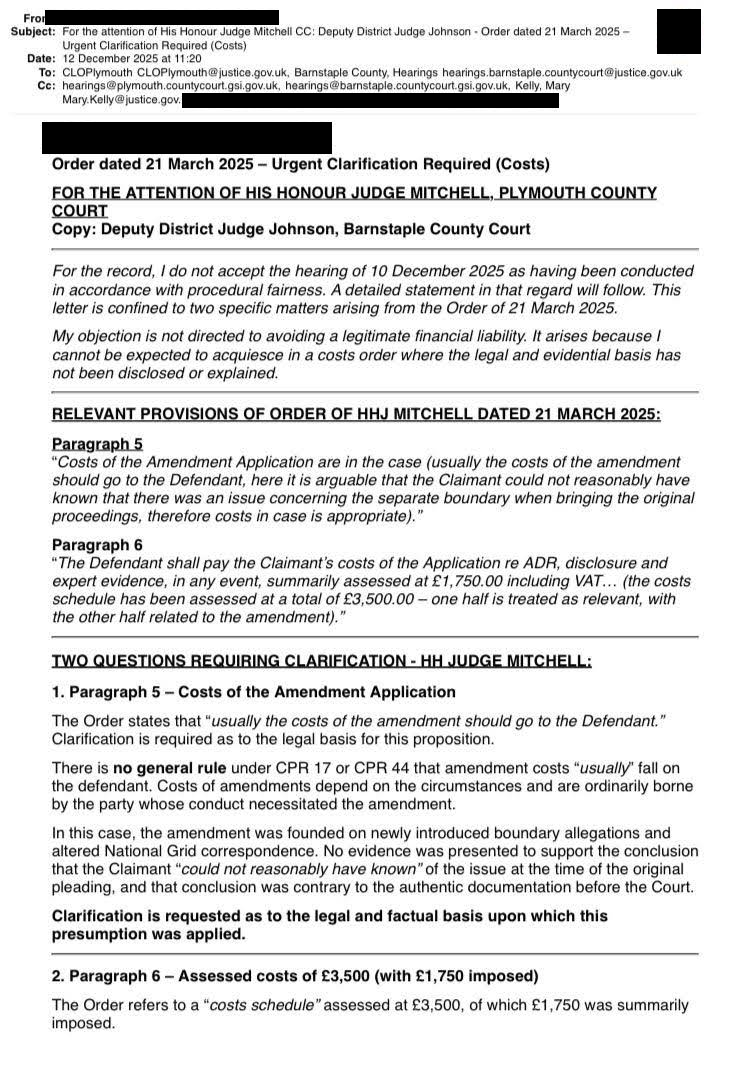
The schedule, £3,500 calculation and £1,750 payment challenged
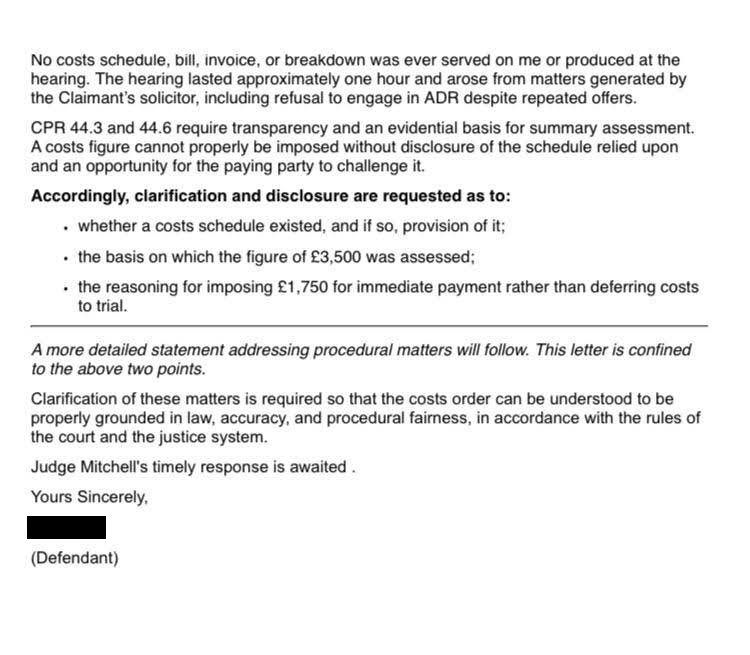
Miss E asks whether a costs schedule existed, for its provision, the basis of the assessment and reasons for immediate payment. Her request spans two images attached to the public review.
Resumption notice
Seldons resumes acting two days later
Cornwell’s covering email and N434 confirm the firm’s return. The publication asks why representation changed on the hearing date, what assistance continued and who remained responsible for the outstanding document requests.
Written objections and sending record
R4 and R5 challenge the expert evidence before the January hearing
Mr J’s dated submissions challenge the inputs, mapping, bank alterations and further expert costs. Original sent attachments include the executed National Grid documents; partial court receipt and later resends are recorded separately.
Stay email and enforcement correspondence
A stay is sent; a continuation warning and eventual hold follow
The 2 March sending record identifies the sealed stay order. Later correspondence warns that agents have been allocated and action will continue without the requested residential evidence; a subsequent reply confirms a hold. Sandbrook’s later account says the initial email was not matched to the case until 5 March. The exact receipt, allocation and processing records are sought.
Complaint reply and witness statement
Who prepared and retained the N293A?
The 6 March reply says Shergroup, speaking as an enforcement agent, was not involved in preparing or filing the form. The 8 March statement says Shergroup Legal prepared and submitted it. The separate company identities and the capacity in which each account was given require a documented explanation.
Writ hearing and correspondence
The writ defect, the N260 demand and the firm’s reply
Dagnall identifies a wrong-registry error and orders a transfer and temporary stay. Mr J requests the earlier N260 and proof of service; Seldons asserts service but declines further documents unless required.
Family visit to Barnstaple court
Ten days after the hearing, the family seeks verification of the seal
Miss E and Mr J show the disputed document to a helpful court usher. Their supplied automatic transcript records his provisional doubt about its appearance and Barnstaple origin, and his advice to seek a definitive answer from civil administration. The investigation asks for the original sealing record.
Certification requests and follow-ups
The family puts the certification and witness-account questions in writing
The reviewed correspondence includes a 12 March certification request, a 2 April follow-up and the 6 April letter to Sandbrook. The 6 April email says the 26 March request remained unanswered at that date; it does not establish uninterrupted non-response through September.
Notice and replies
The five-year CPN and the evidence questions
The notice is issued on 29 May. June correspondence identifies dashcam reliance and records the subsequent police response; Miss E challenges the assessment of her own conduct.
CPN appeal filings
Miss E sends her appeal and continuation statement
The published source record traces the protective appeal and the following day’s omitted continuation statement.
Court order
The outcome the family challenges
The reviewed order determines rights of way and boundaries in Mr Mayo’s favour and makes injunction and costs orders. Miss E and Mr J challenge the treatment of their evidence.
Filed appeal
Miss E files eight grounds challenging Walsh’s judgment
The signed N161 and Bristol High Court stamp record KA-2026-BRS-000028. Miss E alone is the appellant. Her grounds challenge the handling of evidence and procedure, property findings and costs.
Court notification
The court circulates the sealed appeal copy
The HMCTS email supplies the notice and a covering letter stating that the application will be referred for judicial consideration. The filed grounds are now distinct from the family’s later supporting accounts.
Written challenge
A statement for the court and public record
Mr J’s eight-page statement, dated 18 August and signed and emailed on 19 August, raises ten challenges to the judgment. Sent Items shows the civil appeals mailbox among the copied recipients; Barnstaple automatically acknowledged the email.
Disclosure and allocation order
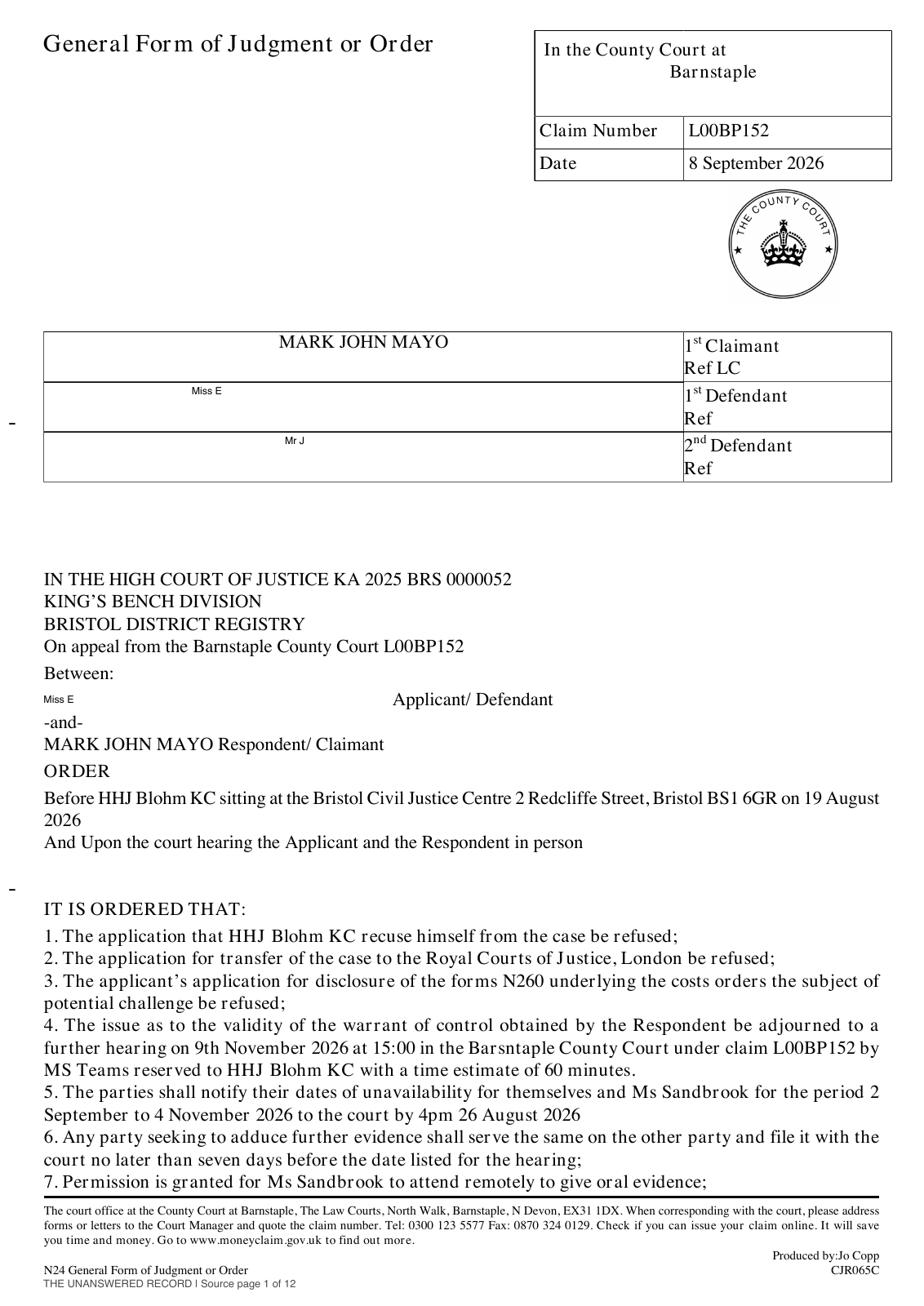
The costs-disclosure application is refused
The order refuses N260 disclosure and London transfer and reserves a further enforcement hearing to Leslie Adrian Blohm (Senior Circuit Judge and Designated Civil Judge, Bristol; appointed to the Western Circuit in October 2022). Miss E’s subsequent protective appeal challenges the reasons, procedural identity and independence of that handling.
Separate protective appeal
Five grounds challenge the Blohm order
The signed N161 and grounds seek permission, an extension, a stay and independent determination. The reviewed CE-File email records submission. This is separate from the August appeal against Walsh’s judgment.
Sent warning
Mr J warns Mayo against interfering with the sale
The cease-interference email identifies approaches to agents, discouraging purchasers and false or misleading statements undermining title, and reserves proceedings for resulting losses.
Estate-agent correspondence
The sign and prospective buyers
The agent reports that the displayed sign put the first viewers off. The family’s allegation of deliberate interference is examined in the planning chapter.
Agent feedback on earlier viewings
The agent reports first-viewer deterrence
Billy Vowles says the sign put the first viewers off. Those Saturday viewings precede the 13 September warning; the second viewers first needed to sell their own home.
Independent scrutiny requested
The appeal continues; Bristol’s handling is challenged
Miss E identifies both appeal references and renews her request for independent determination. Her 14 and 18 September correspondence links that demand to the earlier N260 disclosure refusal, transfer decision and changing procedural references.
CPN bundle correspondence
The complete appeal bundle is resent
Miss E resends the 103-page bundle and asks that the complete file reach the legal adviser.
Agent withdrawal letter
Marketing temporarily withdrawn with the family’s agreement
The agent cites Mayo’s objections and displayed notices, records buyers being put off, and says continued marketing would not be in the sellers’ interests.
Complaint to Mayo and Torridge
Miss E asks for the authority behind the display
Her letter demands the actual planning position and the source, status and authorisation of displayed material, and reserves claims for resulting harm.
Miss E and Mr J · Their wider allegation
The conviction behind their continuing challenge.
Miss E and Mr J say they firmly believe that a criminal syndicate, rooted in a local hunting syndicate, has infiltrated parts of the judiciary in Devon and Cornwall and includes individuals within the police and council.
The Unanswered Record is documenting the events, records and unanswered questions on which they base that belief, and examining each claimed connection.
The case concerns the family’s home and neighbouring land in the Torrington area. The linked articles follow the relevant court proceedings, company records, professional responses and public-body decisions.
Separate regulatory questions · proposed, not submitted
Does this record warrant an SRA investigation?
Three solicitor-conduct concerns and a separate review of the regulator’s handling. Read the submission, acknowledged receipt, closure and questions for Laurence Price (SRA Investigation Officer who signed the 30 October 2025 decision) and the SRA.
A sign at the property. Questions in the planning file.
The family alleges unequal treatment and suspects planning concerns are being used to obstruct its sale. The new article examines the recorded permissions, disputed concrete works, heritage objections and the unverified origin of the smaller displayed sheet.
This concerns the same family and neighbouring properties; a coordinated connection to the separate BH68 or court-costs issues has not been established.
New overview · Historical allegations and later outcomes
Annex E connects the strands.
The February 2026 annex provides a map of the family’s allegations. The overview now records Seldons’ October receipt and reservation, Cornwell’s earlier denial, the SRA’s decision not to investigate and the adverse July 2026 trial order. The family challenges that outcome; the approved reasons and subsequent appeal position are a separate verification task.
Follow each concern to the person or institution asked to answer it, the source material and the recorded response.
People & organisations
Who is asked to answer?
Every recipient in the current questions register is included below. Their linked records identify their roles and the questions addressed to them.
View all 59 recipients
The public starting point · Barnstaple County Court
A public review. Questions still demanding answers.
Before this website, Miss E put her concerns before the public herself. A pensioner defending a neighbour dispute, she described why she believed the court process had failed her—and published images of her requests for answers.
It takes courage to question an institution. We stand beside her by following the documents and keeping the questions in view.
External source: Google Maps. The review identifies its author by her own name. Full review and all three attached images re-examined on 23 September 2026.
Reported reach: Mr J says Miss E told him Google had notified her that the review had been viewed more than 1,000 times.
Paul Mitchell · Leslie Adrian Blohm · The costs record
She asked how the costs were calculated. Later, disclosure was refused.
Miss E’s public review contains two written requests to Paul Mitchell about the March 2025 costs order. The later order before Leslie Adrian Blohm expressly refuses disclosure of the N260 forms underlying the costs orders under potential challenge. Read the requests and the refusal together.
Miss E and Mr J allege deliberate suppression of the underlying costs evidence. They allege that Paul Mitchell’s assessment imposed an illegitimate financial burden and that Leslie Adrian Blohm’s later disclosure refusal shields that assessment from scrutiny. Mr J alleges knowing judicial wrongdoing and asks that possible collusion and criminal conduct be investigated. Their challenge is specific: identify the original costs statement, its filing and service record, the calculation and the reasons for refusing access.
An order to pay. Repeated requests for the calculation. Then an order refusing disclosure. Where is the record that answers her?
Her public review · The actual correspondence
Two written requests. Three published images.
The letters that accompanied Miss E’s review are available here. Select any image to enlarge it.
13 November 2025
Written reasons requested
Miss E asks Paul Mitchell for written reasons for the costs following the 10 March hearing and the decision to require immediate payment.
12 December 2025 · First page
The £3,500 / £1,750 calculation challenged
The request quotes paragraphs 5–6 of the order dated 21 March 2025, challenges the amendment-costs reasoning and identifies the assessed sum.
12 December 2025 · Continuation
Show the schedule. Explain the figure.
Miss E says no schedule, bill, invoice or breakdown was served on her or produced at the hearing. She asks whether the schedule existed, for its provision, the calculation and the reason for immediate payment.
Source: the three images attached to her Barnstaple County Court review, re-examined 23 September 2026. The December letter reproduces passages of the March order.
19 August hearing · 8 September 2026 N24
The later refusal is in the written order.
“The applicant’s application for disclosure of the forms N260 underlying the costs orders the subject of potential challenge be refused;”
Paragraph 3 · Order recording the hearing before Leslie Adrian Blohm
Paul Mitchell: what signed statement, calculation and submissions supported the £3,500 assessment and Miss E’s £1,750 liability? What substantive answer addresses her November and December letters?
Leslie Adrian Blohm: which costs orders and forms did this refusal cover? What legal basis and recorded reasons justified refusing disclosure, and how was Miss E expected to test the calculation and claimed service?
Mark John Mayo, Luke Cornwell and Seldons LLP: produce the original costs statement and the email with attachment said to have been sent on 17 March 2025. What was filed and served for the later paper assessment, following the 17 March deadline?
Miss E’s Ground 4 challenges the refusal. Her account of the claimed 17 March transmission is set out in her appeal material. The question remains the original March assessment record—not the separate costs schedules prepared for later hearings.
Later correspondence · Reporting updated 15 September 2026
More than a year of requests. Where is the costs record?
Miss E and Mr J challenge the legitimacy and proportionality of the costs decision. They report that neither Paul Mitchell, Barnstaple County Court nor claimant Mark John Mayo has supplied them with the N260 or equivalent itemised costs statement supporting the assessment, despite repeated requests.
They describe the 10 March 2025 hearing as approximately one hour and question the amount in the context of the hedge dispute. The questions below seek the work, fees and reasoning behind the figures—not just the time spent in the hearing.
29 April 2026 · The signed final notice
The Unanswered Record has examined Mr J’s signed, two-page Final Notice – Outstanding N260 and Reasons for Costs Order, addressed to Paul Mitchell. It states that no N260 has been produced and that it does not appear on the court file. It asks for the statement, confirmation of filing and service, and a full explanation of the costs decision within seven days.
This is later correspondence supplied to the publication, separate from the three images attached to the original review. The seven-day period was requested by the letter’s author. The original signed PDF is retained off-site.
Paul Mitchell · Barnstaple County Court · Mark John Mayo
The allegation · Contributor account
The family’s allegation: an unjustified order used as pressure.
Miss E and Mr J allege that the costs order was fictitious and illegitimate, intended to exert coercive pressure rather than reflect a justified assessment. They point to the continued non-production of the underlying costs statement, calculation and adequate reasons as the basis for that allegation.
Mr J says Miss E presented her signed BH68 wayleave agreement at the hearing, while Mr Mayo relied on the disputed email attributed to Amelia Skea (National Grid Wayleave Services; Bodmin, Cornwall, in the attributed April 2024 email signature). He questions why costs were imposed against Miss E in those circumstances and what the court recorded about the competing material.
Mr J says requests for the basis of the amount have been put to Paul Mitchell, Jack Christopher Kelsey Webb (professionally Jack Webb; barrister, 3PB, Bristol; called to the Bar in 2016), Luke Oliver Keith Cornwell (SRA 664668; solicitor and partner, Seldons LLP, Bideford, Devon) and Mark John Mayo. The question is specific: identify the costs statement, the work and figures claimed, the filing and service record, and the reasons for the amount ordered. If those records cannot be produced, explain why.
10 March hearing. 17 March claimed service.
The supplied rough transcript of the 10 March 2026 hearing records Mayo saying his solicitors sent the N260 and offering to arrange resending. Miss E disputes receipt; she and Mr J allege a false service account and seek the original message and attachment. Whether the exchange was under oath or affirmation is not established by this transcript.
The 10 March 2025 order allowed written costs submissions by 4pm on 17 March, with the award following on 21 March. Seldons’ asserted 15:37 sending time on 17 March could meet that deadline. Produce the actual schedule, recipients, original message and attachment: the unresolved issue is what was filed and served, not merely that service was said to follow the hearing.
For summary assessment of costs, Practice Direction 44, paragraph 9.5, requires an itemised, signed statement broadly following N260; for hearings other than fast-track trials, filing and service are required at least 24 hours before the hearing. Paragraph 9.6 addresses non-compliance in the court’s costs decision. The question is what was supplied, when, and how any failure was addressed. Practice Direction 44, paragraphs 9.5–9.6 ↗
What justified the amount, and what consideration was given to Miss E’s evidence and objections? The hearing record and the costs record are both needed to examine the family’s challenge.
Miss E and Mr J’s allegation and Mr J’s hearing account, supplied 15 September 2026.
What N260 or equivalent signed costs statement was before you when costs were assessed following the 10 March 2025 hearing? Identify the document, its date and where it is held, and provide the available copy through the court. If no such statement was available, what other material supported the assessment and why did the court proceed on that basis?
Why it matters: A financial order must be capable of explanation by reference to the material and reasoning used. Identify the costs evidence and reasoning on which the assessment was based.
Identify when and how the costs statement was filed with the court and served on Miss E. Produce the filing and service record. If it was not filed or served within the applicable time, how was that addressed, and what opportunity was Miss E given to examine and challenge the costs sought? The supplied rough 10 March 2026 hearing transcript records Mayo attributing N260 service to his solicitors and offering to arrange resending. Miss E disputes receipt. What original message and attachment establish service, and which costs material supported the 21 March 2025 assessment after the 17 March written-submissions deadline?
Why it matters: The person facing a financial demand needs to know its basis and have a meaningful opportunity to challenge it. Filing with the court and serving the other party are separate matters.
The published correspondence challenges an assessment of £3,500 and a £1,750 payment requirement. What work, hours, rates, fees and adjustments produced those figures? Identify the recorded reasoning, the operative order and the payment deadline. Explain the basis for the payment timing that Miss E describes as immediate.
Why it matters: The amount assessed, the amount payable and the time for payment each require a clear explanation. Which items of work beyond attendance at the hearing, if any, were claimed and allowed, and where are they recorded?
Where are the reasons explaining the costs assessment and payment requirement recorded? Identify any judgment, order, hearing recording, transcript or contemporaneous note that contains them, and explain how Miss E can obtain the relevant record. What costs submissions were considered, and what objections by Miss E were addressed?
Why it matters: A party cannot meaningfully understand or challenge a decision if its reasoning cannot be located. Which order, written reasons or transcript passage explains the decision?
What substantive response addresses the requests repeated in the 29 April 2026 final notice? Identify the date, recipient and supporting records for any response already given. If the requested documents or reasons have not been provided, explain what remains outstanding, who is responsible for responding and how the request will be resolved.
Why it matters: Repeated requests for the basis of a financial order should lead to a traceable outcome. The continuing reported gap matters because it leaves the affected party unable to check the decision against its supporting record.
Response position: Miss E and Mr J say these requests remain unanswered. Mr J reaffirmed that position on 13 September 2026. This concerns their ability to understand and challenge a financial order—not merely a missing form.
The costs reporting now connects these 2025 letters, Mr J’s April 2026 final notice, Blohm’s disclosure refusal and Miss E’s protective appeal. Further documents will be placed in this sequence as they are examined.
More than two years. Questions still requiring answers.
Miss E and Mr J say their dispute has continued for more than two years. They report repeatedly raising serious questions, including allegations of fraud, misleading evidence and wrongdoing involving individuals, companies and legal representatives. Their wider allegations also concern court officials and people holding public office.
Duration and wider allegations: Miss E and Mr J’s account, recorded 12 September 2026.
If substantiated, those allegations would matter beyond one dispute. The public interest is in exposing failures, correcting the record and protecting others—not preserving an institution’s reputation at the expense of the truth.
The cost of pursuing a legal case can put further challenges beyond a family’s reach. That is why a serious, document-based concern deserves a public hearing without requiring readers to accept it on trust.
No office places its holder beyond legitimate scrutiny. Public confidence is strengthened by examining serious concerns—not by leaving them unanswered.
One case. A developing public record.
The Unanswered Record is assembling the case across 12 connected strands. As further material is examined, it will be placed in the event chronology and linked to the concern it addresses.
Further reporting will be released in stages as the relevant material is reviewed. Articles and updates will connect to the case, the parties’ questions and the supporting record. Video, interviews and other media are planned alongside the written reporting; they will link back to the same evidence and response record.
Each report will identify what is alleged, what its sources establish, what the relevant parties say and exactly which questions remain. Material answers and corrections will be made visible beside the points they address.
The expanding document index connects agreements, plans, correspondence, notices and court submissions to the reporting. Article links take you to the specific source passage or published image.
Stay with the story
Follow the investigation as the record develops.
Follow what changes when another document, account or answer enters the record.
Follow Daux Scythe, our presenter, on LinkedIn for new reporting, evidence reviews and significant developments. The website remains the home of the articles, documents and response record.
Laurence Price, the Investigation Officer who signed the October 2025 decision, is now listed separately with seven questions about the receipt, assessment and closure.
The 294 questions already published across the investigation can now be searched together or followed by recipient. The original source notes and responses remain linked to each question.
Forestry and the right of way: the photographic record.
The family’s allegations of unlawful felling and misleading access evidence, with four dated aerial images, machinery photographs and the 2024 email sequence.
Miss E challenges the costs-disclosure refusal and the handling of her challenge. Read her five grounds, the dated costs trail and the full formal response, then follow ten direct questions to the judges, solicitors, claimant and court records.
The Mayo–Ithildîn emails, the police–Council meeting and Miss E’s challenge to the evidence used against her. Follow twelve questions to the named officers, Council, claimant, solicitors and court-file administration.
A frozen account. A writ. A costs schedule still sought.
Follow the claimed N260 service, Mr J’s post-hearing demands, Seldons’ refusal to provide further documents unless required, the changed TPDO copies and the writ’s wrong-registry finding.
10 March hearing → 17 March refusal → disclosure appeal
The N260 was said to be available. Where is it?
The rough hearing transcript records Mayo offering to arrange resending through his solicitors, while Sandbrook participated in the hearing where non-receipt was challenged. Seldons’ later letter declined to reproduce it. Follow the offer, the refusal and the questions about what each person checked.
The recovered certificate. The registry contradiction.
See the N293A and its seal, compare Sandbrook’s account with Dagnall’s order, and examine the different interest-start wording. Fourteen direct questions address the submission, certification and disclosure record.
The 6 and 7 May 2026 letters before action and their evidence are now available as indexed downloads, checked against the original sent attachments. The source hub also records Geldards’ denial and Skea’s September representation letter, distinguishing those replies from the authentication and contractual-record questions.
Connected scrutiny / Paul Mitchell and the expert process
What protected a fair examination of the boundary?
The 23 May direction, Venn’s interpretation and the missing-agreement issue sit beside the separate N260 dispute. Mr J alleges deliberate bias and collusion; the questions identify the records needed to test that allegation.
The survey limits were challenged before judgment.
The original report’s visual assessment, the later request for access and Mr J’s email to the court belong in one sequence. What established the disputed line, and where were the missing agreements and survey limitations addressed?
The £120,000 field purchase: who issued the statements?
Compare the letterheaded invoice with both completion statements. Follow the 12 March–5 April payment sequence, the source-email question and the records needed to authenticate the transaction.
21 recordings, in camera-date order: the entrance checks, the rubbish sequence, the night-time activity and the tractor passage—alongside Miss E’s account of the impact.
The verified correspondence links Jack Christopher Kelsey Webb to the June 2025 warning and the trial-eve safeguarding submissions. Read the automatic reply, the family’s allegation, and the distinct questions for Webb, Cornwell, Seldons, 3PB, the BSB and the SRA.
April 2025: Miss E’s injury report, the solicitor’s letters and the court’s response. Follow the five named questions and the records needed to answer them.
A pensioner in tears. Noise recorded inside her home. Read the direct challenge to Timothy Edmund Walsh’s findings in the supplied transcript, Torridge’s response and the fourteen demands for answers.
12 main strands bring together 21 investigative reports. The original costs hearing remains a section of the case file. These routes explain the shared documents, events and proceedings; the linked articles identify the allegations, evidence and replies.
From proposed small claims to alleged deliberate hardship
Start with the proposed track, affordability warnings and actual directions. Follow the financial demands, disputed costs foundation and later scrutiny request, identifying what each decision added to the burden.
Compare the original-sale account, driver’s recollection and 2026 withdrawal, then follow the warning, official-authority questions and loss evidence. The claims route explains section 32A discretion for older claims and prompt protection of recent claims.
Alleged financial coercion: the demands, accusations and harm
Miss E plans a claim against Mayo concerning alleged extortion and wrongful accusations. Start with the June letter; follow the financial basis, disputed accusations, responses and consequences. No new claim is described as filed.
Before the purchase: disclosure and the history of the home
Start with the sellers’ answers and response, then examine the driver’s recollection, noise history and dated photographs. Keep later evidence distinct from proof of what the sellers knew at the time.
Different events affect the same home. Follow the route, recorded conduct, noise and planning decisions without confusing their dates or decision-makers.
Start with the 1987 fencing promise, the sale representations and alleged avoidable dispute. Compare the utility records, expert inputs and field-transfer evidence, then follow the objections, responses and claimed consequences.