
Named in this strand





See 2 more named people and organisations


One case · Connected questions
One hearing. Two demands for the record.
Mr J reports that at the hearing on 10 March 2025, Mr Mayo relied on the email attributed to Amelia Skea (National Grid Wayleave Services; Bodmin, Cornwall, in the attributed April 2024 email signature) to support his claimed BH68 wayleave, and costs were pursued against Miss E. The reviewed 10 March order deferred costs for written submissions by 17 March; the £1,750 award followed on 21 March.
Miss E and Mr J say the underlying costs statement and calculation remain missing from the material disclosed to her despite repeated requests. They allege deliberate withholding because, in their view, no supporting record can justify the amount imposed.
That is why the missing record matters: without the calculation and reasons, Miss E cannot properly examine or challenge how the amount imposed on her was reached.
What did the email establish? What documents and reasons supported the costs? This investigation follows both questions.
Read the costs reporting → · Questions for Paul Mitchell (Designated Civil Judge for Cornwall, Devon and Dorset; Exeter Combined Court Centre) →
The family’s costs allegation and account of the hearing
The allegation · Contributor account
The family’s allegation: an unjustified order used as pressure.
Miss E and Mr J allege that the costs order was fictitious and illegitimate, intended to exert coercive pressure rather than reflect a justified assessment. They point to the continued non-production of the underlying costs statement, calculation and adequate reasons as the basis for that allegation.
Mr J says Miss E presented her signed BH68 wayleave agreement at the hearing, while Mr Mayo relied on the disputed email attributed to Amelia Skea. He questions why costs were imposed against Miss E in those circumstances and what the court recorded about the competing material.
Mr J says requests for the basis of the amount have been put to Paul Mitchell, Jack Christopher Kelsey Webb (professionally Jack Webb; barrister, 3PB, Bristol; called to the Bar in 2016), Luke Cornwell and Mark John Mayo. The question is specific: identify the costs statement, the work and figures claimed, the filing and service record, and the reasons for the amount ordered. If those records cannot be produced, explain why.
10 March hearing. 17 March claimed service.
The supplied rough transcript of the 10 March 2026 hearing records Mayo saying his solicitors sent the N260 and offering to arrange resending. Miss E disputes receipt; she and Mr J allege a false service account and seek the original message and attachment. Whether the exchange was under oath or affirmation is not established by this transcript.
The 10 March 2025 order allowed written costs submissions by 4pm on 17 March, with the award following on 21 March. Seldons’ asserted 15:37 sending time on 17 March could meet that deadline. Produce the actual schedule, recipients, original message and attachment: the unresolved issue is what was filed and served, not merely that service was said to follow the hearing.
For summary assessment of costs, Practice Direction 44, paragraph 9.5, requires an itemised, signed statement broadly following N260; for hearings other than fast-track trials, filing and service are required at least 24 hours before the hearing. Paragraph 9.6 addresses non-compliance in the court’s costs decision. The question is what was supplied, when, and how any failure was addressed. Practice Direction 44, paragraphs 9.5–9.6 ↗
What justified the amount, and what consideration was given to Miss E’s evidence and objections? The hearing record and the costs record are both needed to examine the family’s challenge.
BH68 / Read the letters and the evidence
What was put to Shackson and Skea?
The 6 and 7 May 2026 letters before action and their evidence are now available as indexed downloads, checked against the original sent attachments. The source hub also records Geldards’ denial and Skea’s September representation letter, distinguishing those replies from the authentication and contractual-record questions.
Download the letters, examine the evidence and follow the replies →
The unanswered authentication request · Updated 25 September 2026
An email to authenticate.
Why is the answer still missing?
26 February 2025: Miss E asked National Grid whether the emails attributed to Mr Mayo and Amelia Skea were genuine, whether the reply answered the displayed request, and what its records showed about BH67 and BH68. By 25 September 2026, 576 days had passed. Mr J reports that the family still has no substantive authentication answer. [G, pp. 3–5]
- 7–10 March 2025 — chased and referred. The 7 March follow-up explicitly copied Amelia Skea. On 10 March, Angela Caddy (National Grid Records Assistant in the March 2025 referral correspondence) said the enquiry had been referred to Estates Specialist Nigel Merrifield (National Grid Estates Specialist named in the March 2025 referral correspondence). The reply identifies a referral, but supplies no authentication result. [G, pp. 1–2]
- 24–26 April 2026 — “were dealt with”. Howard Mark Hacking (professionally Mark Hacking; solicitor and partner, Geldards LLP, Nottingham; individual SRA 156301) of Geldards LLP, acting for National Grid Electricity Distribution (South West) plc, said he was instructed that previous requests had been dealt with. Mr J disputed that account. Which dated answer dealt with these four verification questions? [J, pp. 2–3]
- 7 May 2026 — a formal notice and a solicitor’s acknowledgement. The letter before action addressed to Ms Skea asked what she had written, which agreement and records supported it, what checks occurred, who authorised the position and why the earlier questions remained unanswered. Hacking acknowledged the forwarded letter and documents and directed further correspondence through him. His separate promise of a substantive response concerned the Shackson correspondence. [H, pp. 1–4] [I, p. 1] [J, p. 1]
- 8 September 2026 — a denial, not an authentication result. Mark Hacking denied that the earlier correspondence gave rise to a valid claim, stated his position on company responsibility and directed contact through Geldards. His reviewed email did not authenticate the disputed exchange or identify the BH68 instrument.
- 9–10 September — representation and service confirmed. Skea’s signed letter dated 9 September, sent by Geldards on 10 September, confirmed her instructions to Hacking, authorised acceptance of service and requested no further direct contact. These were replies to the September service request; they did not answer the earlier factual verification questions.
- 25 September 2026 — 141 days after the letter before action. The original sent attachments and the September responses have now been checked. The later replies reviewed supply neither an authentication finding nor the particular instrument supporting the asserted BH68 rights. Read the sent packs and dated response record →
Did you receive this request? Did you send this reply? Which agreement did “your wayleave” mean?
Why the delay matters: Miss E has a signed agreement with the same operator concerning BH68. The family says the disputed exchange was used to undermine her position in the boundary litigation. Leaving its authenticity unresolved leaves a contracting pensioner unable to check the apparent company confirmation relied upon against her.
A denial of liability does not authenticate an email.
Miss E and Mr J do not regard the continuing absence of a factual answer as an innocent omission. They suspect that the unanswered questions conceal a problem with the correspondence or the rights asserted through it. Their demand is a records-based answer: did Skea send the reproduced words, is the copy complete and unaltered, and which agreement supports each statement about BH67 and BH68?
Amelia Skea and National Grid: produce the retained exchange and the record check. If the copy is accurate, confirm it against the original. If it is not, identify the differences. If you cannot verify it, explain precisely why and what checks remain. Mark Hacking and Geldards: now that correspondence is directed through you, who is responsible for obtaining those factual answers, what has been checked and when will the outcome be supplied?
The question for National Grid’s leadership is not why a solicitor was instructed. It is why the company has not supplied a checkable answer to these particular questions in the responses reviewed. Referral and representation must not displace the underlying record. Read the authentication question. Read the question for Geldards. Read the questions for Zoë Yujnovich (Chief Executive, National Grid plc, since November 2025; group executive office in London).
One pole. Two representations. One connected allegation. · Updated 25 September 2026
The email suggests the right.
The map suggests the land.
Where is the supporting record?
Miss E and Mr J allege that the email attributed to Amelia Skea supplied apparent contractual support, while Nick Shackson’s email and map supplied apparent geographical support for the same disputed BH68 entitlement. Their allegation is that National Grid staff helped Mr Mayo create a false appearance of rights to undermine the agreement and pole location Miss E relied upon as boundary evidence. They allege fabrication or misleading presentation, not merely poor communication. Compare the attributed email [F] · Compare the plan and title wording [C]
The boundary connection is the point. The family identifies BH68 beside the stock fence at the top of the bank and says its predecessor wayleave history was never disputed by earlier field owners. They say challenging her BH68 position was a means of discrediting that fence-line evidence. Miss E’s executed agreement expressly links to plan 83920/SI; the rival representations must be reconciled with that record. See her agreement plan and the boundary explanation →
Shackson’s documented explanation changed from “apparatus on your title” to “not any particular title”. The reviewed Skea/Geldards replies do not authenticate the disputed exchange, whose reproduced header shows Cornwell forwarding it to himself. Were the two representations supported by identifiable company records—or used to create an appearance of rights those records could not substantiate? Read the combined challenge beside the evidence comparison →
- The agreement: which executed agreement or other instrument supports the claimed BH68 rights for Mr Mayo, and how does it relate to Miss E’s signed agreement? Compare the agreement records.
- The plan and its court use: why was it introduced at that stage, what was it said to establish, and where is the agreement justifying that use? Read the question for Luke Cornwell.
- The originals: can Amelia Skea and National Grid authenticate the attributed exchange by producing the retained messages, headers and attachments? Why do the supplied replies contain no authentication answer? Examine the disputed copy.
- The changes: what did Luke Cornwell change, if anything, where was it disclosed, and when was the explanation given? The October 2025 submissions already alleged editing and challenged the redaction explanation. Read the submission’s exact words.
- The follow-through: where is the substantive response promised by Mark Hacking about the Shackson correspondence, and which answer supplies the requested records? Read the follow-up question.
National Grid: answer both representations together. Identify the agreement or other instrument supporting each claimed right, the land and apparatus it covers, and the basis of any asserted transfer. Reconcile it with Miss E’s agreement and plan. Identify who knew about her documents, who checked the competing position, who authorised each representation and who received any correction. The linked questions ask Zoë Yujnovich to secure that records-based review.
If the records support the position advanced, identify them. If our account is wrong, correct it with the documents. If a record cannot be supplied, explain why. The purpose is an answer readers can examine—not another assertion they must take on trust.
The companies must address their own part
What does the company stand behind?
National Grid Electricity Distribution (South West) plc: Miss E and Mr J direct their allegation about the supply and description of the plan to the company as well as Mr Shackson. Separately, they challenge how the company handled Miss E’s requests to authenticate the emails and identify the relevant agreement. A new executive-review question asks who took responsibility, what was checked, where the outcome is recorded and when any unresolved points will be answered. Read National Grid’s full question pack.
Seldons LLP: Mr J alleges deliberate misrepresentation in the handling of the disputed email copy and directs his allegation of fraud to Luke Cornwell and the firm. The newly reviewed 27 October 2025 email expressly addressed the solicitor personally and the firm corporately, and demanded preservation of originals and metadata. The firm-level allegation is therefore documented in that earlier notice, not just in his present account. What did Seldons preserve, check and answer after that notice? [N, pp. 1–2] Read Seldons’ full question pack.
Each pack brings the allegations, exact questions, source notes, recorded replies and response instructions together. The new executive and firm-review questions have not been sent by this publication; they are not recorded as overdue.
The pole. The stock fence. The disputed bank.
Why BH68 mattered
to the boundary claim.
Miss E and Mr J allege that the competing BH68 claim was used to undermine the documentary history supporting their boundary at the stock fence. Their allegation goes further: they say moving the fence down the bank would obstruct their view of forestry activity they had reported, and that this was the real purpose behind pursuing the disputed strip.
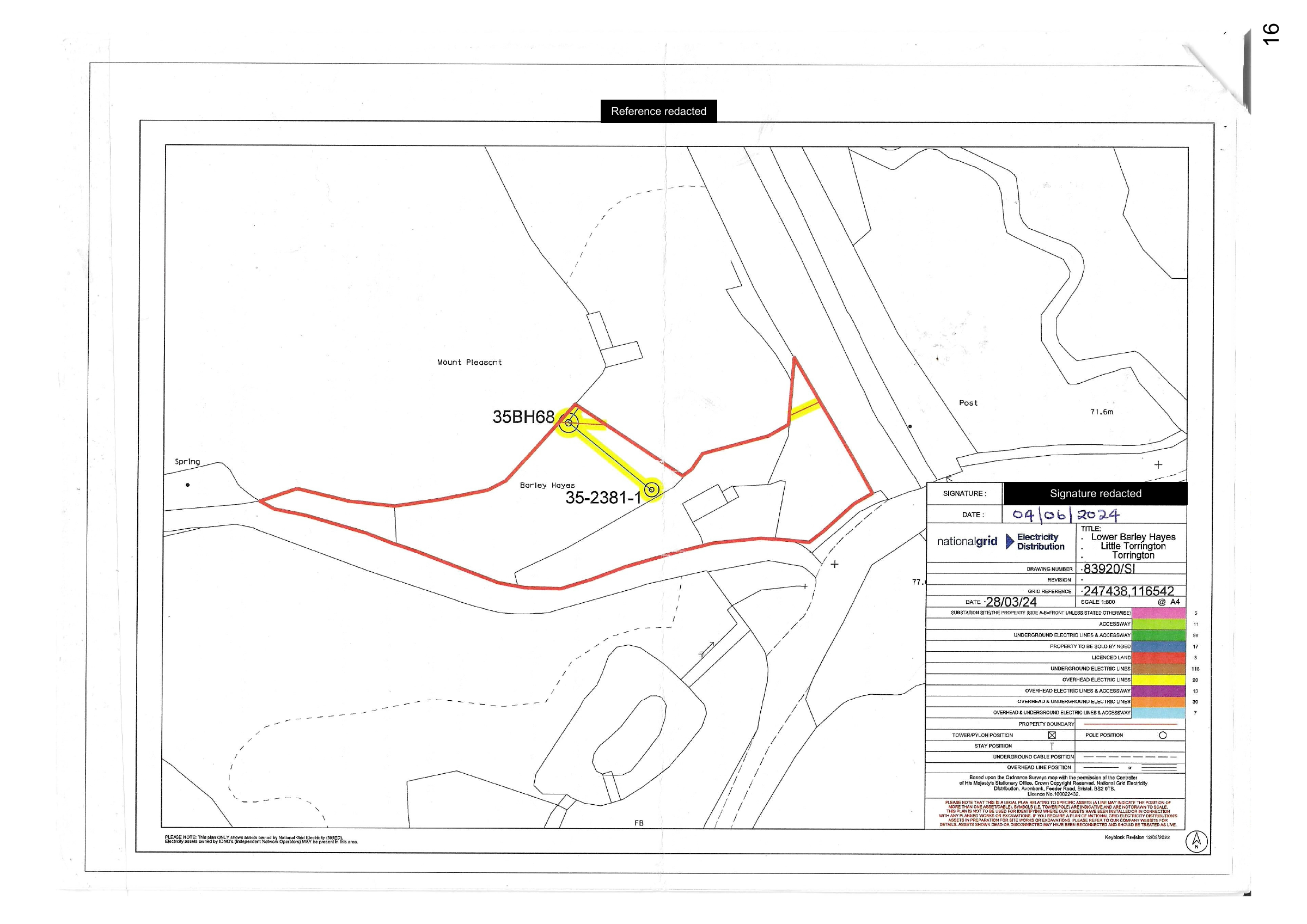
A longstanding arrangement—then a competing claim.
The family says BH68 stood on the Lower Barley Hayes side of the stock fence at the top of the bank for decades, covered by the Jenkins predecessors’ wayleave, without any dispute from the previous owners of the field. They say the competing claim arose only after Mr Mayo acquired the field. PCC’s January 2024 letter independently records earlier dealings with the property’s previous owners; the reviewed agreement and payment record document Miss E’s subsequent arrangement.
The plan places BH68 beside the red edge; the family identifies that location on the ground as the stock fence. This is why the pole was material: challenging Miss E’s rights also challenged a piece of evidence she relied upon for the fence-line boundary. The question is how the rival boundary case was reconciled with this signed plan, the physical position of the pole and the predecessor history.
The alleged motive: changing the line of sight.
Mr J says the field-boundary challenge came after the family reported suspected unlicensed commercial felling, Forestry Commission involvement and earlier access proceedings before Offen. He says equipment and operations were visible from the top of the bank, and alleges that moving the fence below it—or restricting access to that vantage point—was intended to prevent observation. The family regards the strip’s value as disproportionate to the expense of the litigation and questions what other purpose the claim served. Read the dated forestry correspondence →
The timing needs an answer in dates and documents: when was each boundary position first asserted, what change was sought, and what contemporaneous reason was given? That sequence is central to the family’s allegation of a link between the forestry complaint and the later boundary dispute.
£2,000 and £25: identify the equipment behind each figure.
- Miss E’s executed agreement
- £2,000 one-off payment; 14-year term. The schedule describes an 11 kV and LV line, four conductors and earthwires, two pole legs, stays, guards and supporting equipment. The plan marks both 35BH68 and 35-2381-1.
- The reply attributed to Amelia Skea
- £25 annually in advance. It follows Mr Mayo’s displayed request naming BH67 and BH68. The exact exchange and its underlying agreement remain the subject of the family’s authentication challenge.
Mr J suspects that the smaller payment concerned different apparatus, such as a stay, rather than the BH68 rights being advanced. National Grid holds the records needed to resolve that question: identify the assets, agreement, payment category, payee capacity and period behind each sum. Follow the claimed transfer and payment evidence →
Three direct questions.
- Mr Mayo, Luke Cornwell — Seldons LLP and Seldons: which title document, survey or other evidence supports the boundary position you advanced? Show where it deals with BH68, the stock fence, the bank and Miss E’s signed plan. Identify any recorded competing claim by the field’s previous owners.
- Mr Mayo and his representatives: give the first dated assertion of the disputed boundary and each later amendment. What reason was recorded for seeking that line, and how do you answer the family’s allegation that the change was intended to obstruct observation of the forestry activity?
- National Grid Electricity Distribution (South West) plc: what land and apparatus records supported this plan and agreement? Reconcile the predecessor history, the rights claimed by Mr Mayo and both payment records. What agreement supports the £25 payment, and does it cover BH68, BH67, a stay or other equipment?
Why this matters: the dispute concerns which land, equipment and rights the documents actually describe—and whether evidence supporting Miss E’s boundary position was properly confronted. A payment figure or a disputed email cannot answer that without the underlying record.
Compare the documentary foundations
Miss E has a signed agreement.
Where is the competing BH68 chain?
Miss E’s position rests on an executed contract, an identified plan, dated third-party correspondence and a documented payment arrangement—not simply an assertion that she has a wayleave. The family says the authenticity of her agreement has never been challenged. Their question is why a competing BH68 claim was advanced without explaining how its underlying rights fit with that record.
Miss E: the records we have examined
Contract and plan. The agreement dated 4 June 2024 names National Grid Electricity Distribution (South West) plc, specifies a 14-year term, schedules the apparatus and includes a signed plan identifying BH68. See the plan. [A, pp. 4–6]
History and third-party involvement. Property Compensation Consultants’ 10 January 2024 letter records its earlier dealings with the property’s previous owners and recommends a new agreement. The family identifies those predecessors as the Jenkins family and describes decades of an undisputed BH68 arrangement.
Payment trail. The contract specifies a £2,000 one-off payment. PCC’s 1 July 2024 letter states that it enclosed the £2,000 cheque. The agreement covers the scheduled equipment and term; the payment is not itemised solely against BH68. Read the dated contract, history and payment sources.
Mr Mayo: the claim and the unresolved links
Contract and plan. The produced material includes historic 1963 and 1975 agreements, payment records and a later plan. The field’s conveyancing copies were supplied on 17 October 2025; the historic agreement PDFs followed on 6 November. Which exact pages and provisions connect those records to Mr Mayo’s asserted BH68 rights? Follow the disclosure and transfer claim.
Authentication and history. The disputed April exchange names BH67/BH68 in the request and “your wayleave” in the reply; its outer header is Cornwell to Cornwell. Shackson later confirmed payment records and asserted a transfer. The family still seeks authentication of the exact exchange and the land-and-apparatus chain behind it. Read the email pages.
Payment trail. The attributed reply states £25 annually, without a per-pole breakdown. National Grid is asked to identify the assets, agreement, payee capacity and calculation—and reconcile these with Miss E’s documented arrangement. Read the financial challenge.
The integrity question is direct: Miss E can point to her named contract, signed plan and supporting correspondence. National Grid, Mr Mayo, Luke Cornwell and Seldons: point to the documents that establish the competing BH68 entitlement, authenticate the disputed exchange and explain how both claimed arrangements fit together. Produce the agreement and explain its scope.
Why this matters: Miss E and Mr J allege that the competing claim was used to undermine evidence supporting their stock-fence boundary. Their documented arrangement must be confronted on its substance: which right is disputed, on what evidence, and where was that evidence reconciled with her agreement?
The disputed wording · Images published 19 September 2026
“Your wayleave.” Which agreement? Which poles?
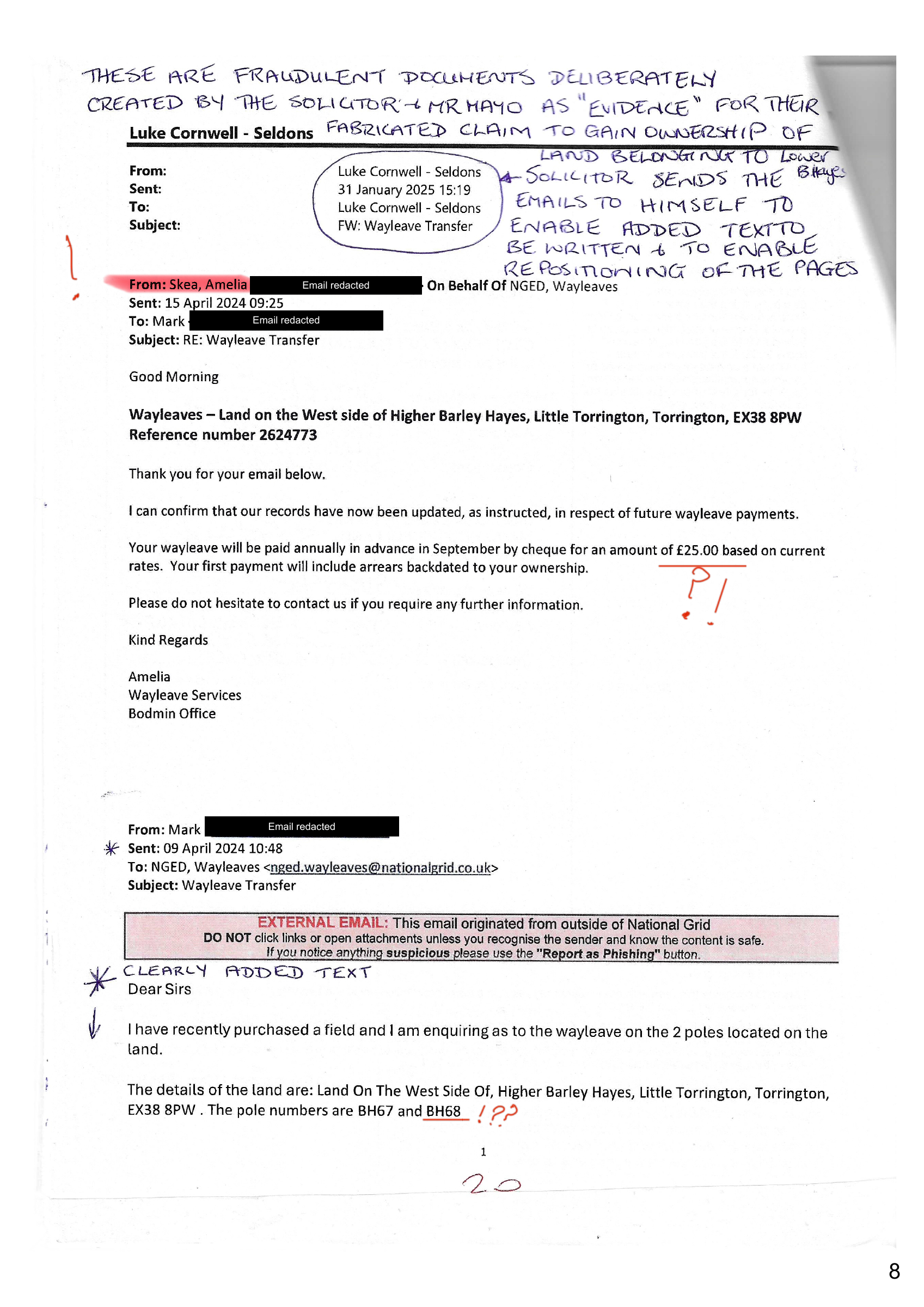
The words matter. The two-page printout joins a message attributed to Mark John Mayo, dated 9 April 2024, to a reply attributed to Amelia Skea of National Grid, dated 15 April 2024. Her signature identifies Wayleave Services, Bodmin Office. The company addressed by this investigation is National Grid Electricity Distribution (South West) plc. [F, pp. 1–2]
See the copy being challenged.
The images reproduce the family’s annotated copy. The handwriting records their allegations; it is not part of the original email text. Black boxes added for publication cover direct email addresses and a personal address.
- At the top: Cornwell → Cornwell. The printed outer header names “Luke Cornwell – Seldons” in both fields, dated 31 January 2025, 15:19, subject “FW: Wayleave Transfer”.
- At the bottom: BH67 and BH68. The embedded request attributed to Mr Mayo, dated 9 April 2024, 10:48, names both poles.
- In the reply: £25 annually. The message attributed to Amelia Skea, dated 15 April 2024, 09:25, says “your wayleave” will be paid annually at £25, reference 2624773.
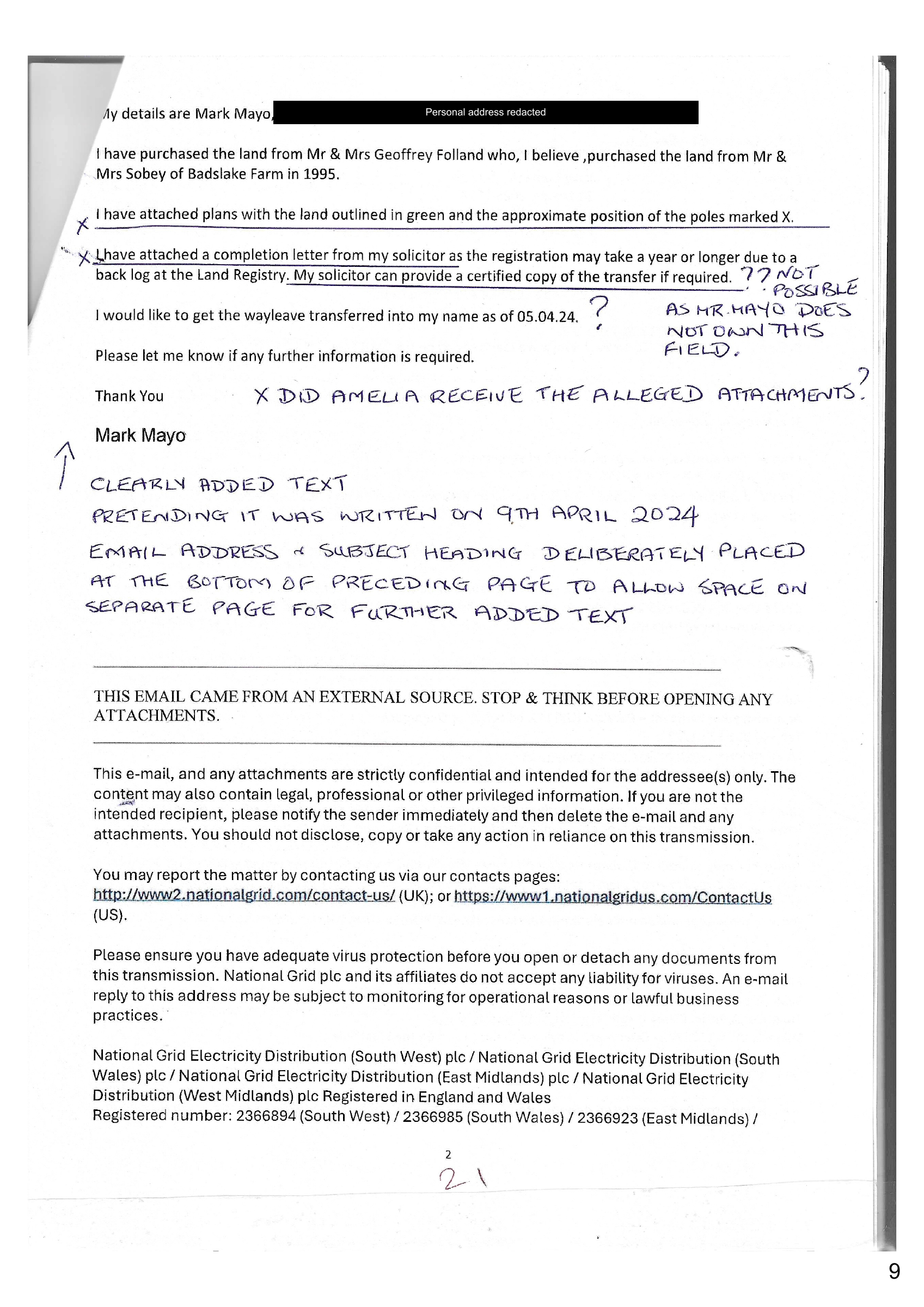
Read page 2: the claimed attachments and transfer request
The continuation says a marked plan and solicitor’s completion letter were attached and requests transfer from 5 April 2024. The family’s annotations challenge those statements and ask whether Amelia received the attachments.
Publication-copy and source details → · Cornwell: identify every change and the original version →
Mr Mayo’s attributed request
The pole numbers are BH67 and BH68.
The message requests a transfer into his name from 5 April 2024. It says a marked plan and a solicitor’s completion letter were attached, with a certified transfer copy available if required. Those attachments are not in this printout. [F, pp. 1–2]
Ms Skea’s attributed reply
Your wayleave will be paid annually in advance in September by cheque for an amount of £25.00 based on current rates.
It also says records have been updated, with arrears backdated to ownership. The displayed reference is 2624773. [F, p. 1]
Read together, the request and reply can convey that the wayleave update answered an enquiry about both named poles. The pole numbers appear in the incoming message, not repeated in Ms Skea’s reply. That makes authentication of the linked exchange essential: did she receive that precise request, did she send that reply to it, and which instruments supported “your wayleave”?
Mr J reports that neither a BH68 nor a BH67 wayleave agreement in Mr Mayo’s name has been produced to the family. If “your wayleave” referred to an existing or transferred agreement, identify it—for each pole—and show how it applies. The original request, reply, attachments and agreement records should establish the connection the printout appears to make.
The dates matter. These attributed April messages predate Miss E’s June 2024 agreement. The records must explain the relationship between that April payment update and the later signed agreement for BH68.
Why the self-forwarded copy?
The outer printed header dated 31 January 2025 names Luke Cornwell – Seldons as both sender and recipient, with the subject “FW: Wayleave Transfer”. Mr Cornwell is a solicitor and partner at Seldons Solicitors (Seldons LLP), Bideford, Devon; the firm's public office and professional sources are listed on his profile. Mr J questions the handling of the disputed exchange; handwritten annotations on the copy allege fabrication. [F, p. 1]
Why was this copy self-forwarded? Was any wording added, removed or changed? Produce the received message, the forwarded version and their full headers so the versions can be compared. The original messages and attachment package are the records needed to answer those questions. Read the question for Luke Cornwell and Seldons. Read the authentication question for Amelia Skea.
The financial challenge · Raised before the October 2025 hearing
Two named poles.
One £25 payment. Which records explain it?
Miss E and Mr J allege that BH68 was inserted into correspondence concerning a different, lower-value arrangement. They connect the disputed wording, self-forwarded presentation, unproduced executed agreements in Mr Mayo’s name and unresolved authentication requests. The amount is part of that challenge—not an isolated accounting query.
The request names two poles; the reply gives one annual amount. £25 divided equally between two poles would be £12.50 each. That is the family’s proposed calculation: the email itself gives no per-pole allocation. National Grid should identify whether the sum covered both poles, one pole or different apparatus, and produce the itemised calculation.
The October documents already put this issue before the court.
The rebuttal’s page 7, section 6 alleges a “£25 minor-pole rate spliced into a feeder installation context (~£2,000 per term)”. It then seeks native messages, server confirmation, executed instruments, a survey and remittances. The oral summary’s page 8, II.C.2 raises the same financial comparison; page 11, II.D.4 challenges payments to two owners for what the family says is the same installation. These passages document the specific allegation and records sought. Rebuttal source → · Oral-summary source →
Identify the actual equipment and valuation.
Miss E’s agreement records 11 kV and LV equipment, a 14-year term and a £2,000 one-off payment, with maintenance, access and damage-related obligations. Its schedule includes conductors, two pole legs, stays and associated equipment; its plan identifies both BH68 and 35-2381-1. See the agreement plan and schedule comparison →
What the published technical and payment sources establish
WPD’s technical glossary describes a feeder as a circuit supplying electricity from a substation. The term alone does not identify the individual pole’s fittings or its payment category. Technical glossary, page 4 ↗
The operator’s published policy describes termed settlements for both low- and high-voltage wooden-pole claims. ENA’s 2024/25 agricultural guidance distinguishes apparatus, land use and owner/occupier components; it is not an itemised valuation of this property. The sources reviewed do not establish a mandatory “feeder pole” premium or show that £25 can only mean a stay. Operator settlement policy, pages 40–43 ↗ · ENA rate categories ↗
The relevant answer must therefore come from National Grid’s asset records and the tariff or negotiated valuation actually applied in April and June 2024. Its termed agreement specimen, clauses 2–4 ↗ also sets out access, interference and damage provisions: identify the corresponding rights and obligations in the arrangement claimed for Mr Mayo.
National Grid and Amelia Skea: authenticate the exact incoming BH67/BH68 request and the reply displayed with it. Identify every asset covered by the £25, its engineering classification, the applicable rate or valuation, payment capacity and period. Explain how that record relates to Miss E’s agreement, including any allocation to BH68 and 35-2381-1 and any payment or term attributable to voltage, equipment, access or safety obligations. Produce the instrument and calculation—not another unexplained reference to “your wayleave”.
Cornwell and Seldons: what original records did you check before relying on the exchange? Where was the financial challenge answered, and where are the retained, self-forwarded and court-filed versions compared? National Grid’s detailed payment question → · Cornwell’s provenance and editing question →
The particularised allegation
Was BH68 added to an exchange about BH67?
The family’s expanded Annex E alleges that Luke Cornwell inserted BH68 references into an exchange originally concerning BH67, then used the altered material with Mr Mayo to support the boundary claim. It identifies the self-forwarding header, alleged font changes and shifts between “wayleave” and “wayleaves” as features of that allegation. Pages 19–20 set out the alleged mechanism; pages 12–13 connect it to the missing underlying instrument and disputed plan. [M, pp. 12–13, 19–20]
That is the allegation to answer: was BH68 in the message National Grid actually received, or was it introduced into a later version? Compare the retained incoming email, the reply, Mr Cornwell’s self-forwarded copy and the court version. Identify every substantive difference, who made it and when.
Amelia Skea: authenticate the words—or identify what is wrong.
Mr J advances two suspected explanations: that Ms Skea knows material wording was altered or falsely attributed to her and has left it uncorrected; or that she knowingly participated with Mr Mayo and Mr Cornwell in presenting misleading correspondence as confirmation of BH68 rights. In his account of 19 September 2026, he bases those suspicions on the self-forwarded copy, the unresolved agreement chain and the prolonged failure to authenticate the exchange. The expanded Annex E sets out the alleged insertion by Mr Cornwell; the allegation about Ms Skea’s knowledge is Mr J’s account.
The alleged purpose connects this question to the wider case. Miss E and Mr J say the competing BH68 claim was used to weaken the significance of her agreement and plan beside the stock fence. They allege that moving the fence down the bank would obstruct their view of Mr Mayo’s tree-cutting activity. That is why they regard the missing authentication answer as material to the boundary dispute, not a routine unanswered email. See the plan and the alleged boundary motive.
Did you write “your wayleave” in response to the displayed request naming BH67 and BH68? If so, which agreements and records justified it? If that is not what you received or sent, identify the false or changed passage and when you first became aware of it. What correction or notification followed? National Grid should identify the officer responsible for checking its retained records and supplying the answer. [G, pp. 2–5] [H, pp. 1–3]
Why it matters: an apparent third-party confirmation can give a disputed claim credibility it would not otherwise have. The authenticity question goes directly to whether the words relied upon came from National Grid and whether its records support the rights being asserted. Follow the dated requests and the unanswered record.
Primary court material reviewed · 18 September 2026
The pleading is identified.
Where is the redaction notice?
Paragraph 42 of the second amended Particulars of Claim relies on MJM2 pages 20–25 as evidence of a wayleave transfer. The June trial bundle contains that pleading, its statement of truth and Luke Cornwell’s signature dated 23 September 2025, followed by the disputed email exhibit. The National Grid chain names Cornwell as both sender and recipient on 31 January 2025. No redaction explanation appears on the inspected pleading, exhibit cover or six email pages.
Mr J recalls a later privilege/redaction explanation in court, possibly at a strike-out hearing before Paul Mitchell, and says he objected. The hearing, date and precise words remain to be confirmed. His October submissions separately refer to a written Reply.
If the copy was edited, identify the written notice, the material withheld and the preserved original. What did the court and Miss E receive, and when? The expanded article connects these questions to CPR 31.19, PD 31B paragraph 35 and the SRA’s evidence-integrity standards.
Read the allegation, verified page references and direct questions → · Read the SRA evidence question →
BH68 → court exhibit → regulatory report
The email allegation reached the regulator.
The October report expressly raised the disputed utility chain. Laurence Price (SRA Investigation Officer who signed the 30 October 2025 decision) confirmed receipt of files on 23 October 2025. The SRA’s 30 October decision recognised the allegation but declined investigation, giving a court-first reason. The expanded reporting now compares the actual submission, decision and follow-up promise.
Follow the SRA response trail → · Read the seven handling questions →
BH68 · The agreement, the payment and the claimed transfer
If the rights transferred,
show the chain.
Miss E and Mr J allege that a payment-update email and historic agreements were used to create the appearance of BH68 rights in Mr Mayo’s name without producing the underlying documentary chain. They say their challenge at the strike-out hearing was specific: produce the field’s conveyancing records and the previous owner’s relevant wayleave, and show what actually passed to Mr Mayo. Mr J reports that no executed BH68 wayleave in Mr Mayo’s name has been produced to the family as at 19 September 2026.
Miss E’s record contains more than an email.
We have examined her signed agreement dated 4 June 2024, its plan identifying BH68 and another apparatus reference, and its provision for £2,000 over a 14-year term. The fuller seven-page file also contains PCC’s 1 July 2024 letter stating that it enclosed a £2,000 cheque. PCC’s 10 January 2024 letter records earlier dealings with the property’s previous owners and says their agreements would have expired, making a new agreement and payment appropriate.
The family says the Jenkins predecessors held the BH68 arrangement for decades without a competing claim. National Grid: how does your retained history of this apparatus reconcile that predecessor record and Miss E’s new agreement with the rights now claimed by Mr Mayo? Read the dated source comparison →
The demands. The production. The unanswered connection.
- The attributed April 2024 exchange: Mr Mayo’s displayed request names BH67 and BH68; the reply attributed to Amelia Skea describes updated payment records and “your wayleave”. The family has repeatedly sought authentication of that exact exchange.
- 17 October 2025: Cornwell’s email lists a conveyancing-file attachment, and his covering letter describes supplied copies with omissions and redactions. The question is which pages establish the BH68 entitlement and continuity—not merely whether an attachment existed.
- 24 October 2025: Cornwell says the benefit of the 1963 and 1975 agreements has transferred, pointing to item 5. The revised schedule labels that item “National Grid Wayleave Payments (1 September 2025)”; the historic agreements appear separately as items 12 and 13.
- Annex J1/J2, 25–26 October: Mr J challenges the claimed transfer, the disclosure sequence and the difference between the asserted entitlement and the documents produced. J2 interprets the later wording as a retreat to belief. Cornwell’s actual words were that his client’s “position remains” that the benefit had transferred.
- 6 November 2025: Cornwell supplied the historic agreement PDFs, plan and payment records. His covering letter denied a change of position. On 7 November, Mr J challenged their connection to BH68, the plan’s supporting authority and the payment figures. Follow the demands, delivery and objections →
Ask the solicitor. Ask the firm. Ask the regulator.
Which pages establish the claimed rights? Who checked the email copies? Where is the firm’s answer to the 7 November objections? The new question set also asks the SRA how it assesses the later material against document-integrity and supervision standards.
A payment entry must be connected to the right it is said to prove. Cornwell and Seldons: identify the provision, assignment, successor-owner entitlement or other instrument linking each historic agreement to Mr Mayo, the relevant land and BH68. Show how the chain survived the subdivisions and changes of ownership described by the family. Point to the relevant pages in the conveyancing file.
National Grid: reconcile the money with the apparatus. Identify the agreement, asset reference, payee capacity, period and payment category behind the £25 annual figure and Miss E’s £2,000 term payment. Explain any overlapping rights or payments, and who approved them. The amounts cover different periods and potentially different equipment; the missing answer is the company’s reconciliation.
Amelia Skea: did you send the displayed reply to the displayed BH67/BH68 request? Identify the retained messages, attachments and agreement supporting it. Mr J says that answer is still outstanding; the recorded referral and solicitor replies do not supply the authentication sought.
Why it matters: the family says the disputed chain was used to challenge rights supported by Miss E’s executed agreement. A general denial of tampering cannot replace the answer to the specific transfer claim. Agreement and land-history question → · Payment reconciliation → · Mr Mayo’s documentary-chain question →
Response record expanded · 18 September 2026
Cornwell’s denial. Seldons’ reservation. Where is the firm’s reasoned review?
Cornwell’s 24 October email, signed Seldons LLP, denied tampering and described further copies printed by Mr Mayo and delivered personally. The separate firm letter of 28 October acknowledged the corporate notice and reserved its position. It supplied no reasoned firm-level assessment. The Unanswered Record asks who reviewed the allegations about the solicitor and the firm, what originals were compared and where the substantive answer is recorded. Read the two responses and the distinction →
The wider overview also records the SRA’s closed assessment and the July 2026 order determining boundaries and rights of way in Mr Mayo’s favour. The family challenges the treatment of its evidence. Read those later outcomes and the continuing questions →
Receipt and response sources → · Seldons’ wider question pack →
Additional documents reviewed · 13 September 2026
The allegation was put in writing. What followed?
- 25–26 October 2025 — Annex J-1: the notice addressed to Luke Cornwell demands authentic underlying BH68 documents and alleges insertion of the pole into fabricated correspondence. Its cover and letter carry different dates, both retained here. [P, pp. 1–3]
- 26 October 2025 — Annex J-2: Mr J challenges the email’s alleged alteration, the late listing of 1963/1975 agreements and a position attributed to the 24 October correspondence that their benefit had transferred. The question is what original instruments and earlier statement-of-truth wording supported that position. [O, pp. 2–4]
- 27 October 2025 — notice to the solicitor and firm: the email addresses Luke Cornwell and Seldons, lists Annex E, J-1 and J-2, and demands preservation of originals and metadata. It asks for acknowledgement and firm-wide preservation within 24 hours. [N, pp. 1–2]
- 29 October 2025 — request addressed to CPS mailboxes: the family seeks criminal assessment and coordination with the SRA, specifically alleging insertion of BH68 and use of the material in proceedings. This copy records the outgoing request, not an authority’s decision to investigate. [Q, pp. 1–3]
The significance is notice and opportunity to check. The separately reviewed 28 October 2025 letter acknowledges the previous day’s correspondence and attachments and reserves Seldons’ position. Cornwell’s 24 October email had expressly denied tampering and described further copies printed and delivered personally by Mr Mayo. What originals were preserved? Was Ms Skea asked to authenticate the exchange? Who compared the content of the versions, and where is the written result? [T, response trail]
The court record · 13–14 October 2025
The editing challenge was sent before the hearing.
The newly examined emails show Annex E, the oral summary and the additional rebuttal sent to the court before the 14 October strike-out hearing, copying Luke Cornwell and Sandra Bubyer. On 14 October, the court confirmed that the additional rebuttal was “printed and placed on file”.
Where does the hearing record address the disputed emails and claimed BH68 transfer—and which original documents answered the challenge? Follow the dated sequence and recipient questions →
Editing allegation · Primary record and recollection updated 18 September 2026
Filed first. Editing explained only after challenge?
Mr J alleges that Luke Cornwell of Seldons Solicitors put the disputed emails attributed to Amelia Skea and Mr Mayo before the court in place of the executed wayleave agreement the family was requesting. He says an explanation about editing emerged only after the family challenged the self-forwarded copy.
The October 2025 submissions · Exact extracts
The editing allegation was already in the written submissions.
The defendant’s October submissions expressly alleged editing of the email chain and challenged a later redaction explanation. Emails examined on 19 September 2026 record the oral summary and rebuttal being sent on 13 October; the court confirmed the additional rebuttal was printed and placed on file on 14 October. The extracts below are the defendant’s words from the supplied copies. Read the transmission and version record.
The Claimant’s solicitor, Mr Luke Cornwell of Seldons LLP, has admitted in writing to self-forwarding and editing a National Grid email chain that he later filed under a statement of truth.
The explanation later offered — that this was “redaction” — was retrospective and untenable.
The rebuttal likewise alleges that Mr Cornwell “has now admitted in writing to editing and re-forwarding email correspondence after the fact”. Its page 5 refers to an admission within his Reply; page 18 disputes the redaction explanation. [K, pp. 5, 17–18]
The question is precise: what does the original Reply say, which version does it describe, and where can the changes and their disclosure be checked?
The court material is now identified: paragraph 42 of the second amended claim relies on MJM2 pages 20–25. The statement of truth, signature and six email pages have been reviewed. Read the precise references and written-notice questions.
The sequence Mr J reports
- The submission: Mr J says the emails were presented as authentic evidence in material supported by a statement of truth. He says the copy did not show what had been removed or disclose that it had been edited.
- The challenge: Mr J says Miss E disputed the emails’ authenticity and the rights they appeared to imply, contrasting them with her own executed agreement. The family challenged why the copy showed Mr Cornwell forwarding the exchange to himself.
- The later explanation: Mr J reports that Mr Cornwell then acknowledged self-forwarding and editing, citing privileged client material. He now recalls an oral explanation before Paul Mitchell, possibly at a strike-out hearing, and says he objected. The hearing and date are not yet confirmed. Mr J says this explanation came after the submission and only after that challenge, rather than when the material was first presented.
Mr J says the corresponding executed agreement remains unproduced despite requests to multiple parties for more than a year. Authentication and wayleave-record requests appear in the February–March 2025 correspondence; the May 2026 letter before action reports follow-ups extending beyond a year. [G, pp. 3–5] [H, pp. 1–3]
Why the sequence matters: the concern is whether a changed copy was presented without disclosing the changes—and whether the version relied upon faithfully represented the original. An explanation about protecting client information should identify the nature and extent of the changes, when notice was given and how the original can be checked without exposing genuinely protected information.
What was changed? Where is the written notice? When was the explanation first given? What checks supported paragraph 42, and can the preserved original be compared with MJM2? Read the version-and-redaction questions and the question about the court filing.
The procedural question: notice and preservation
The reviewed allocation order places this claim on the multi-track. Practice Direction 31B, paragraph 35, addresses notice and preservation when altered electronic copies are supplied; any case-specific direction must also be identified. Read PD 31B, paragraphs 3 and 35 ↗
CPR 31.19(3)–(4) requires a claim to withhold inspection of all or part of a document to be stated in writing with its grounds. Whether these requirements were breached here depends on the applicable procedure, orders, notices and actual versions—not simply on the fact that a copy was forwarded. Read CPR 31.19 ↗
Nick Shackson · National Grid · The plan and the changing description
“On your title.”
Then: “not any particular title.”
Miss E and Mr J allege a material reversal—not an innocent clarification. A plan supplied with wording suggesting apparatus lay on Mr Mayo’s title was later described as a general-area map. They believe the original presentation was deliberately misleading, helping create an impression of BH68 rights that conflicted with Miss E’s executed agreement. Their 6 May 2026 letter before action challenges the compatibility of those two descriptions and asks whether Shackson’s wording was “deliberately imprecise”, given his knowledge of the dispute. Read the allegation in Appendix D, pages 2–3 → The question is not merely who sent the map, but what justified presenting it as apparatus “on your title”.
If it identified no particular title, what was the plan meant to establish?
Mr J says the family had already challenged the missing wayleave agreement and associated plan in court before this map was put forward as evidence. Their allegation is that the plan was sought and used to fill that exposed gap—to give the appearance of documentary support for Mr Mayo’s claimed BH68 rights without producing the agreement to which the plan supposedly belonged. They regard the subsequent reliance on the 1963 and 1975 instruments as a further attempt to sustain the same disputed entitlement. They say those instruments concerned another owner’s land before subdivision and that Estates Specialist Tom, whom they identify as Tom Watson (estates and wayleaves specialist, National Grid Electricity Distribution (South West) plc, listed at Bodmin, Cornwall; the professional match discussed in the meeting account), told them the old arrangements were defunct.
Shackson, Mr Mayo and his representatives: who requested this plan, for what stated purpose, and what agreement was it supposed to accompany? Produce the request and instructions. Identify when each map or historic instrument was first relied on, the right it was said to establish, and the records connecting it to BH68 and Mr Mayo’s land after subdivision. What did this map add to the claim if it identified no particular title? Follow the historic-agreement and transfer questions →
28 April 2025 · 10:12:14 BST
“Please see attached plan showing the apparatus on your title.”
Shackson’s email to “Mark”, subject Higher Barley Hayes. The outer forwarding header records Mr Mayo sending it to Luke Cornwell on 16 October 2025, with Apparatus Higher Barley Hayes.pdf listed. Appendix C, page 2 →
10 February 2026 · 14:55
“The map I sent to Mr Mayo displayed a general area at Barley Haynes not any particular title.”
Shackson’s reply is quoted inside Miss E’s 13 February response. His words appear in black; her questions and comments appear in blue. Appendix B, pages 2–3 →
He had already acknowledged Miss E’s documents. What did he check before telling Mr Mayo “on your title”? On 13 March 2025, Shackson confirmed that he could open her attachments and would review them and contact Bodmin records. The thread sought authentication of the disputed exchange and listed her Owner Wayleave Consent and pole/boundary material. Miss E and Mr J allege that, despite this notice, his later email gave Mr Mayo an apparent title-specific confirmation without explaining its relationship to her existing agreement. National Grid must identify the check, the result and the basis for the wording—not simply relabel the map after challenge. See the earlier acknowledgement, Appendix B, page 8 →
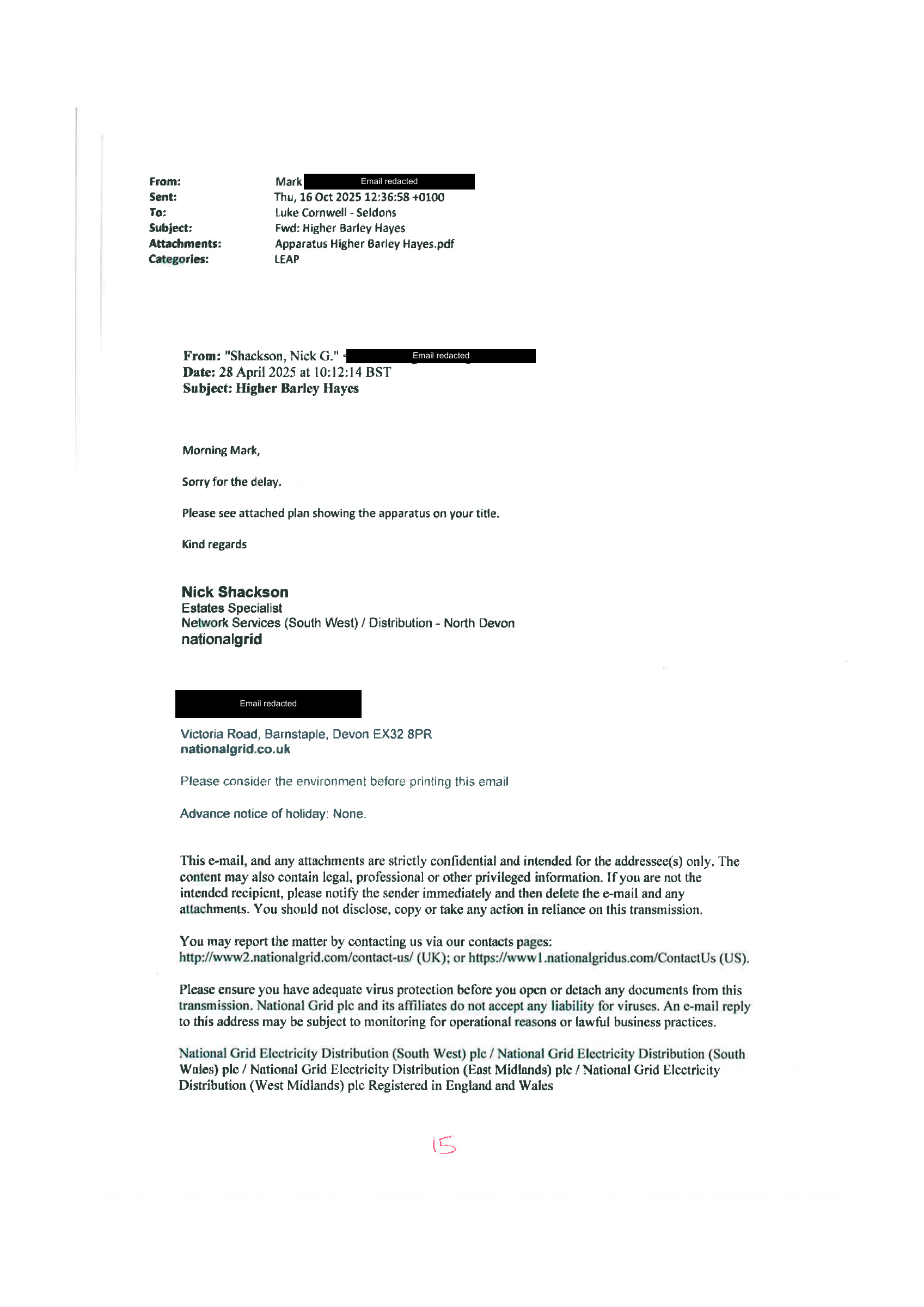
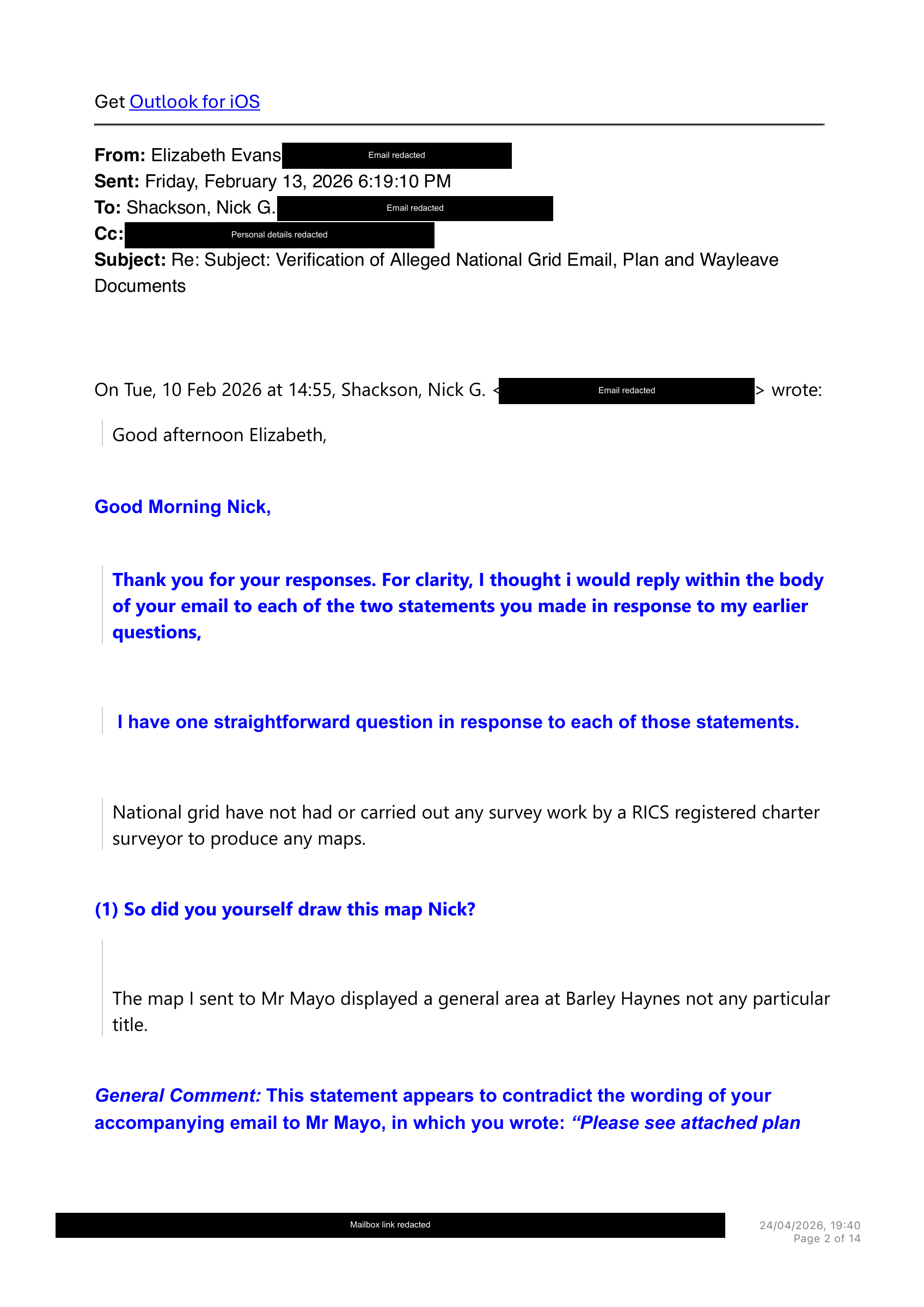
Read the continuation: which apparatus did you mean?
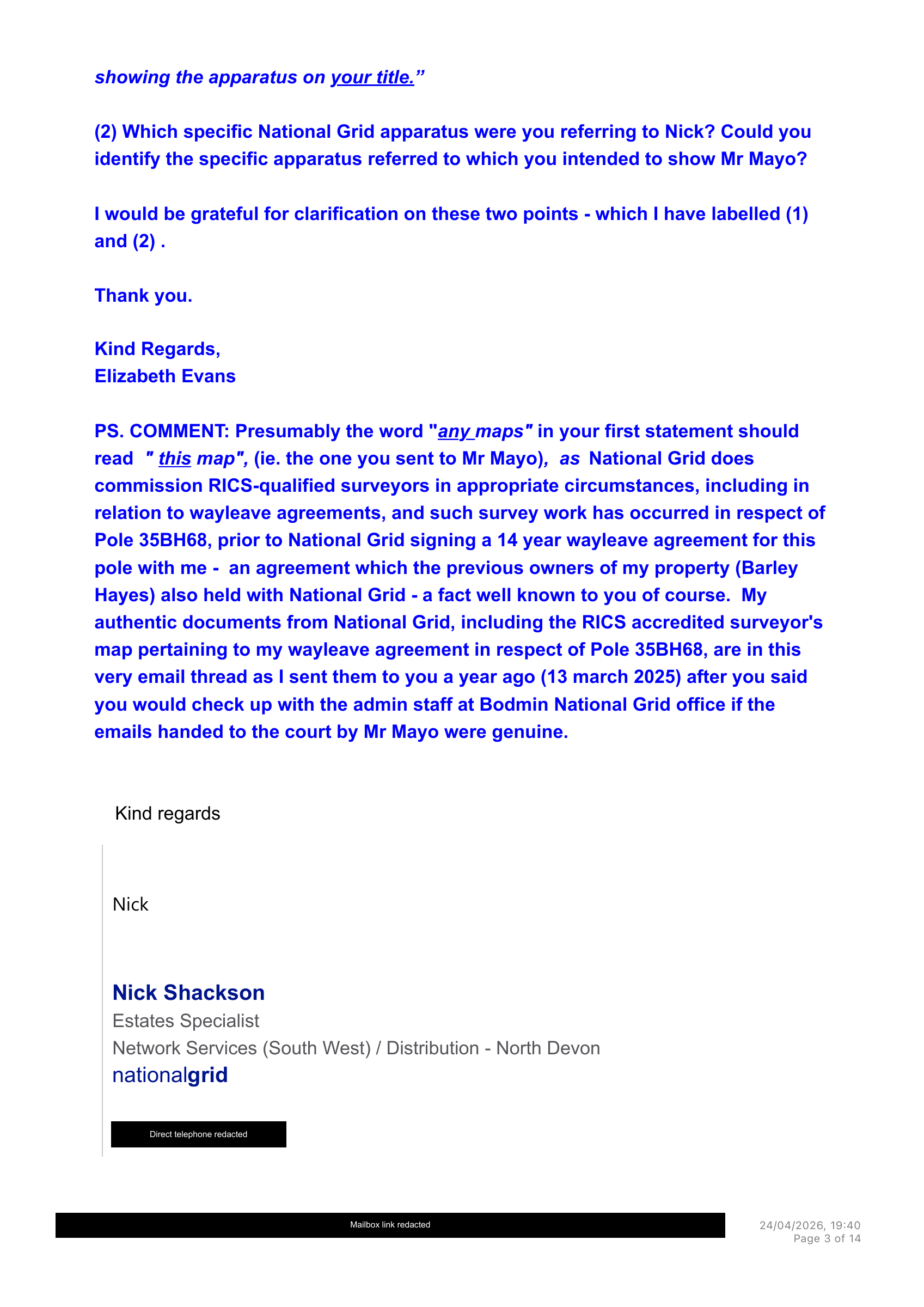
The actual plan: which title does it identify?
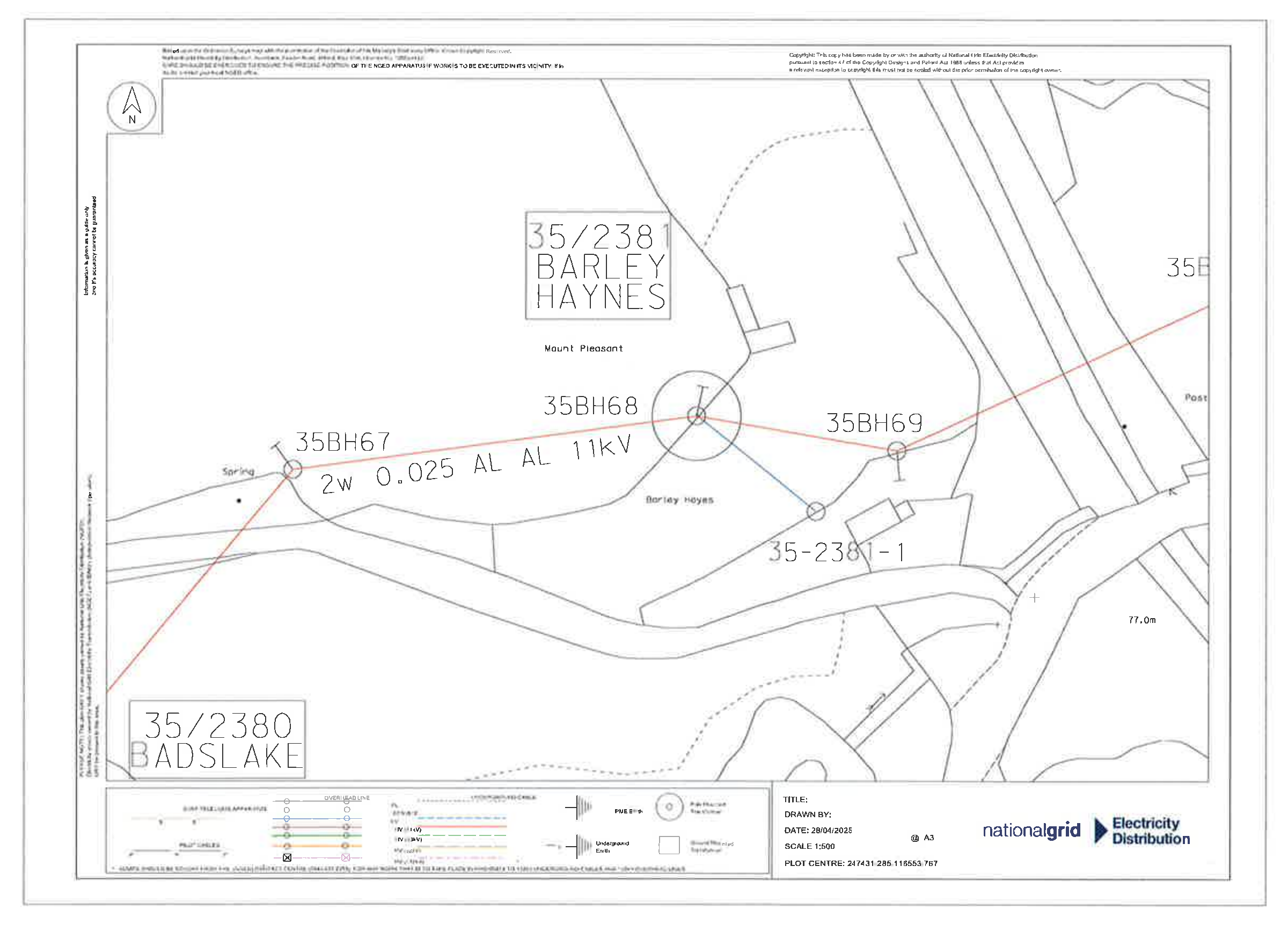
The drawing labels 35BH67, 35BH68, 35BH69 and 35-2381-1. Its “TITLE” and “DRAWN BY” fields are blank, and it carries a printed warning about positional accuracy. It does not identify a registered title number or set out a signed wayleave agreement. Which of the marked assets was the email asserting to be on Mr Mayo’s title, and on what checked land record?
By contrast, Miss E’s agreement expressly identifies plan 83920/SI and defines the property by the red edge on that plan. That is a documented connection between contract and drawing. Compare Miss E’s signed agreement plan → The family asks where the corresponding contractual connection is recorded for the April 2025 map.
Which version of the record reached the boundary surveyor?
Mr J reports that Mr Mayo supplied Shackson’s email and map to Dennis Venn for a boundary survey, but did not supply Miss E’s National Grid agreement and linked plan. He alleges that this selectively presented the apparent support for Mr Mayo’s position while excluding the contractual record supporting Miss E. The instructions and document bundle have not yet been reviewed by this publication.
The question for Mark John Mayo, Luke Cornwell and Seldons LLP is direct: what was sent to Dennis Venn, by whom and on what date? Produce the instructions and document index. Did they include Miss E’s executed agreement and plan 83920/SI? If not, why not? Once Shackson’s general-area explanation was available, was that qualification passed to the surveyor and the court?
The question for Dennis Venn: which documents did you receive, which did you rely on, and what independent check established any connection between the April plan, Mr Mayo’s title and BH68? The report and its source list would allow readers to test Mr J’s account. Follow the wider questions about expert instructions →
The challenge was specific—and documented.
- 13 March 2025: Shackson confirmed he could open Miss E’s attachments, would review them and contact Bodmin records. Her message in the same thread sought authentication of the disputed exchange and listed the Owner Wayleave Consent and pole/boundary material. What did that promised check establish before the April plan was sent?
- 28 April and 16 October 2025: the original plan email was sent in April; the displayed forward to Cornwell is dated 16 October, two days after the strike-out hearing. The following day’s disclosure schedule listed the plan and email.
- 24 October and 6 November 2025: the revised schedule added the 1963 and 1975 agreements; copies were then supplied with the plan and payment records on 6 November. Mr J’s 7 November reply challenged the plan’s supporting authority and the documents’ connection to BH68. Read the dated disclosure and objections →
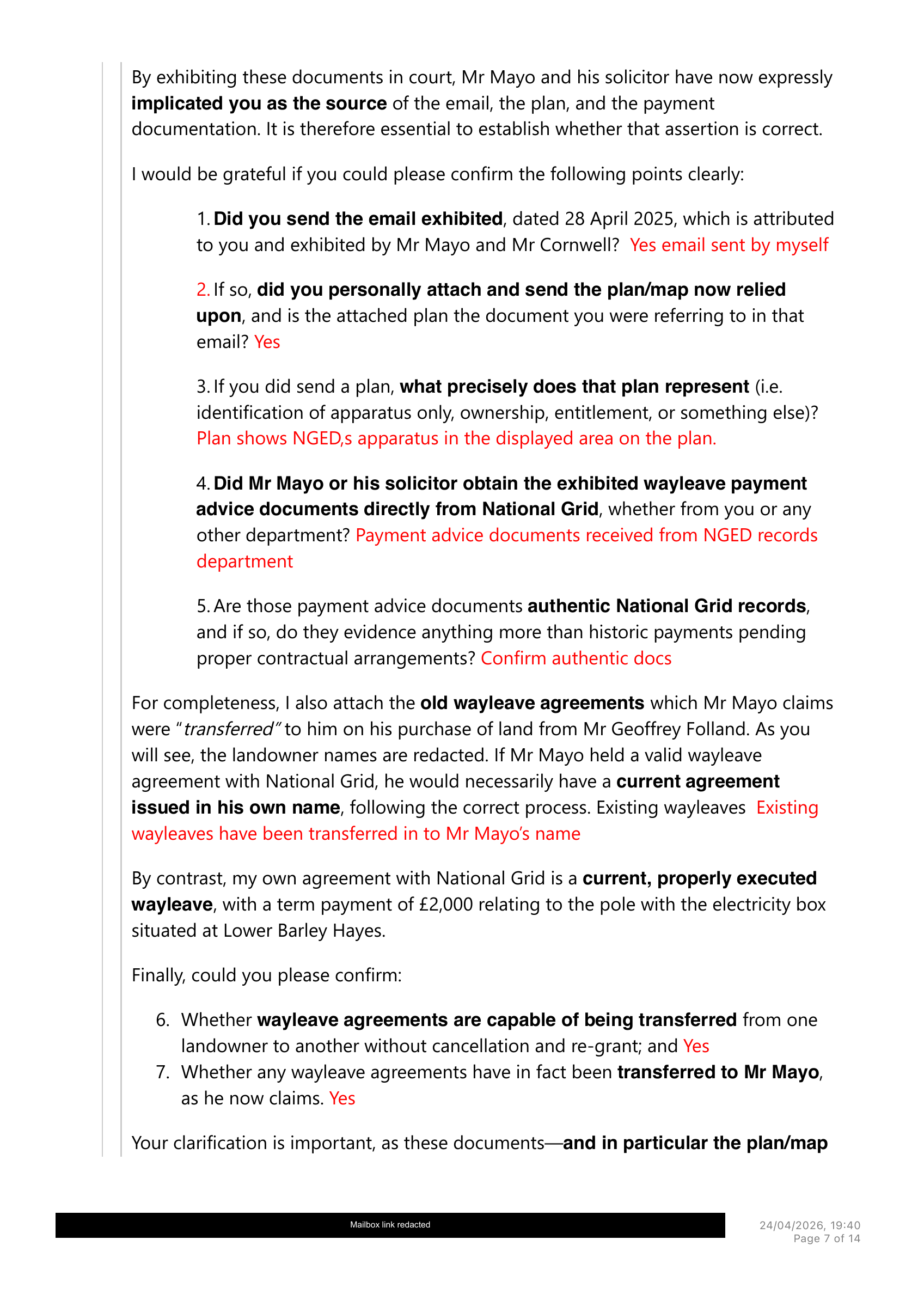
- 2 February 2026: he confirmed sending the email and plan, described it as showing NGED apparatus in the displayed area, confirmed the payment documents as authentic and said existing wayleaves had transferred to Mr Mayo. He did not identify the particular transferred instruments or the specific apparatus intended by “your title”.
- 2–10 February: Miss E asked which title he meant and who surveyed and drew the map. His later reply said no RICS-registered chartered-surveyor survey work had produced the maps and described this one as a general area, not a particular title.
- 13 and 24 February: Miss E asked who personally drew it and which apparatus the original wording meant; Mr J chased those two questions. The reviewed replies do not supply those identifications.
- 6 May 2026: the letter before action demanded the basis for the original wording, an explanation of the changed description, the relevant transfer instruments and the requests or authorisations behind the email. The covering email lists Appendices A–D. Letter before action, pages 1–5 →
Read the earlier receipt and the 2 February answers in full on these pages
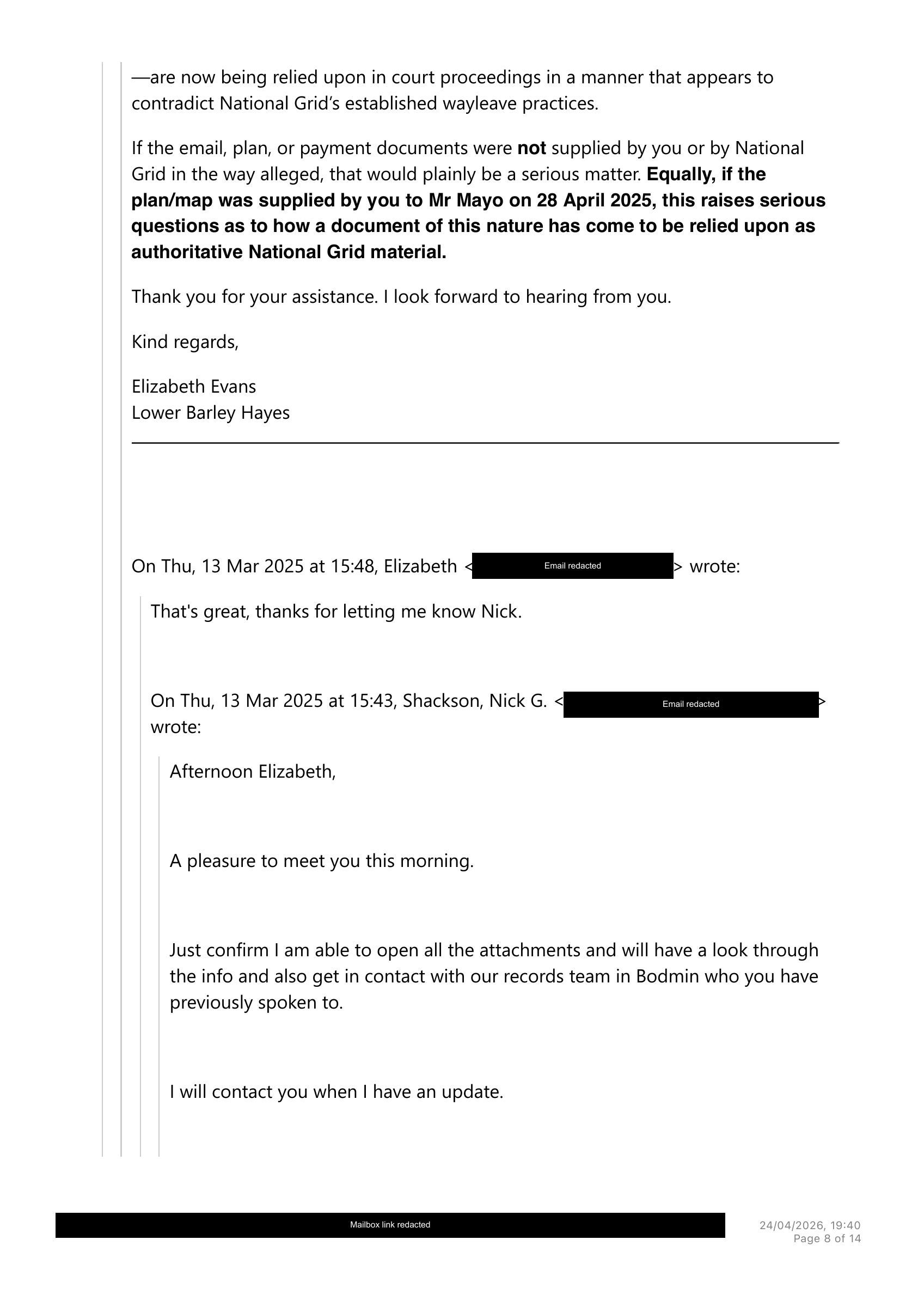
The reported Bodmin explanation: Mr J says Estates Specialist Tom, identified by the family as Tom Watson, told them that this general plan could not be used for wayleave purposes. The letter before action records the related office account about the absence of a BH68 agreement in Mr Mayo’s name; the plan-suitability statement is Mr J’s further account. National Grid: identify the plan’s permitted purpose and the records supporting it.
Answer the original representation—not just the map’s later label.
- Nick Shackson: which title number and which apparatus did “your title” mean? Who drew the plan, and what title or survey material was checked? What changed between the two descriptions?
- National Grid: what did the promised Bodmin check establish about Miss E’s agreement before this plan was supplied? Why did the email not explain how its title wording related to her agreement and plan? Was the original description maintained, corrected or withdrawn, and who was notified?
- Mr Mayo, Cornwell and Seldons: what was the plan put forward to prove? When did you receive the later qualification, and where was the court told of it? Produce the exhibit reference, relevant submission and any correction, together with the document set supplied for the boundary survey.
Why the contrast is material: a statement about apparatus on someone’s title can carry a different meaning in a boundary dispute from an area map which identifies no particular title. Miss E’s allegation is that the former impression was used against her while the underlying BH68 entitlement remained unresolved. The title, apparatus, contractual link and court presentation all require a specific answer.
Shackson: title and apparatus question → · Cornwell and Seldons: court-use question → · Shackson’s full question pack →
Images reproduce supplied exhibits. Black boxes cover direct contact details, Mr J’s personal identifier and private mailbox links; dates, substantive wording and original reply colours remain. Source and reproduction notes →
The correspondence trail
Requests. A referral. A promise. Where are the records?
- 26 February–10 March 2025: Miss E sought authentication of the April exchange. A 7 March follow-up copied Amelia Skea. On 10 March, Records Assistant Angela Caddy said the enquiry had been referred to Estates Specialist Nigel Merrifield. That is a recorded referral, not an authentication answer. Nothing here identifies Nigel as the “Tom” in the later office account. [G, pp. 1–5]
- October 2025 submissions: the rebuttal and oral-argument summary allege a written admission of editing and challenge a retrospective redaction explanation. The 13 October sending records and the court’s 14 October confirmation of the additional rebuttal are now documented. Read the filing trail. [K, pp. 5, 7, 17–18] [L, pp. 2, 5, 26]
- 2–24 February 2026: Nick Shackson confirmed sending the April plan, authenticated payment advice and stated that existing wayleaves transferred to Mr Mayo. On 10 February he explained the map’s general-area purpose and said no registered chartered-surveyor survey work produced it. Miss E’s 13 February authorship and specific-apparatus questions were followed up on 24 February. No direct answers to those narrower points appear in the reviewed copies. [B, pp. 1–7]
- 24–26 April 2026: Mark Hacking of Geldards LLP said he was instructed that previous information and document requests had been dealt with. He asked the family to specify further documents, the proposed claim and remedy. Mr J disputed the characterisation and initially withheld a substantive response pending confirmation of authority. [J, pp. 2–3]
- 5–7 May 2026: Nick confirmed Geldards’ instruction. Mr J later accepted its authority. On 7 May, Mr Hacking acknowledged receiving the forwarded email to Ms Skea with its letter before action, directed further correspondence through him and said he was reviewing recent emails and letters addressed to Mr Shackson, with a substantive response to follow. He also stated NGED’s position that the employees acted in the course of employment and any claim would be against NGED. These are genuine responses and a stated legal position—not authentication of the disputed emails or a finding about personal liability. [E, p. 3] [I, p. 1] [J, pp. 1–2]
The unresolved point: the replies reviewed—including the September denial and representation/service letters—do not identify the native exchange, original attachments or particular instrument supporting the asserted BH68 position. Where is the document-supported answer?
The family’s account
The allegation is deliberate misrepresentation.
Mr J, speaking for himself and Miss E, alleges that the plan was deliberately created and presented to imply rights not demonstrated by the agreement record, and that parts of the linked email material were fabricated. He describes the alleged purpose as fraudulent, intended to create ambiguity over the family’s boundary and contractual rights.
The family’s letters attribute to an estate specialist called Tom an office statement that no current or historic BH68 agreement existed in Mr Mayo’s name. They describe only defunct historic multi-pole agreements, a predecessor agreement for Miss E’s property and her current agreement. Geldards’ correspondence itself refers to office visits on 13 April 2026 and a home visit the next day; it does not confirm the words attributed to Tom. The office recording and the title and subdivision history are needed to test this account. Historic agreement copies have since been supplied separately; their current application remains a question to examine. [D, pp. 1–3] [H, pp. 1–3] [J, p. 3]
The public professional match is Tom Watson, Estates and Wayleaves Specialist, National Grid Electricity Distribution (South West) plc, Bodmin, Cornwall. National Grid’s directory and dated public correspondence support that professional identification. The family’s letter itself names only “Tom”; his profile separates those professional sources from the reported meeting.
Mr J says the continuing absence of the requested originals and agreement deepens his concern that the email record was altered after sending or deliberately created to mislead. He wants the people who supplied and relied upon these documents to explain their provenance and produce the records against which they can be checked.
Evidence, inference, limits
What follows from the record?
- A payment statement needs its supporting record. It is reasonable to ask whether an administrative update was treated as evidence of wider rights. Neither £25 annually nor a £2,000 contractual provision answers that scope question on its own.
- A claimed transfer needs an identifiable basis. PCC’s January 2024 letter described previous-owner agreements for Miss E’s property as expired; Nick’s later reply refers to transfers to Mr Mayo. Produce the relevant instruments and explain their continued application, including the land and poles covered. [A, p. 1]
- A promise to answer creates a point of accountability. What happened to the promised response? Who is responsible for completing it? If earlier requests were answered, supply those answers. The reported delay leaves the central verification work unfinished.
- A disputed printout calls for the original. Compare the retained exchange, the self-forwarded version and the attachments. Identify and explain every difference. That comparison is the direct way to test the allegation.
Why these questions remain public
Miss E and Mr J make the fraud allegation and report that the substantive answers remain outstanding. Their account is presented alongside the agreement, disputed correspondence, formal requests and October 2025 submissions examined in this report. The allegation and the document gaps are specific; the answer must address them.
An acknowledgement does not authenticate an email. A transfer assertion does not identify the agreement behind it. We ask the named parties to produce the originals, identify the relevant agreement and explain the versions put before the court. The recorded replies are set out above. Substantive answers and corrections will be placed alongside the questions they address.
The absence of an answer does not make the question disappear.
The records that would settle the questions.
The questions below ask for identifiable material: the original email exchange and attachments; the agreement, plan and basis of any transfer; the payment-record changes and checks behind them; and the court filing explaining what was relied upon. They distinguish recorded requests from new editorial follow-ups.
People and organisations in this record
Document review · 12–13 September 2026
The documents we have reviewed.
The Unanswered Record has reviewed the supplied PDF copies of the 6 May 2026 letter before action addressed to Nick Shackson (D, six pages) and the 7 May 2026 letter before action addressed to Amelia Skea (H, four pages).
The review covers the executed agreement and signed plan, April 2025 plan and email, disputed April 2024 exchange, verification requests, Geldards’ replies and October 2025 submissions. On 13 September we reviewed five additional documents: the expanded Annex E, Annexes J-1/J-2, the notice to Cornwell and Seldons and the CPS referral request. The attributed exchange was re-examined. All 17 distinct documents (129 pages) are identified below.
The supplied copies examined for this article are listed below.
References use PDF page numbers. The links below open source notes.
- A · The signed wayleave agreement
- B · The questions and the replies
- C · The April 2025 plan and email
- D · The 6 May 2026 letter before action addressed to Nick Shackson
- E · The covering email and representation reply
- F · The April 2024 correspondence attributed to Amelia Skea and Mr Mayo
- G · The verification requests and the March 2025 referral
- H · The 7 May 2026 letter before action addressed to Amelia Skea
- I · The email transmitting the Skea letter and supporting documents
- J · Geldards’ April and May 2026 replies
- K · October 2025: the defendant’s rebuttal to the claimant’s reply
- L · October 2025: the summary of oral argument for the strike-out hearing
- M · Annex E: the particularised allegation of email insertion and evidential manipulation
- N · 27 October 2025: notice to Luke Cornwell and Seldons, with a demand to preserve originals
- O · 26 October 2025: Annex J-2 challenges the email, disclosure history and claimed transfer
- P · 25–26 October 2025: Annex J-1 demands the underlying wayleave documents
- Q · 29 October 2025: the family’s referral request addressed to the CPS
The reporting record
What changed in this article.
- Connected allegation · Boundary significance
One pole. Two representations. Where is the supporting record?
The article now prominently explains the family’s allegation that the attributed email and title-worded map supplied complementary apparent support for Mr Mayo’s disputed BH68 entitlement, undermining Miss E’s boundary evidence. The linked questions ask National Grid to substantiate both representations against its original records.
Read the combined allegation beside the evidence - Document comparison · Further account
What did “on your title” mean—and who relied on it?
Shackson’s original wording is contrasted with his later general-area explanation and earlier receipt of Miss E’s documents. Mr J’s further account raises questions about the material supplied to Dennis Venn. The updated response trail distinguishes Skea and Geldards’ September replies from the outstanding authentication questions.
Compare the statements and follow the questions - Verified sent attachments · Downloadable evidence
Shackson and Skea: read the letters and the evidence sent.
The May letters before action and their indexed supporting packs are checked against the original email attachments. The source hub distinguishes the specific BH68 questions from Geldards’ denial and the September representation and service replies.
Download the letters and follow the response record - Correspondence re-examined · Authentication timeline
570 days after the first request: where is the authentication answer?
The 26 February 2025 request, March referral and May 2026 letter before action are brought together with Geldards’ recorded replies. Mr J reports that the authentication answer remains outstanding. The updated questions ask who checked the original exchange, what they found and where the written outcome is recorded.
Read the requests and the unresolved authentication question - Exhibits displayed · Plan and reply comparison
“On your title”—then “not any particular title”.
Shackson’s April email and plan are displayed with his February replies and Miss E’s challenge. The dated sequence connects his earlier receipt of her documents to the 6 May letter before action, asking what supported the title wording and whether a correction reached those relying on it.
Read the plan and the changing description - Email images · October objection
Cornwell to Cornwell. BH67 and BH68. The £25 question.
Both annotated email pages are now available to read, with a guide to the self-forwarding header, pole references and payment wording. The October rebuttal and oral-summary passages are identified, and the National Grid question now seeks the actual asset classifications, rate or valuation and contractual basis behind each payment.
Read the disputed email pages - Plan published · Boundary connection
Why BH68 mattered to the stock-fence boundary.
Miss E’s agreement plan is now shown beside the family’s account of the longstanding fence line and alleged forestry-related motive for challenging it. Direct questions ask for the rival title evidence, dated boundary claims and National Grid’s asset-by-asset reconciliation of the £2,000 term payment and £25 annual record.
See the plan and boundary questions - Documentary comparison and firm accountability
If the rights transferred, show the chain.
Cornwell’s post-hearing reference to a wayleave-payment item is set beside Miss E’s signed agreement and PCC’s £2,000 cheque letter. Expanded questions ask for the instrument, land and succession records—and identify who authorised and separately reviewed Seldons’ response to allegations against its solicitor and the firm.
Read the transfer and payment comparison - Pleading and exhibit identified
The verified pleading. The exhibit. The written-notice question.
The BH68 article now links the precise pleading and email-exhibit pages, the family’s reported objection in court and the updated redaction-rule questions for Cornwell, Seldons and the SRA.
Read the court-record update - Material response context added
Cornwell’s denial, Seldons’ reservation and the later outcomes
The article now records the 28 October acknowledgement, the 24 October denial and replacement-copy explanation, and links to the SRA decision and July 2026 court order.
Read the response update - Executive-review questions prepared
National Grid’s standards. Six questions for its Chief Executive.
A new question pack for Zoë Yujnovich asks which policies applied, who will examine the BH68 records, where the substantive answers are and when a written outcome will follow. Official policy sources and the recorded reply trail are linked. These executive questions have not yet been sent.
Read the executive-review questions - Contributor account added
10 March hearing. 17 March claimed service.
Mr J reports a sworn claim that the N260 was sent on 17 March. The family disputes that account and alleges deliberate withholding and an illegitimate costs order. The questions ask for the statement, service evidence and recorded basis of the assessment.
Read the dated account and questions - Contributor account added
BH68 and the costs hearing: the connection described by Mr J
Mr J reports that the attributed wayleave email was relied on at the same hearing where the costs order was made. The article now connects that account to Paul Mitchell’s costs questions and the wider case record.
Read the hearing connection - Source notes added
Five source notes added to the formal-notice trail
The October notices and referral request are now explained alongside Annex E and J-1/J-2. The reporting connects the family’s formal allegations, the preservation requests and the documents sought.
Follow the formal notices - Reporting updated
BH67, BH68 and the exact email wording
The existing attributed exchange has been re-examined. The article distinguishes the incoming message naming both poles from the reply’s “your wayleave” wording and sets out the family’s specific insertion allegation.
Read the email comparison - Questions updated
The plan, agreement and email questions connected
The questions now connect Mr J’s account of late introduction and court reliance on the plan with the requested agreement and disputed email. Readers can follow each question to its source and response record.
Read the connected questions
Substantive additions and corrections will be recorded here. The full case can be followed through Latest developments.
The next chapter
The next test is the record.
Authenticate the email. Identify the agreement. Explain the costs. The next question is how the disputed material travelled through this case: who relied on which version, for what purpose, and what happened when it was challenged.
This is one part of a case extending over more than two years. Further reporting will trace the connections as additional documents, accounts and responses are received and examined. Each chapter will show what changes the account, what answers a question, and what remains unresolved.
The questions remain open. So does the opportunity to answer them.
Executive accountability · Added 18 September 2026
National Grid’s standards.
Who will account for this record?
The question for Zoë Yujnovich, Chief Executive of National Grid plc: will you commission a review that answers the documentary questions—not merely records that replies were sent?
Miss E’s signed agreement is with National Grid Electricity Distribution (South West) plc. The family challenges the company’s handling of the attributed email, the plan and the instruments said to support Mr Mayo’s position. These questions ask the group’s current Chief Executive to secure an accountable review of that handling.
The wider dispute spans more than two years, according to the family. The reviewed authentication request is dated 26 February 2025; Ms Skea is visibly copied on 7 March 2025. A referral followed on 10 March. Later replies from Mark Hacking of Geldards LLP include a 7 May 2026 promise of a substantive response concerning Mr Shackson. Mr J reports that the core authentication and agreement questions remain unresolved. A reply exists. The question is whether the answer does.
National Grid publishes ethics and service standards. We ask which applied to these events, whether the handling met them and what will be done about any failure. NGED’s complaints procedure treats wayleave disputes as legal or contractual matters; the review must identify the appropriate route for the associated record-integrity and conduct concerns. Read the official policies and their scope.
Mark John Mayo v Miss E / L00BP152 · Pole BH68
The questions requiring a direct answer
These questions arise from the supplied documents. The response notes describe that bundle, not all possible correspondence or the position today.
- Nick Shackson · Estates Specialist · National Grid
Did you personally draw the plan sent to Mr Mayo on 28 April 2025? If not, who prepared it?
Why this matters Traceability
A plan should be traceable to its author and source material. That allows its reliability and limitations to be checked. Identify who prepared the plan, as well as who sent it.
Miss E asked about personal authorship on 13 February 2026. The earlier reply confirms sending the plan, which is a different point. No direct answer to the later authorship question appears in the supplied bundle.
Sources: B, pp. 2–3BH68-01 · No direct answer in supplied record · View question record ↗
- Nick Shackson · Estates Specialist · National Grid
Which apparatus and which title did “the apparatus on your title” refer to? What supported that wording, and how does it relate to your later description, “not any particular title”? Did you carry out the Bodmin records check you proposed on 13 March 2025 before sending the April plan? If so, what did it establish? Was this intended as the plan accompanying a particular wayleave agreement? What could it establish about BH68, and what could it not establish? Identify any agreement to which it was attached. Who requested the plan, for what stated purpose, and what agreement was it intended to accompany? Produce the dated request and instructions. What was a general-area map intended to establish about Mr Mayo’s particular rights? Identify the registered title number, the apparatus references intended and the title or survey records checked before the 28 April 2025 email. What did the Bodmin records check promised on 13 March establish about Miss E’s agreement? Was the original title description maintained, corrected or withdrawn after the 10 February 2026 explanation, and who received any correction? Produce the dated records.
Why this matters Precision
A general apparatus map and a statement about a particular title do not necessarily establish the same thing. Integrity requires the wording to match what the underlying records can support, so those relying on it understand its limits.
The 13 February request asked which apparatus the phrase meant. The 24 February follow-up says this remained unanswered. The February reply explains that the map displayed a general area; the available copies contain no direct answer identifying the apparatus intended by the earlier wording.
Sources: C, p. 2 · B, pp. 1–5, 8 · D, pp. 4–5 · B, pp. 2–3, 7–8 · C, pp. 1–2 · D, pp. 1–5BH68-02 · No direct answer in supplied record · View question record ↗
- National Grid Electricity Distribution (South West) plc · via Geldards LLP, the instructed firm, and Mark Hacking, its named contact
What agreement or other basis supports the claimed BH68 wayleave rights connected with Mr Mayo? Produce the agreement, its date, parties and plan. Identify the land and apparatus covered. If an older agreement is relied upon, what establishes its continued application after any ownership change or subdivision, and how does it relate to Miss E’s signed 2024 agreement? When and why were the 1963 and 1975 instruments first obtained and relied on, and what explains their addition to the 24 October 2025 schedule? For the 1963 and 1975 instruments now relied on, identify the executed agreement, plan, apparatus, original land and the provision or transaction connecting the asserted right to Mr Mayo. Map that chain through the subdivisions and ownership changes described by the family. Does “transferred” refer to the operator’s apparatus/access rights, a payment entitlement, or a right claimed personally by Mr Mayo? Which conveyancing-file pages support it? Reconcile that account with PCC’s January 2024 predecessor letter and Miss E’s June agreement.
Why this matters Verifiability
Miss E’s signed agreement provides a specific record against which the claimed BH68 rights can be compared. A transfer assertion should identify the relevant agreement or other basis, the land and apparatus, and why an older arrangement is said still to apply. Without those records, the family cannot test the competing claim.
Mr Shackson’s 2 February reply states that existing wayleaves transferred. The supplied replies do not identify the individual agreements or establish whether one covers BH68. The later 5 May reply confirms instruction of Geldards LLP and separately names Mark Hacking as a contact, not as the author of the original statement.
Sources: A, pp. 1, 4–6 · B, pp. 5–7 · D, pp. 3–5 · E, p. 3 · J, pp. 1–3 · T8, historic agreements, conveyancing disclosure and payment comparisonBH68-03 · Clarification not found in supplied record · View question record ↗
- Luke Cornwell / Seldons Solicitors · concerning Mr Mayo’s representation described in the correspondence · Bideford, Devon, United Kingdom
Mr J says the April 2025 plan was introduced late in the proceedings and relied upon in court to support Mr Mayo’s claimed BH68 rights. Why was it introduced at that stage, and what exactly was it presented as proving? Given Mr Shackson’s later description of a general-area map, “not any particular title”, what justified relying on it for that purpose? Identify the document and the assertion it supported. Where is the executed BH68 wayleave agreement in Mr Mayo’s name and its accompanying plan that the family says it repeatedly requested? If your position rests on an older agreement or another instrument, identify it and explain how it applies to the relevant land and BH68. Identify the accompanying statement of truth, its signatory and the precise assertions it verified, including which email version was exhibited. The family alleges that the plan was used to fill the gap exposed by its demand for the underlying agreement and associated plan. What instructions or requests led to obtaining it, and which executed instrument did you say it belonged to? The supplied forwarding header records Mr Mayo sending Shackson’s email to Cornwell on 16 October 2025. Identify the precise court exhibit and assertion it supported. When did you receive Shackson’s later general-area explanation, and where was that qualification or any correction put before the court? Mr J now reports that the email and map were supplied to Dennis Venn for a boundary survey without Miss E’s agreement and linked plan 83920/SI. What was supplied, by whom and when? Produce the instructions and document index. If her agreement and plan were omitted, why? Once Shackson’s later general-area qualification was available, was it passed to the surveyor and the court? What underlying instrument connected the exchange attributed to Skea and Shackson’s plan to the same claimed BH68 entitlement? Identify precisely what each was relied on to prove and how that case addressed Miss E’s agreement, plan and pole-location evidence.
Why this matters Fair presentation
On Mr J’s account, the plan was relied upon in court despite not being suitable as a wayleave-agreement plan. The integrity issue is the gap between what a document was presented as proving and what it could support. Producing the filing, the agreement and the explanation for the late introduction would allow that gap to be tested. Identify the agreement’s terms, parties and scope.
The issue is why this plan was introduced and what evidential basis supported its reported use—not simply whether it was used. Mr J says it was relied upon, was not suitable as a wayleave-agreement plan, and did not supply the missing executed agreement. The correspondence records Mr Shackson’s later general-area explanation. The reported court use and timing are Mr J’s account; this question seeks the precise filing, justification and underlying agreement.
Sources: C, pp. 1–2 · B, pp. 2–7 · A, pp. 4–6 · D, pp. 3–5 · K, p. 7 · L, pp. 2, 5 · C, p. 2, forwarding header · B, pp. 2–3, later explanation - Amelia Skea · Wayleave Services, Bodmin Office · National Grid Electricity Distribution (South West) plc
Did you send the 15 April 2024 message saying “Your wayleave will be paid annually in advance in September” in response to the displayed 9 April request naming BH67 and BH68? Was BH68 in the email National Grid actually received? Produce the retained request, reply, full headers and attachments. For each pole, identify the agreement or other instrument behind “your wayleave” and the record linked to reference 2624773. If any displayed wording is not what you received or sent, identify it, when you became aware of it and what correction or notification followed. Miss E’s verification requests began in February 2025: why do the supplied replies still contain no authentication answer? If you have answered, identify the dated reply. If you cannot verify the exchange, explain what prevents you, who is checking it and when an answer will be provided. Who took ownership of the 10 March 2025 referral, what retained records were examined and where is the written outcome? What explains the absence of an authentication answer after the 7 May 2026 formal notice was acknowledged by Geldards? Can National Grid confirm whether it stands behind the exact wording relied on, separately from its denial of legal liability?
Why this matters Authenticity
The reply can be read as confirming the request about two named poles. If the request was altered, or the reply concerned different records, the apparent confirmation could convey a materially different meaning. Authenticating both sides of the exchange and identifying the instrument for each pole tests that connection directly.
By 25 September 2026, 576 days had passed since the initial verification request and 141 days since the letter before action. Miss E and Mr J regard the absence of a substantive authentication answer as a serious, non-innocent omission. The September replies reviewed deny a valid claim and confirm representation and service arrangements, but do not authenticate the disputed exchange or identify the supporting BH68 instrument.
Sources: F, pp. 1–2 · G, pp. 2–5 · H, pp. 1–3 · I, p. 1 · J, p. 1 · M, pp. 12–13, 19–20BH68-05 · Authentication not found in supplied record · View question record ↗
- National Grid Electricity Distribution (South West) plc · concerning the payment-record update attributed to Amelia Skea · South West Wayleave Records, Bodmin
Which agreement or other instrument did “your wayleave” refer to, for BH67 and for BH68? Identify the land, apparatus and recipient linked to reference 2624773. What payment records were updated, by whom and on what documents? Produce the archived plan and completion letter referred to in the April 2024 request and explain whether the stated £25 annual amount concerned one pole, both poles or different apparatus. How does that position relate to Miss E’s June 2024 BH68 agreement, its signed plan, 14-year term and one-off £2,000 payment provision? PCC’s 1 July 2024 letter says it enclosed a £2,000 cheque. For each relevant ledger entry, identify the payee’s capacity, agreement and asset references, payment category and covered period. Who authorised any change, and how did you address overlapping apparatus or land rights, apportionment, cancellation or correction? Provide the reconciliation without private banking details. Identify the engineering classification of each asset and the tariff or negotiated valuation actually applied. Show any allocation between BH67, BH68, 35-2381-1, stays and other equipment, and identify any payment or contractual requirement attributable to voltage, equipment, access or safety obligations. The family raised the financial comparison in its October 2025 rebuttal, page 7, and oral summary, pages 8 and 11: where is that particular objection answered?
Why this matters Documentary basis
An assertion that payment records were changed should be traceable to the documents and apparatus it concerns. Integrity requires explaining whether the records describe the same pole and rights, rather than treating an administrative payment entry as proof of an agreement or of the disputed boundary.
The April 2024 printout predates the June agreement. Identify exactly what was updated, the documents supporting the change and how the later agreement relates to it. The supplied replies leave that comparison unresolved.
Sources: F, pp. 1–2 · A, pp. 4–6 · G, pp. 3–5 · H, pp. 2–3 · I, p. 1 · J, p. 1 · K, p. 7, section 6 · L, pp. 8 and 11 · F, published annotated pages · T8, seven-page Owner Wayleave Consent copy, p. 7BH68-06 · Supporting update records not supplied · View question record ↗
- Mark Hacking / Geldards LLP · for National Grid Electricity Distribution (South West) plc · Nottingham office
On 24 April 2026 you said you were instructed that earlier requests “were dealt with”. Which dated reply answered Miss E’s questions about the genuine incoming message, the corresponding reply and the BH67/BH68 records? On 7 May you acknowledged the forwarded letter before action to Amelia Skea and its documents, and directed future correspondence through you. Who is responsible for the authentication check, what original records have been examined and where is the written outcome? Separately, where is the substantive response you promised to the recent Shackson correspondence? Produce the answers and supporting records. If any point remains unresolved, explain the obstacle, the person responsible and the date for an answer. In light of the 8 September denial and the 9–10 September representation and service letters, who owns the factual verification work? What prevents National Grid from identifying an original message and its supporting agreement through its instructed representatives?
Why this matters Answerability
A promise of a substantive response gives the family a concrete commitment against which to ask what happened next. An acknowledgement leaves the underlying verification work unfinished. Accountability requires the promised answer, its supporting records or an explanation of what prevents it.
The replies reviewed leave the family’s central request unresolved: identify the authentic exchange and the particular records supporting the claimed BH68 position. Proposed follow-up—not yet sent.
Sources: G, pp. 1–5 · J, pp. 1–3 - Luke Cornwell / Seldons Solicitors · Bideford, Devon, United Kingdom
The 31 January 2025 header names you as both sender and recipient: why did you self-forward the exchange attributed to Amelia Skea and Mr Mayo? The family’s Annex E specifically alleges insertion of BH68 into correspondence originally about BH67. Was the phrase “The pole numbers are BH67 and BH68” present in the message received from your source? Produce that message and the native exchange, including attachments, and compare them with the self-forwarded and court-filed versions. Identify every addition, removal or change, who made it and when. If you removed material on privilege grounds, identify the dated written notice or disclosure-list entry under CPR 31.19, its recipients and the grounds for withholding. Where is the unaltered original preserved under PD 31B paragraph 35? If no notice exists, explain why and identify any relevant direction. Paragraph 42 of the second amended claim relies on MJM2 pages 20–25: what checks supported that verified assertion? Identify the first redaction explanation and any hearing record addressing Mr J’s reported objection. Mr J says the emails were relied upon while the requested agreement and Ms Skea’s authentication remained outstanding: what checks supported that reliance, and which agreement supported the claimed BH68 rights? Provide the dated explanation and version comparison with appropriate protection for genuinely confidential information. Your second 24 October email cites item 5 as evidence of transfer; the schedule labels it National Grid Wayleave Payments. What within that item identifies BH68 and establishes the claimed transfer, and how does it connect to the 1963 and 1975 instruments?
Why this matters Document provenance
The family’s concern is that the disputed copy carried the weight of an agreement they say was never produced, without a checkable confirmation from the attributed sender. The integrity test connects provenance, meaning and reliance: which words were actually sent, what changed, what verified them and what justified the use made of them in court?
Mr J’s concern is cumulative: no executed BH68 agreement in Mr Mayo’s name has been produced to the family, the attributed sender has not provided the authentication they seek, and the court copy was self-forwarded with editing explained only after challenge, according to his account. He alleges these connected gaps raise serious doubts about the email’s authenticity and its use as evidence. This question asks Mr Cornwell to address that connection directly: identify the checks, produce the originals and agreement, and account for each change and its disclosure.
Sources: F, pp. 1–2 · G, pp. 3–5 · A, pp. 4–6 · D, pp. 3–5 · K, pp. 5, 7, 17–18 · L, pp. 2, 5 · M, pp. 12–13, 19–20 · N, pp. 1–2 · O, pp. 2–4 · T, recorded 24 October replies and T7: paragraph 42, MJM2 and redaction rules · T8, 24 October transfer email and revised schedule - National Grid Electricity Distribution (South West) plc · Chief Executive’s Office / executive review
Is this handling of a wayleave-holder’s verification requests consistent with National Grid’s standards? Identify who took responsibility after the February and March 2025 requests, the referral and the April 2026 office visits. Who checked the disputed emails and agreement records, what did they conclude, and where is the written outcome? Will a senior officer review BH68-03, BH68-05 and BH68-06, explain any unresolved delay and give a date for a document-supported response?
Why this matters Corporate responsibility
Responsibility should remain traceable when a wayleave-holder’s concern passes between departments and external solicitors. Integrity requires a checkable outcome: who investigated, which records they examined and what answer the company stands behind.
Identify a responsible senior officer, the checks performed, their written outcome and the route to completing any unresolved work. Mr J reports that the substantive verification answers remain outstanding; this register does not mark the new executive question as overdue.
Sources: G, pp. 1–5 · D, pp. 1–3 · H, pp. 1–3 · J, pp. 1–3 - Seldons LLP / Seldons Solicitors · managing partner or professional-standards partner · Bideford
Seldons’ letter of 28 October 2025 acknowledges the 27 October correspondence and attachments and reserves the firm’s position. What action followed that notice? Who was responsible, which records were preserved and where is the substantive review outcome? Cornwell had rejected the tampering allegations on 24 October and supplied copies said to have been printed by Mr Mayo and delivered personally: what comparison established that their content matched the originals? Will a partner identify the received, self-forwarded and court-filed versions, each change, the written withholding notice and grounds under CPR 31.19, and the preserved original under PD 31B paragraph 35? Who checked the version relied on in paragraph 42 of the amended claim? Identify the first redaction explanation and any response to the reported objection in court. Was verification sought directly from Amelia Skea or National Grid? Identify the supporting record and any correction required. Does the firm adopt the denial sent from Cornwell’s account under the Seldons LLP signature, and on what documented assessment? Who reviewed the allegations about his own conduct and the firm’s responsibilities? Was the later reservation a holding response; if so, where is the concluded, reasoned response? Who authorised him to respond for the firm on allegations about his own conduct? What assessment addressed any conflict between defending him, protecting the firm and advising Mr Mayo?
Why this matters Evidence stewardship
A firm-level answer should explain how evidence bearing its solicitor’s name was handled and checked. The integrity test is whether the disclosed copy preserved the original meaning and made its changes traceable, including the action taken if a problem is found.
The firm is asked for its own position, the supervision record, a protected version comparison and any correction needed. Identify each change and explain its effect on the meaning of the message supplied.
Sources: F, pp. 1–2 · K, pp. 5, 7, 17–18 · L, pp. 2, 5 · M, pp. 12–13, 19–20 · N, pp. 1–2 · O, pp. 2–4 · T, notice, acknowledgement, earlier denial and T7: primary court record - Mark John Mayo · response may be provided through his representative
Which agreement or other instrument do you rely on for rights concerning BH68? Identify its date, parties, plan, apparatus and the land to which it applies. If you rely on an older agreement rather than one in your name, identify the record establishing its continued application to your land. Explain how that position relates to Miss E’s signed June 2024 agreement. If the family has misstated your position, provide the precise correction and supporting document. Did your 9 April 2024 email contain the words “The pole numbers are BH67 and BH68” as shown in the disputed copy? Provide your sent message, its attachments and the reply you received, and identify the agreement or other instrument relating to each pole. Identify the field’s preceding owners and the provision or transaction by which any BH68 rights or payment entitlement passed to you. Which pages in the disclosed conveyancing file prove that chain? If no predecessor wayleave for BH68 is relied on, identify the alternative basis. How do the historic instruments and payment item cited on 24 October support that basis?
Why this matters A checkable claim
A claim about particular land and apparatus should identify the instrument and reasoning that support it. Naming the agreement and its scope lets readers compare competing accounts against documents rather than implications.
Identify the instrument, its scope and the basis on which it is said to apply. The question is not whether any historic documents exist, but which document supports the particular BH68 position now relied upon.
Sources: A, pp. 4–6 · B, pp. 5–7 · C, p. 2 · D, pp. 3–5 · F, pp. 1–2 · M, pp. 19–20 · T8, conveyancing disclosure, historic agreements and transfer email - Zoë Yujnovich · Chief Executive, National Grid plc · for referral to the responsible NGED South West executive
Which employee-conduct, customer-communication, wayleave-record, complaint and document-integrity policies applied to the identified BH68 events during 2024–2026? Provide the policy titles, effective dates and relevant provisions, identifying the responsible National Grid legal entity. Which requirements applied to external solicitors, and through what instruction or contractual arrangement? If a document cannot be shared in full, provide the applicable provisions and explain the restriction.
Why this matters Standards that can be tested
A company’s public commitments should lead to identifiable standards against which particular conduct can be reviewed—not a general assurance that leaves the substance unchecked.
Identify the actual standard, version and responsible entity before assessing compliance. Website terms of use are not a substitute for the rules governing staff and case handling.
Sources: S, published standards and scope · A, pp. 4–6 · G, pp. 1–5 · J, pp. 1–3 - Zoë Yujnovich · Chief Executive, National Grid plc · for referral to the responsible NGED South West executive
Will you appoint a reviewer not previously involved in the disputed handling, with authority to obtain the relevant records and require corrections? Name the responsible office, provide a case reference and a secure route for the indexed correspondence and letters before action. Confirm preservation of original emails, headers, attachments, plans and version histories. Which route will examine authenticity and staff conduct if the wayleave-rights dispute is being handled through legal proceedings?
Why this matters Accountable review
A concern passed between staff, departments and solicitors needs an identifiable owner able to reach the underlying records and give a reasoned outcome.
Confirm a responsible reviewer, remit, secure delivery channel and preservation arrangements. The proposed internal review is not represented as an externally independent inquiry.
Sources: S, ethics and wayleave-complaint scope · D, pp. 1–5 · H, pp. 1–3 · J, pp. 1–3 - Zoë Yujnovich · Chief Executive, National Grid plc · for referral to the responsible NGED South West executive
Will the review authenticate the complete BH67/BH68 exchange attributed to Amelia Skea against National Grid’s originals, including headers and attachments, and explain any difference from the self-forwarded copy? Identify the instrument, parties, land and apparatus supporting “your wayleave” for each pole, and reconcile that position with Miss E’s signed June 2024 BH68 agreement. What record supported the April 2025 plan’s “on your title” wording, given Mr Shackson’s later general-area explanation? What did Shackson’s promised March 2025 records check establish about Miss E’s agreement before he used that title wording? Was the description maintained, corrected or withdrawn, and were people relying on it notified? Examine the two representations together: did the attributed exchange and title wording support the same claimed BH68 entitlement, and which identifiable records substantiate that connection? Who knew about Miss E’s agreement and plan 83920/SI, who checked the competing position, and who authorised the representations? If either was inaccurate, identify the recipients, reliance and correction.
Why this matters Traceable evidence
The agreement, email and plan must be connected by records that can be checked. An executive assurance cannot replace authentication of the very material in dispute.
Provide a source-backed comparison: authentic company message, underlying instrument, relevant pole and land, and the purpose and limits of the plan. Identify any correction rather than relying on the disputed wording to verify itself.
Sources: A, pp. 4–6 · B, pp. 2–8 · C, p. 2 · F, pp. 1–2 · G, pp. 1–5 · S, record-integrity standards - Zoë Yujnovich · Chief Executive, National Grid plc · for referral to the responsible NGED South West executive
Which substantive authentication and agreement issues raised in the documented February–March 2025 correspondence remain unresolved, and why? For each point, identify the request, responsible person, checks made and dated answer with its supporting document. Account for the 10 March referral, the May 2026 letters before action and the 7 May promise of a substantive response concerning Mr Shackson. If the company considers the questions answered, show exactly where—not merely that correspondence took place. The reviewed 8–10 September correspondence denies a valid claim and confirms representation and service arrangements. Where does National Grid answer the separate factual question: is the reproduced email genuine, complete and unaltered, and what agreement supports its words?
Why this matters An answer is more than an acknowledgement
Miss E and Mr J need to verify the records affecting their rights. Beyond the recorded referrals and acknowledgements, where are the supporting agreement and authenticated email?
Produce a question-by-question response schedule and explain any unresolved delay. The documented authentication request dates from 26 February 2025, with Ms Skea visibly copied on 7 March; this is not described as two years without any reply.
Sources: G, pp. 1–5 · D, pp. 1–5 · H, pp. 1–3 · J, pp. 1–3 · S, customer-service and complaints standards - Zoë Yujnovich · Chief Executive, National Grid plc · for referral to the responsible NGED South West executive
Who held responsibility for checking Amelia Skea’s and Nick Shackson’s handling of the disputed records and the ensuing requests? Identify the non-privileged scope of Geldards LLP’s role, who retained complaint ownership after referral to the firm, and what process ensured the factual questions were investigated and answered. If information is withheld, identify the category and reason, and what non-privileged factual outcome can still be provided.
Why this matters Responsibility survives referral
Use of external advisers should leave the company able to explain who owns a concern and which factual checks underpin its response.
Identify responsibility, the review undertaken and the factual position the company stands behind. Do not treat a referral to legal representatives as a substitute for identifying how the record-integrity concern is addressed.
Sources: D, pp. 1–5 · E, p. 3 · G, pp. 1–5 · H, pp. 1–3 · J, pp. 1–3 · S, policy applicability - Zoë Yujnovich · Chief Executive, National Grid plc · for referral to the responsible NGED South West executive
Will you provide a dated written outcome against each question, setting out the records examined, applicable standards and findings, and identifying any corrections required? Explain the relevant agreement terms, notice provisions, contractual protections and review or escalation routes for Miss E. Give a realistic completion date and arrangements for progress updates. Where a point cannot be resolved, identify the missing record and the steps being taken to obtain it.
Why this matters A checkable conclusion
Give Miss E and Mr J a written account of what was checked, the findings and any resulting changes. The result should answer the material questions, not simply close the correspondence.
The response sought is a dated outcome that can be compared with the source material, with an explanation of unresolved points and any action required. A response deadline will be recorded only after a request is actually sent.
Sources: A, pp. 4–6 · D, pp. 1–5 · H, pp. 1–3 · J, pp. 1–3 · S, executive and company standards
Stay with the story
Follow the investigation
as the record develops.
Follow what changes when another document, account or answer enters the record.
Follow Daux Scythe, our presenter, on LinkedIn for new reporting, evidence reviews and significant developments. The website remains the home of the articles, documents and response record.
This opens his profile; choose Follow on LinkedIn.